AI-Augmented Design Processes for Early-Stage Product Teams
Early-stage teams gain speed from AI design tools, but risk shipping faster without shipping better.
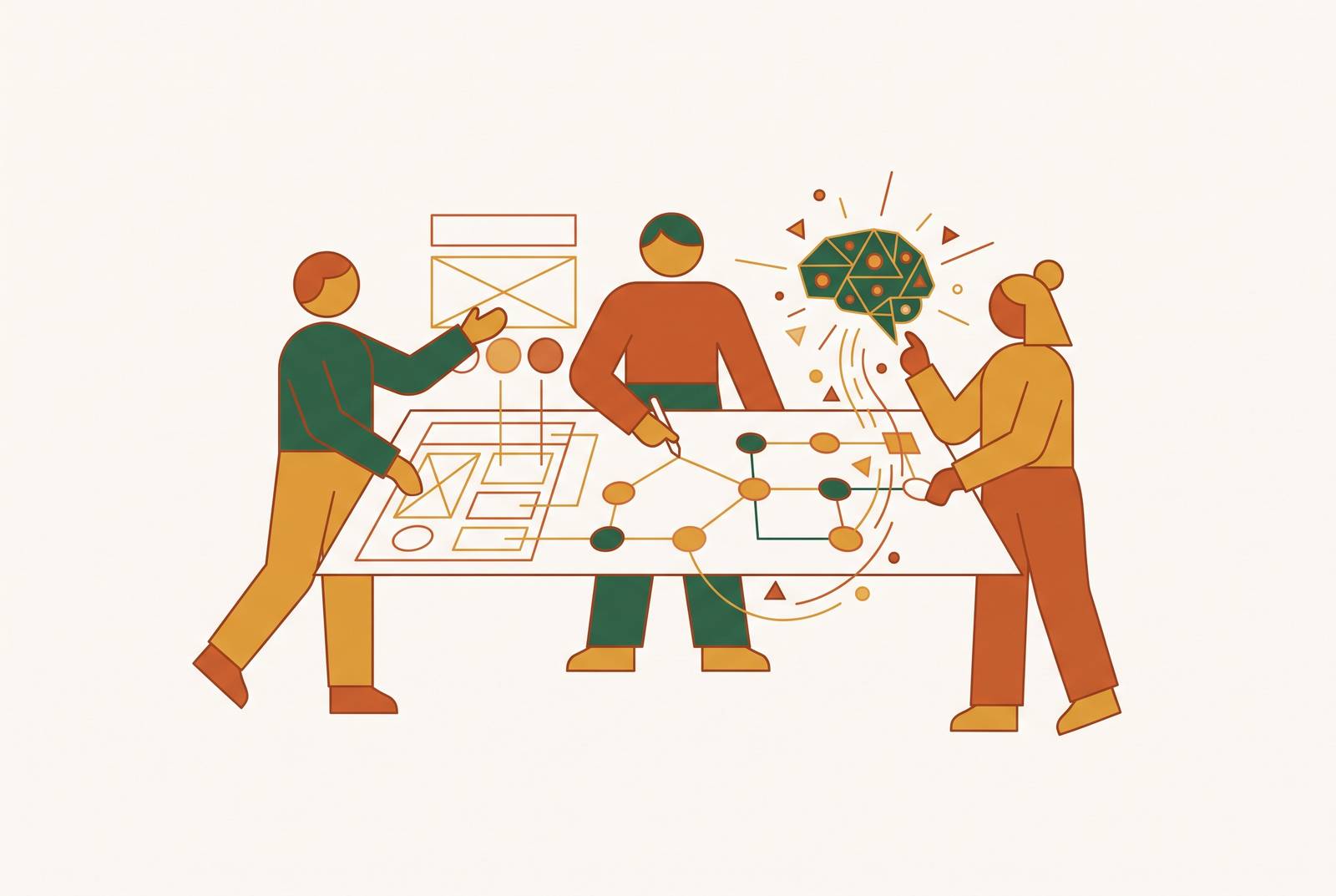
The old creative workflow (sketch, prototype, test, revise, repeat) assumed a headcount early-stage teams don't have. So AI wasn't adopted at these companies through a tidy, leadership-approved rollout plan. It slipped in sideways, through tools people were already using. Figma shipped AI features into files designers already had open. Research platforms began auto-synthesizing interview transcripts nobody asked them to summarize. Prototyping tools spat out variants from a text prompt before anyone decided it was wise.
That unplanned entry point matters, because it explains why adoption looks so lumpy from the outside. One stage speeds up dramatically while a neighbor barely changes, and decisions get made faster without getting made better. That last part is the trap.
The gap between early-stage and larger companies is closing at a fast pace. In 2025, early-stage startups were twice as likely as growth-stage or public companies to adopt AI tools; now 60% at both stages report strong organizational support AI in Product Design: 11 Use Cases & Examples for 2026. Weekly AI usage for design tasks jumped from 54% in 2025 to 91% in 2026, with 75% using it daily, and the average designer's toolstack more than doubled, from three tools to seven AI in Design Report 2026 / Designer Fund & Foundation Capital. That's a wholesale rewiring. That's a discipline rewiring itself in about a year.
But nearly half of designers admit they're still hunting for their go-to tools. The stack hasn't settled. So most early-stage teams make real workflow decisions in an environment that hasn't settled. So the question worth asking isn't whether to use AI anymore. That debate is over. The real question is how to fold it into a process that ships a better product, not just faster output.
What AI accelerates well across the design workflow
AI's capability breaks into three categories, each mapping onto a different design stage AI in Design Report 2026 / Designer Fund & Foundation Capital. Generative AI creates: images, layouts, copy. Assistive AI nudges: suggestions, autocomplete, small error corrections before shipping. Most teams are running all three at once without ever stopping to name which is which AI in Design Report 2026 / Designer Fund & Foundation Capital.
Research and synthesis used to be the bottleneck that ate weeks. Now the mechanical part, compressing transcripts, behavioral data, and survey responses into something readable, takes hours instead of days. What's actually improving is coverage and speed, not interpretation itself. The microtool approach scales down: a two-person team doesn't need all five tools, but scoping each intervention and embedding governance early applies regardless of size.
Ideation tells a similar story, and there's a specific number worth knowing. IDEO's 2024 study of 1,000 business leaders found algorithmically generated questions produced 56% more ideas, 13% more diversity, and 27% more detail than a control group. That's not AI replacing a brainstorm. That's AI widening the options a human must sort through (a meaningfully different thing).
Prototyping shows the sharpest, most literal speed gain in the whole workflow. 2026 industry guidance puts average time savings at around 60%, turning a day of layout work into roughly twenty minutes AI in Product Design: 11 Use Cases & Examples for 2026. Other benchmarks agree: McKinsey projects up to half less product development time, Deloitte found 20-30% faster time-to-market with AI-enabled design systems, and Adobe reported concept creation time dropping up to 60% CodeAnt.ai AI in Product Design: 11 Use Cases & Examples for 2026. Engineering handoff benefits too: documentation improves, AI adoption surfaces implementation issues earlier in review, and the design-system gap narrows.
None of this should get taken as a blanket endorsement, though. Nielsen Norman Group's 2024 review found few design-specific tools meaningfully improved workflows; most practitioners just used chatbots to draft copy or brainstorm. The speed claims above hold true only in specific, well-structured situations. They are not a universal multiplier you get for free just by turning a tool on.
The specific tools early-stage teams are using at each phase
Given that nearly half of designers are still shopping for a stable toolset, it helps to think in terms of what each tool is actually built for, rather than which one has the loudest launch post.
At the ideation stage, Galileo AI turns a text prompt into a polished interface concept (dashboard, mobile screen, or SaaS landing page), giving teams a visual direction instead of a blank canvas. Uizard sits nearby, turning a rough idea into wireframes and interactive prototypes without requiring advanced design skill, which makes it a natural fit for a founder trying to communicate an idea to someone non-technical. Figma Make generates working interactive apps from a natural-language prompt, letting a non-technical founder test a concept in an afternoon instead of waiting on a designer. Figma's report found 85% of designers and developers said AI will be essential to their future, showing AI woven into a tool teams already use, not forcing a switch.
Moving a little closer to production changes the tools' character. v0 by Vercel generates working frontend layouts and components from a described interface, closing the gap between a mockup and something buildable. Pricing runs from a free tier ($0/month, $5 included credits, deployment, Design Mode, GitHub sync) to Team ($30/user/month) and Business ($100/user/month) The 8 Best AI Tools for Product Development in 2026. That range matters for a small team doing budget math: the free tier is genuinely usable for testing an idea before anyone commits real spend.
Superengineer.ai acts as an AI project manager orchestrating agents across front-end, back-end, and database architecture, turning a high-level requirement into a cohesive, production-ready application. On research, tools like Claude, Figma AI, Maze AI, Anima, Dovetail AI, and Notably each cover one slice (transcription, behavioral analysis, survey synthesis) rather than replacing research wholesale.
The tool hierarchy itself keeps shifting under everyone's feet. Claude overtook ChatGPT as designers' most-used general AI tool in 2026, and coding tools moved from a side interest to a core part of design. Treat all of this as a spectrum running from fast and rough to close to production, and pick an entry point on purpose. Don't default to whichever tool made the most noise on launch day. Lovable suits MVPs, validation, internal tools, and early SaaS products, making experimentation accessible without lengthy cycles, though production use still requires judgment, per eleken.co.
Where AI-generated output creates new problems for small teams
The numbers make more sense once you see how the debt actually forms. AI tools remove the friction of writing code. They do nothing to remove the complexity of maintaining it. Debt doesn't pile up in some crumbling legacy system nobody touches. It piles up in a fast-moving environment where delivery speed outruns the team's ability to review, document, and understand what got built.
That's not a hypothetical risk. Roughly 41% of all committed code across teams today is AI-assisted AI-Assisted Development Is Creating a New Kind of Technical Debt. LinearB's 2026 Software Engineering Benchmarks Report, covering 8.1 million pull requests across 4,800 teams, found AI-generated code carries 1.7 times more issues per pull request, with technical debt rising 30-41% after AI adoption AI-Assisted Development Is Creating a New Kind of Technical Debt. Those are a measurable, repeated pattern. That's a measurable, repeated pattern across thousands of teams.
Small teams run into a specific version of this. When developers each reach for AI independently on the same problem, the team ends up with approaches that work individually but aren't architecturally coherent. Nobody did anything wrong exactly. Each solution passed its own tests. As a panelist at the ICSE 2026 Technical Debt panel put it, without architectural constraints and governance, AI optimizes locally and generates debt, like an unsupervised junior developer solving today's ticket without regard for design principles.
The business case for taking this seriously isn't abstract either. IBM Institute for Business Value research found enterprises that fully account for technical debt in AI business cases project 29% higher ROI, while ignoring it drags ROI down 18-29% (unchanged for accuracy). Gartner projects 40% of AI projects will be cancelled by 2027 over this kind of escalating cost and weak risk control. On design, the pattern appears as three failure modes: inconsistent outputs, over-reliance on generated content, and decisions made faster without being made better. All three are avoidable AI in Design Report 2026 / Designer Fund & Foundation Capital. None of them are rare.
Anthropic's microtool model as a case study in deliberate AI integration
What does deliberate integration actually look like in practice, rather than as a principle on a slide? Anthropic's design team offers one answer: small, purpose-built tools functioning as infrastructure rather than ad hoc habits.
Each piece solves a narrow, specific problem rather than trying to be everything at once. An ideation sandbox generates a wide range of UI directions from a single brief, building exploration into the process rather than leaving it to whoever brainstorms. A design system picker plugs Anthropic's fonts, colors, and components into Claude, so every prototype starts on-brand instead of drifting. A research index makes past user studies queryable on demand, which speeds up synthesis without pretending to replace the judgment layer that interprets what the research actually means. A tool called looping PRs auto-opens a pull request and watches it through continuous integration until it merges, absorbing execution overhead so humans review instead of babysit. A content guardrail runs as a Slack agent scanning production code for off-brand copy, building governance in rather than bolting it on after shipping.
What ties all five together is scope discipline. Each tool does one thing. None of them replace judgment, and the system as a whole raises the quality floor for everyone touching it, not just the strongest individual contributor. Jessica Rosenberg, Head of Brand at AirOps, calls this emerging role the "Agent Captain": a designer who orchestrates AI systems, building infrastructure that preloads design-system components into coding tools so every prototype starts from the same baseline.
A two-person team obviously doesn't need five microtools running in parallel. But the principle scales down fine: scope each AI intervention narrowly, and put governance in place before it's needed rather than after something breaks. What this case study can't answer is how a team without dedicated design infrastructure resources gets from zero to this. That's a fair gap, since it's really a question of team structure, not tooling.
How to structure the human-AI division of labor on a small product team
Most small product teams should aim for AI-augmented, not AI-native. Augmented means AI accelerates and sharpens human work. AI-native means the intelligence is the product itself, a much narrower and riskier target. Getting the production foundation solid matters just as much as whatever AI layer sits on top of it.
AI is also good at predicting usability issues, running session analysis, speeding feedback cycles, improving documentation consistency, flagging implementation issues early, and keeping the design system aligned with what's built. But some decisions must stay human: framing the problem, making trade-offs, understanding the context behind user behavior, deciding what gets built, and judging which AI-generated option fits the business or regulatory environment AI-Assisted Development Is Creating a New Kind of Technical Debt. This isn't a minority opinion among people who do this for a living. A UX Tools Survey found nine in ten senior designers call AI a copilot, not a replacement. That's the practitioner consensus, not marketing copy from a vendor with something to sell.
AI is quietly making cross-functional fluency a lot more accessible. A product manager can prototype something working in an afternoon. A designer can pull behavioral analytics without waiting on a data analyst's calendar. An engineer can give useful feedback on interaction design without sitting through a design crit. Roles are getting less rigid, a real advantage for a five-person team where everyone wears three hats AI in Design Report 2026 / Designer Fund & Foundation Capital.
For teams building an actual MVP, a sharper definition than "quick demo" matters." An AI MVP is the smallest system producing decision-grade value: narrow enough to ship fast, sturdy enough to reveal real user behavior. If that MVP touches customers or employees, it needs basic governance from day one: approval steps, disclosure of AI involvement, and an escalation path. That's the discipline of governance applied when it matters most. That's the moment a team decides how responsibly it will use AI, and it's harder to retrofit later than to decide upfront.
The bottleneck that trips teams up is usually structure, not the tools themselves. It's structure. Among engineering-adjacent teams, 78% of leaders expect AI to help operations, yet most rollouts stall before a second team gets access. Teams navigating this well in 2026 share three habits: they started with the workflow and let tooling follow, built shared literacy instead of ad hoc adoption, and set governance before an incident forced it. Generating layout options, writing initial UX copy, synthesizing research data, and creating documentation for handoff.
Managing the technical debt that fast AI-assisted shipping produces
Technical debt at an early-stage team is a predictable cost of moving fast. It's a predictable cost of moving fast, and pretending otherwise doesn't make it go away. The actual failure is a team that ignores the debt until it causes a real incident, instead of treating it as a known, manageable line item from the start.
Targeted assessments of where that debt is concentrated tend to reveal significant downstream savings, and the break-even period on high-impact refactoring typically runs 6–12. That's a short enough horizon that most early-stage teams can plan around it rather than treat it as some far-off concern for a future, better-funded version of the company.
None of this argues against speed. It argues for treating the speed AI provides as a resource to be budgeted, not a free lunch. A team that ships fast, reviews its work, scopes its AI tools narrowly, and puts governance in place early ends up in a very different position a year out than one that just let the tools run. The difference won't be visible in the first sprint. It appears in whether the codebase is still legible to the fourth engineer who joins, and whether the product still feels like it was designed by one team instead of assembled from several.
Sources
- AI in Product Design: 11 Use Cases & Examples for 2026
- AI in Design 2026: The inflection point is here – Designer Fund
- AI Product Design in 2026: Best Tools, Workflows &Challenges
- The 8 Best AI Tools for Product Development in 2026
- AI-Assisted Development Is Creating a New Kind of Technical Debt
- Technical Debt in the AI Era - ICSE 2026 - conf.researchr.org