Using AI Tools to Accelerate MVP Development Without Accumulating Debt
How AI accelerates MVP builds while avoiding technical debt that surfaces later.

Building a startup's first product with AI is the default now. GitHub reports that 92% of developers use AI tools day to day, and founders who once budgeted six months for a working MVP are now shipping in two to six weeks. That's a different category of timeline. It changes what "MVP" means as a milestone: the bar for showing up with something real dropped from a quarter's runway to a few sprints.
But speed alone doesn't explain what's happening. The tools compressing that timeline are doing specific, identifiable work inside the build. Knowing what they're doing, and where they quietly stop doing it, is what lets an MVP hold up under real users instead of falling apart the first week someone outside the founding team pokes at it.
AI Tools Inside an MVP Build Right Now
AI touches nearly every phase of a build now, not just the coding part. Each phase has its own tools doing the heavy lifting, and the range is wider than most founders expect.
Discovery and planning now runs through language models that turn competitor data, user reviews, and search trends into a structured spec before anyone writes a line of code. That cuts down the weeks of back-and-forth that used to happen between a founder's vision and a developer's interpretation of it.
Design moves the same way. Tools like Uizard take a plain-English description and spit out a working layout, turning what used to be several rounds of design review into a conversation that takes hours instead of days.
Development is where most people's minds go first, and for good reason: boilerplate, API setup, function completion, data model scaffolding. These are the tasks AI handles with the least friction, and it shows.
Testing benefits from automated test case generation and pattern-based bug spotting, catching a real share of edge cases before a human looks at the code. Deployment gets smoother too. CI/CD pipelines predict build breaks earlier, and root-cause analysis on incidents moves faster than manual log-digging ever allowed.
The tool landscape reflects that range. Claude Code operates inside the terminal with direct file system and CLI access. It reads a codebase, runs tests, commits to Git, and opens pull requests on its own, priced at $20 a month for Pro up to $200 for Max 20x. GitHub Copilot, sitting natively in VS Code around $19 a month, passed 20 million users by early 2025. Cursor works as a full AI-native IDE designed to accelerate the path from code to working product. Windsurf and Bolt sit in similar territory, coding environments built for MVP speed. Vercel's v0 handles UI generation from prompts. Superengineer.ai takes a different approach: it acts as an AI project manager, running separate agents for front-end, back-end, and database work, then assembling the output into one application from a high-level product requirement. Make.com is on the no-code side, connecting LLMs to an existing stack so small teams can automate workflows without hiring a dedicated AI engineer. And the ChatGPT-4o family is among the most widely used LLM options for startups, letting teams bolt on chatbots and natural-language features without machine learning expertise on staff.
Does a founder need all of these? No, and this is where most teams get it backward. The instinct is to stack tools, one for every task, on the theory that more coverage means fewer gaps. It's the wrong instinct. The founders getting the most value pick one best-in-class option per category and get genuinely fluent in it, because every extra tool in the stack is another integration point and another thing to babysit six months from now.
McKinsey points to generative AI boosting developer productivity somewhere between 20% and 45%, concentrated almost entirely in code writing, testing, and basic component assembly. Notice what's missing from that list: architecture decisions, security design, data strategy. That gap isn't an accident, and it's the entire subject of the next section.
The 70% problem: where AI-generated code stops being enough
Addy Osmani, a Principal Engineer at Google, has written about how AI handles the first 70% of a solution fast, sometimes astonishingly fast, but the last 30% demands exactly as much human expertise as it always did. Most founders read that ratio backward, assuming it means the tools' competence runs out at that point. They assume 70% done means 70% of the risk is gone. It doesn't work that way. The last 30% is where nearly all the risk actually lives.
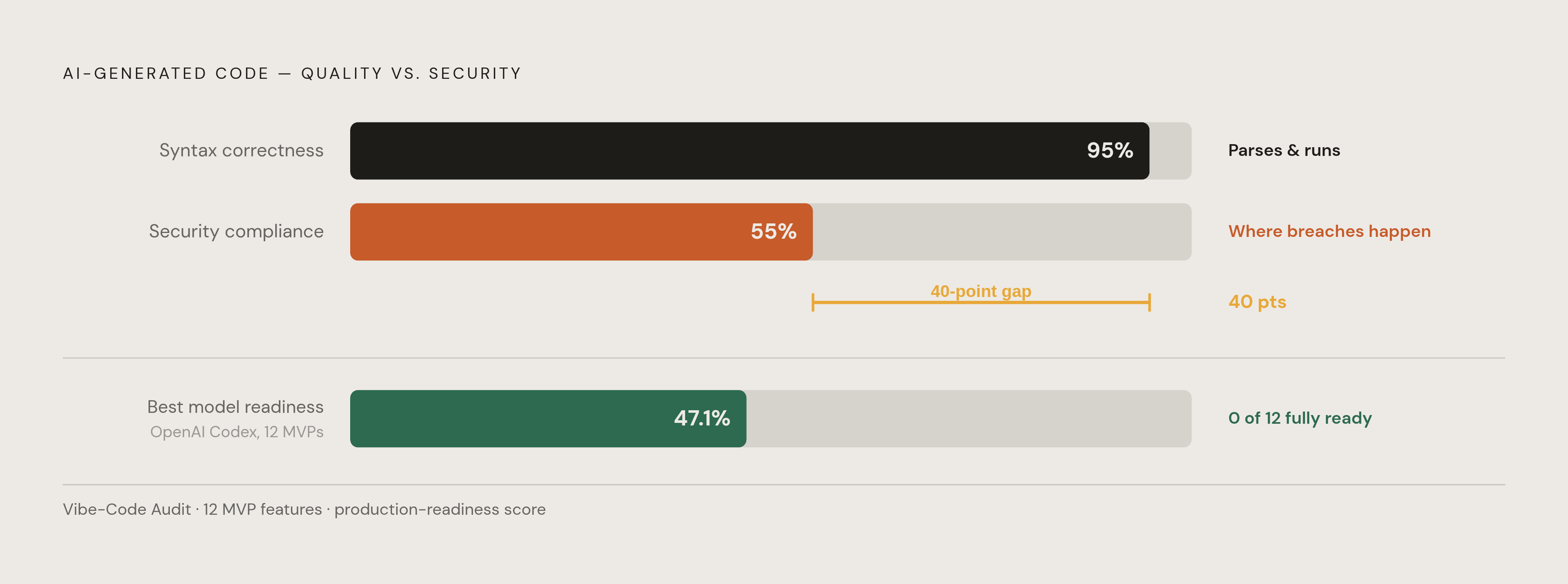
Security shows the gap most clearly. AI-generated code in 2026 is syntactically correct more than 95% of the time, which sounds close to flawless, until you check what "correct" actually covers. It passes basic security checks in only about 55% of cases. Syntax and safety aren't the same thing, and that 40-point gap is exactly where breaches happen six months later.
The production-readiness numbers make the point even sharper. One Vibe-Code Audit tested 12 typical MVP features built with a naive, one-shot AI prompt and found they met only 19.6% of production-readiness controls. Switching to an agentic model, OpenAI's Codex, pushed that up to 47.1%. Better, sure. But in both tests, zero of the 12 features were fully production-ready. Not mostly done, not needing some polish. Zero, in either test.
So what's sitting in that missing 30% to 80%? Threat modeling. Rate limiting. Data validation at the edges. Graceful failure when a dependency goes down. None of that appears in a demo, and AI doesn't skip it out of carelessness. It skips it because that work requires judgment about a specific business's risk tolerance, and no training set contains that judgment.
How technical debt forms inside an AI-accelerated build
Technical debt has a plain definition: the gap between the fastest way to build something and the most maintainable way to build it. The original financial metaphor for technical debt still holds up. Shipping code before your understanding of the problem is complete is a loan, and the interest is every future feature costing more than it should, because that gap in understanding never closed. Debt left unpaid doesn't sit still. It grows.
How does it actually get into an MVP? Rarely through one obviously bad call. More often it's dozens of small, reasonable-sounding trade-offs made under a launch deadline, each one defensible on its own. Skipping input validation on this endpoint because there's no time and it's an edge case anyway leaves that gap in place. Hardcode a config value instead of building a settings system, because there's only one client right now. None of that looks like a problem on launch day. It starts looking like a problem once the product has paying customers, a sales team promising features on a timeline, and investors asking pointed questions in due diligence.
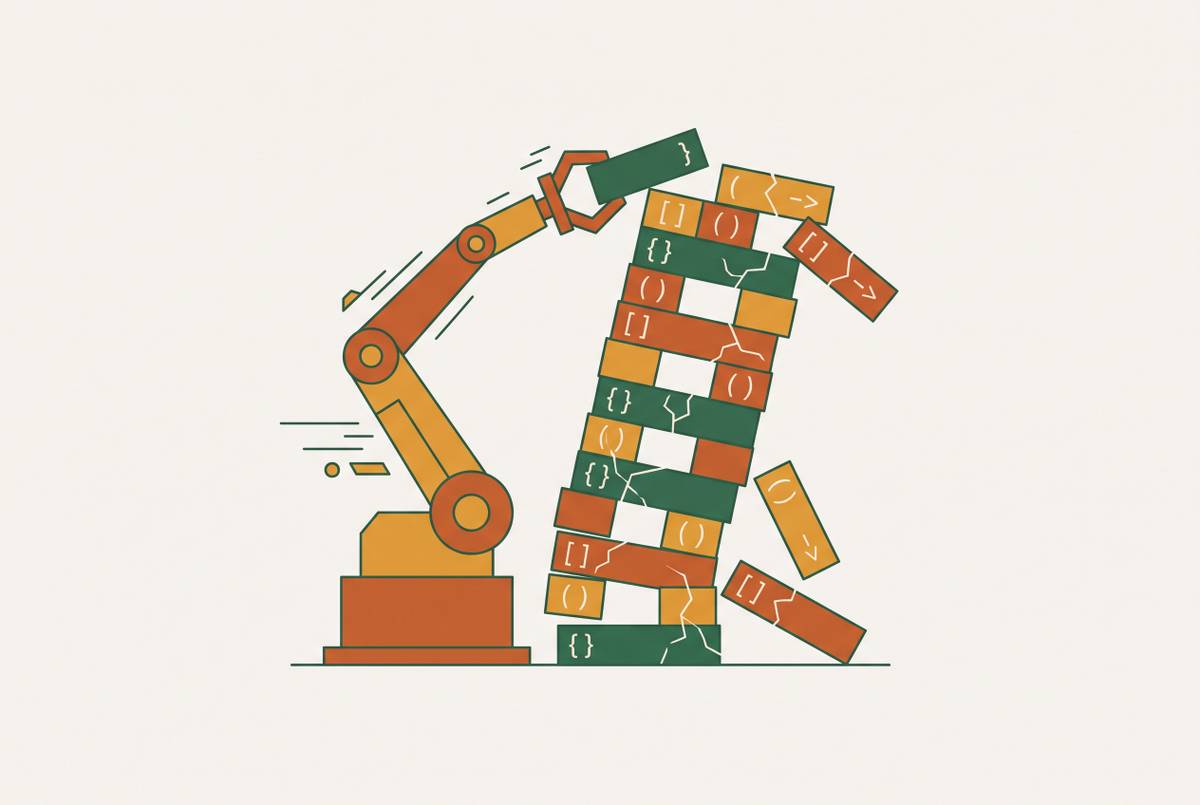
AI doesn't cause this pattern. It speeds it up. Coding assistants raise the pace at which new code enters a codebase, but debt accumulation doesn't slow down to match. If anything, it accelerates, since more code means more surface area for shortcuts to hide in. AI sits on top of whatever foundation already exists, and a poorly structured foundation turns into a load-bearing wall exactly when weight gets added to it: at scale, under pressure, with customers watching.
Deloitte's Global Technology Leadership Study estimates technical debt absorbs between 21% and 40% of total IT spending. That means somewhere between €21 and €40 of every €100 a company spends on technology goes toward debt that already exists, instead of building anything new. That's money spent with nothing to show for it except the absence of a worse outcome.
The architectural decisions made at MVP speed that are hardest to undo
Every shortcut taken to hit a launch date is a decision, whether it felt like one at the time or not. Most of those decisions never get revisited once the product starts working, because nobody schedules a meeting to reconsider something that appears to be functioning fine. That's the whole mechanism. It's a story about something other than founders cutting corners out of carelessness. It's a story about attention going wherever the fire is loudest.
A handful of these decisions carry outsized weight, and they need to be named individually.
Architecture selection under AI-accelerated builds tends to favor whatever is fastest to generate, often before anyone has asked whether the product needs to scale horizontally in eighteen months. Nothing in a prompt-to-code pipeline asks whether the product needs to scale horizontally in eighteen months. That question has to come from a person, and it has to come early, before the pattern is load-bearing.
Data infrastructure is the one founders underestimate most. On any product with AI features baked into the core experience, data isn't a layer you bolt on later, it's infrastructure from day one. Without a pipeline feeding it quality training data, the underlying model stops improving, and retrofitting that pipeline after launch is substantially harder than building it in from the start.
On security and compliance, that 55% figure is a preview of the security exposure that ships if AI output goes unreviewed. Compliance mapping, GDPR, SOC 2, HIPAA, whichever applies, cannot be patched on after a product goes live. It has to get designed into the data flow from the beginning, or it won't happen.
Building core product logic entirely on top of one vendor's API creates a fragile third-party dependency. It's both an investor red flag and a real architectural risk, because if that API changes its pricing, its rate limits, or its terms of service, the product's core function is exposed with no fallback.
Inference cost architecture, model selection, caching strategy, rate-limit handling, needs to get designed before real traffic arrives, not after the first surprising invoice.
Testing infrastructure is a subtler trap. Tools generate individual test cases readily. What they don't do is design an overall testing strategy. Without regression coverage built in at the MVP stage, every future code change carries a risk nobody can quantify, because nothing is watching for what might break.
IBM's research quantifies what deciding these things deliberately, versus letting them slide, costs. Enterprises that fully account for technical debt in their AI business cases project 29% higher ROI than those that don't. Ignoring it moves the number the other way: an ROI decline of 18% to 29% according to IBM Institute for Business Value research. A business case that accounts for debt holds up under scrutiny. One that doesn't falls apart the first time someone asks a hard question in diligence.
None of this is a conversation to revisit later, once things are stable. Whether the MVP survives contact with real users, a real sales pipeline, and an investor's due diligence depends on these decisions, and by the time any of those three occur, the architecture is already locked in.
Using AI as an accelerant for good decisions rather than a substitute for them
Founders who avoid piling up debt aren't the cautious ones moving slowly through the build. They're the ones using AI to think more, faster, rather than think less, faster. That distinction sounds small. It isn't, because the two paths only look alike for the first few months before they diverge. One approach compounds good judgment over time. The other compounds shortcuts, and for the first few months, the two look identical.
Start with the problem, not the tool. Name the specific bottleneck AI needs to solve before picking anything off the shelf. Is the goal better efficiency, a better user experience, or a capability the product couldn't offer before? If the line from an AI feature to actual business impact isn't direct and obvious, the problem statement needs more work, not another tool.
Resist stacking redundant tools. Every additional tool is another integration point, another failure mode, another context switch for whoever's maintaining the thing six months from now. Stack redundancy is its own quiet form of technical debt, even when every individual tool works fine in isolation.
And keep the division of labor honest. AI handles the 70%, generating, synthesizing, scaffolding, and the productivity numbers appear in that share of the work. Human judgment handles the 30%: security review, architecture decisions, data strategy, integration design, the parts that never appear in a demo but always appear in a postmortem. That split is the whole strategy, dividing labor between machine speed and human judgment rather than pretending one can replace the other.
A Production-Ready Path from AI MVP in Stages
Getting to launch and staying live are two different reliability standards, and confusing them is where most rapidly assembled software builds run into trouble. Surviving a demo in front of investors is not the same thing as surviving real users hitting the product at odd hours, a sales team promising it works a certain way, and the slow grind of actual growth.
Stage 1: architecture and security review. Before anything else, check what the AI actually generated against real scale and compliance requirements, not the demo's requirements. Close the security gap directly. AI-generated code passes basic security checks in only about 55% of cases, according to Veracode testing across 150+ models, so this stage is where someone decides which structural calls still need a human before moving forward.
Compliance mapping is where, depending on the domain, fintech, health care, enterprise software, the regulatory requirements that never made it into the MVP scope get identified. Most compliance work touches data architecture too deeply to bolt on after the fact, which is exactly where the patch-it-in-later plan falls apart.
Stage 3: integration and scalability engineering. Real integrations with production systems look nothing like the mocked or simplified connections AI tends to generate by default. Inference cost architecture, resilience against third-party API failures, and data pipeline reliability all belong here, built deliberately instead of inherited from whatever the AI assumed would be good enough to clear a demo.
None of these stages undo the speed AI brought to the first draft. They make sure that speed produced something worth building on, rather than something that has to get quietly rebuilt the first time it actually matters.