Data Architecture Decisions When Scaling an MVP
Schema decisions made at MVP stage determine which scaling bottlenecks hit you later.

Databases rarely fail. Schemas do. When an MVP starts pulling in real users and real traffic, the technology underneath almost never buckles first, the design decisions made months earlier about how data gets shaped and stored are what buckle. This piece walks through which of those decisions are reversible later and which ones are already load-bearing the day they're made.
Most founders treat "pick Postgres or Mongo" as the architecture decision. It isn't. It's one decision among dozens, and usually not the one that ends up mattering. The schema underneath, how tables relate, how tenants get isolated, whether a delete actually deletes, is where the real risk lives. And it's easy to miss, because a bad schema looks completely fine at MVP scale. Ten users, ten thousand rows, nobody notices. The damage stays invisible until volume or traffic finally puts weight on the weak joints.
This is also why swapping databases rarely fixes anything. Moving from MongoDB to Postgres, or the reverse, doesn't repair a design error, it just moves the same error to new infrastructure. Some early schema decisions are neutral and can wait. Others quietly compound, month over month, until they become the thing blocking a Series A or the reason an outage runs for hours instead of minutes. The question worth sitting with at MVP stage isn't "which database." It's which of these decisions can be undone later without pain, and which ones are already permanent.
How technical debt becomes data debt at scale
McKinsey has put technical debt at up to 40% of a company's entire technology estate. For more than half of companies surveyed, it eats over a quarter of the IT budget. That's not an engineering complaint anymore, that's a line item a CFO has to explain.
The Startup Genome Report found that 74% of high-growth internet startups fail because of premature scaling, and the common thread is brittle architecture that can't absorb growth it didn't expect. Data debt is the specific, newer flavor of this problem. It looks like untracked data sources. Missing audit trails. No lineage documentation, so nobody can say where a given field actually came from or what touched it last.
None of this shows up at MVP stage. It shows up two years later, when a customer asks for SOC 2 compliance or a regulator asks about GDPR data handling, and the answer is: nobody wrote any of this down. That's not a moral failing on the founding team's part. It's a predictable stage every fast-moving product goes through. The mistake isn't accumulating debt early, it's letting it sit past the point it was supposed to get paid down.
There's a real difference between strategic debt and unmanaged debt. Strategic debt is deliberate: someone decided to skip something, wrote it down, and put a date on fixing it. Unmanaged debt is the kind nobody chose on purpose, it just accumulated in the gaps between sprints. That distinction runs through every section below. Debt itself isn't the enemy. Debt nobody's tracking is.
Which schema decisions are actually load-bearing
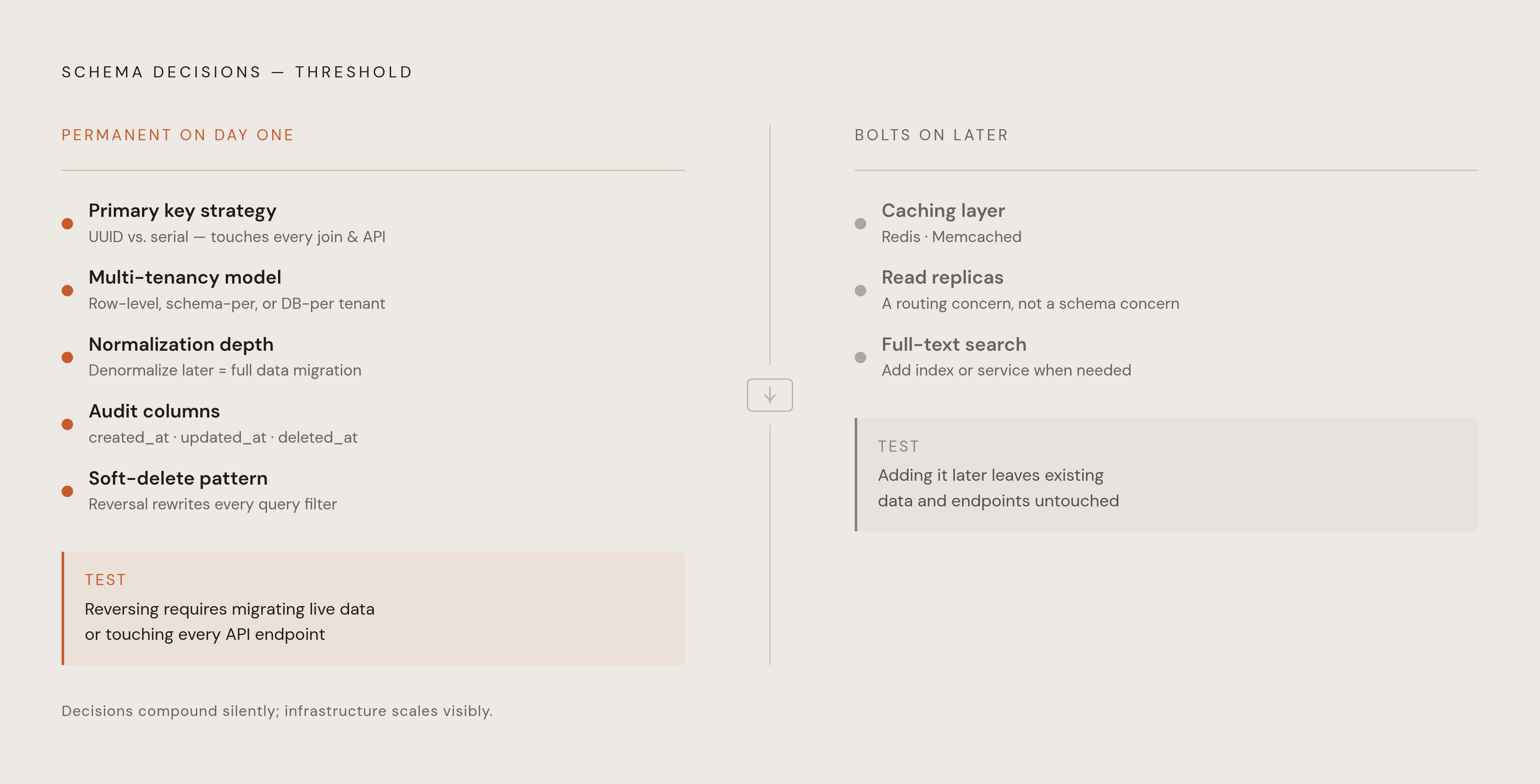
Here's a test that cuts through most of the noise: is this decision reversible before hitting 10x scale? If fixing it later means migrating live data or touching every API endpoint in the system, it's load-bearing. Treat it that way now.
A handful of schema decisions fall into that category almost every time.
Primary key strategy. Surrogate keys versus natural keys sounds like a minor stylistic choice. It isn't. Switching strategies mid-product means touching every foreign key relationship in the database, which in practice means touching almost everything.
Multi-tenancy modeling. Separate schemas per tenant, one shared schema with a tenant ID column, or fully separate databases: whichever gets chosen early gets baked in. Retrofitting a different multi-tenancy model onto a live product with real customer data in it is one of the more painful migrations in software, close to a rewrite in disguise.
Normalization depth. Over-normalize and query performance falls apart under load through N+1 query problems, where fetching one record silently triggers dozens of additional queries. Under-normalize and every new reporting request turns into a schema rewrite. Neither extreme is free.
Audit and timestamp columns. Skip created_at, updated_at, or deleted_at at table creation, and backfilling them across live data later is a genuinely miserable exercise, one that usually involves guessing at history that was never recorded.
Soft-delete versus hard-delete. Pick one pattern and apply it inconsistently across tables, and it creates silent data integrity gaps. Nobody notices until a compliance review or an audit surfaces the mismatch, at which point it's a much bigger conversation than it needed to be.
Compare that against what's genuinely safe to defer. A caching layer like Redis or Memcached bolts on later without touching the schema. Read replicas are an infrastructure decision, not a data model decision. Full-text search can get layered on top whenever it's actually needed. None of these carry the same structural weight.
The practice worth adopting early: write the shortcuts down. Literally. "No distributed caching, will add in Q3." "Monolithic database, sharding planned for Q4." It sounds almost too simple to matter, but a written list turns invisible debt into a legible roadmap, something a future hire or a due diligence reviewer can actually read and trust. A McKinsey Digital Survey from 2024 found that 78% of startups experiencing rapid growth named architecture limitations as their top technical challenge. Most of those limitations trace straight back to schema choices made months or years earlier, back when nobody thought they'd matter.
The Zombie Hybrid problem: when services split but the database does not
Well-documented industry advice still holds up: start with a monolith before moving to microservices. It's the path most successful microservices architectures actually walked, even if the origin story gets told differently in retrospect.
Where founders go wrong isn't choosing microservices, it's the sequencing. They split application services before splitting data ownership. The result: multiple services all still reading and writing to one shared database. Call it the Zombie Hybrid. A schema change made for one service quietly breaks another, because no real boundary exists at the data layer, only at the application layer. Deployments turn risky, not because the code is more fragile, but because the coupling never actually went away, it just went invisible.
This has a name, or rather several names, in documented patterns of premature microservices migrations: the Strangled Monolith, the Zombie Hybrid, and the Fractured Mesh, among others. Each one manages to be worse than the monolith it replaced, just in a different direction.
Amazon Prime Video makes the counterpoint concrete. Its team consolidated a microservices-based monitoring system back into a monolithic design and cut infrastructure costs by more than 90%. Complexity isn't a virtue on its own. Adoption numbers back this up too: a large share of enterprises now run microservices architecture, yet plenty of them are wrestling with cloud complexity and costs that crept up faster than expected. Using microservices and using them well are two different things.
The rule that actually holds: draw data ownership boundaries before drawing service boundaries. A service split without a corresponding data split isn't a microservices architecture. It's a monolith with extra network hops, and all the coupling risk of the original system plus new latency on top.
What the Knight Capital case actually teaches about coupled schema and live risk
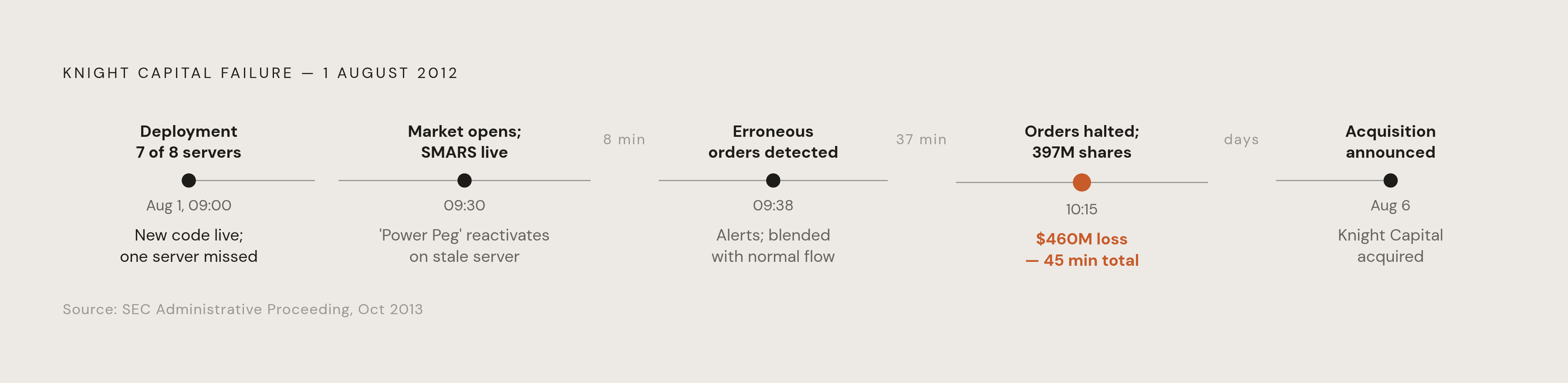
Knight Capital was a major U.S. market-making firm, and its 2012 collapse is one of the starkest cautionary tales in software deployment history. A new deployment reused a flag that was tied to old "Power Peg" logic, code that had been disabled but never actually removed from the codebase. On one server that didn't get the update applied correctly, that dead logic came back to life. Because the system assumed every server ran identical code, the misbehaving server's orders blended in with normal trading flow. Nobody caught it in time because nothing looked obviously wrong from the outside.
In 45 minutes, that single inconsistency generated millions of erroneous orders across roughly 397 million shares in more than 140 securities. The cost ran past $460 million, and the firm was acquired shortly after. Dead code and orphaned schema objects aren't harmless clutter sitting quietly in a corner of the codebase. In a tightly coupled system, they're landmines waiting for the one deployment that steps on them wrong.
The parallel to MVP-stage schema debt is closer than it looks at first glance. Every "temporary" column. Every flag someone swears was "never used in production." Every table that was "just for testing" and never got dropped. These create the exact same category of risk, just at a smaller blast radius. The lesson from Knight Capital isn't "never touch a live system." It's that coupling in the data layer makes every single change riskier than it has any right to be, and that risk doesn't announce itself until the day it does.
Modernizing schema without pausing the product
The fear of touching a live schema is a rational fear, not a paranoid one. ITIC's 2024 Hourly Cost of Downtime Survey found that more than 90% of midsize and large enterprises put the cost of a single hour of downtime above $300,000. Leaving the schema alone feels safer than the alternative.
But deferring a migration doesn't remove the risk, it just relocates it to a future date, usually one that arrives at a worse time than the present would have been. Debt that's visible and understood today turns invisible the longer it's ignored, right up until a crisis forces the issue.
The better model sits between two extremes: not "scale exactly what already exists," and not "rebuild the whole thing from scratch." It's a planned evolution, informed by what the MVP actually taught the team about real usage patterns. In practice that looks like:
- Expand-contract migrations. Add the new column or table alongside the old one. Migrate data in batches, at a pace the system can absorb. Cut over. Only then remove the old structure, once nothing depends on it anymore.
- Feature flags that separate the moment code gets deployed from the moment it actually activates, so a bad rollout can get switched off without a redeploy.
- Blue-green or rolling deployments, so schema changes stop being tied to a scheduled downtime window.
Shopify's well-known fixed-percentage rule offers a useful organizational template: set aside a fixed share of engineering time for refactoring and architectural upkeep, separate from feature delivery. It's a way to keep paying down debt continuously instead of waiting for a crisis to force a rewrite nobody budgeted for.
The failure mode worth watching for is the Strangled Monolith: replacing pieces of the old system incrementally without a clear plan for who owns which data. The result is a system that's neither a clean monolith nor a real set of microservices, and often harder to reason about than either one would have been on its own. CI/CD pipelines, automated testing, and infrastructure-as-code tools like Terraform or CloudFormation all lower the risk of each individual migration step, catching regressions before they ever reach a real user.
How Series A due diligence reads your schema decisions
Series A technical due diligence going into 2025 and 2026 is more structured than it's ever been. Investor scrutiny of technical foundations has grown more structured heading into 2025 and 2026.
The questions on a modern due diligence checklist are direct: can this architecture actually handle 10x growth? Is the current pace of development sustainable, or is it propped up by shortcuts that are about to run out? What does the security posture look like? How is data handled end to end?
Decisions around auth, security, API design, and data handling frequently become the gate standing between a startup and its first enterprise customers. Defer those decisions, and revenue gets deferred right along with them, whether or not that connection is obvious at the time.
One pattern shows up often enough to be worth naming directly: a SaaS company spends three years shipping features as fast as possible. By year four, competitors are shipping equivalent features in days. Work that used to take a week now takes six. The codebase that felt like a productivity engine for three straight years quietly becomes the thing holding the company back, and it ends up selling at 40% of its projected valuation. The same speed that felt like an asset became the liability nobody priced in.
At the data layer specifically, auditors and technical reviewers look for a short, consistent set of things. Audit trails and data lineage, because their absence reads as compliance risk before anyone even opens the code. Multi-tenancy isolation, where a single-tenant schema hiding inside a supposedly multi-tenant product is a hard red flag, not a minor note. Backup and recovery posture, since schema complexity without real migration tooling behind it suggests fragility nobody's tested. And documented architectural decisions: investors want proof the team knows exactly which shortcuts got taken and has an actual plan to address them, not a vague promise to "clean it up later."
Worth balancing against all of this: roughly 42% of startups fail simply because there's no real market need for what they built. Over-engineering a schema before anyone's validated the product is its own trap, arguably a worse one. The goal was never perfecting every layer of the stack. It's knowing which decisions are load-bearing and which ones can wait.
Where nonprofit data architecture diverges from startup architecture
Nonprofit technology constraints aren't just "the same problem, less money." It's a genuinely different operating reality. Smaller nonprofits, those under $1 million in budget, have been reported to spend roughly 13% of their total budget on IT. larger peers spend a much smaller share, reported at around 1.5%. Smaller organizations end up carrying a proportionally much heavier technology burden, even though they have far less capacity to absorb it.
Staff wearing multiple hats compounds this in a way that's specific to the sector. A funded startup can hire a specialist the moment a data problem gets complicated. A nonprofit often has the same one or two people handling donor records, program reporting, and IT, on top of their actual job.
The data crisis here is measurable and it's getting worse, not better. The 2026 CCS Philanthropy Pulse report found 36% of organizations struggling to use their data for decision-making in 2025, up sharply from 14% the year before. CRM and data management problems were cited by 33% of organizations, more than double the 15% reported in 2024. That's not a slow drift, that's a sharp jump in a single year.
Funder expectations are shifting the underlying architecture requirement too. Government and foundation funders increasingly want real-time or near-real-time access to outcomes data. The old annual summary report is being replaced by a live reporting obligation, which means the schema underneath has to support dashboards, not just year-end exports.
Cybersecurity belongs in this conversation as a data architecture issue, not a separate one. Cyberattacks on civil-society nonprofits have been reported to have jumped 241% between 2024 and 2025, and 70% of nonprofits still have no formal cybersecurity policy. Meanwhile 84% of digital donors trust their information is safe online, compared to a reported 34% of donors giving through analog channels. That gap is a trust premium, and the schema either earns it or squanders it.
A few schema decisions matter specifically in this context. Donor and constituent records need to produce audit trails for funder reporting without someone manually pulling data together by hand. Program outcome data needs structure that supports real-time dashboard access, not just a quarterly export job. Role-based access control needs to be designed so a part-time volunteer can't accidentally expose a sensitive donor record they were never meant to see. And the architecture, broadly, needs to be readable by whoever inherits it next, a future in-house hire or a successor agency. A clean handoff isn't a nice-to-have here, it's structural. Grant cycles, not product roadmaps, are what actually drive the pace of technology investment, so schema changes need to be plannable around funding availability rather than engineering preference alone.
What a long-term engineering partner does that a handoff cannot
The core failure of a build-and-exit handoff is that the reasoning behind schema decisions, data ownership choices, and technical shortcuts lives in people's heads, not in any document. When those people leave, the debt doesn't disappear. It just goes invisible again, waiting for the next person to rediscover it the hard way.
An ongoing technical partnership works differently in a few specific ways. Architectural decisions get written down and kept current, not just implemented and forgotten. The partner is still there when the next load-bearing decision comes up, not only when the first one got made. And debt gets tracked on purpose: what shortcuts were taken, and when they're scheduled to get fixed.
For founders, this matters because their actual job is owning go-to-market and closing customers, not firefighting a production database at 2am. A technical partner who owns the data architecture layer is what makes that division of attention possible in the first place.
For nonprofits, the calculation has shifted too. The 2024 Deloitte Global Outsourcing Survey found that access to specialized talent is now cited by 42% of respondents as a leading driver of outsourcing decisions, according to the Deloitte Global Outsourcing Survey. The real question isn't whether an organization can afford a technical partner. It's whether it can find one that actually understands grant cycles, board reporting, and the reality of running technology on a constrained, multi-hat staff.
A few questions are worth asking of any prospective partner before signing anything. Do they document architectural decisions in a form a board member or future hire could actually read? Do they keep a technical roadmap legible to people who aren't engineers? Do they track debt explicitly, or do they just ship features and call it progress? Can they operate inside grant cycles and tight budgets rather than treating those as obstacles? And is their architecture actually designed for a future handoff, or does it quietly create dependency on them specifically?
One organizational pattern worth naming: a split-team structure, where one group pushes feature delivery forward while another holds the foundation steady. It only works, though, when someone owns that foundation as a standing responsibility. Not a cleanup sprint scheduled once a year. A job someone actually has, every week, whether or not anything's on fire.