Technical Debt Categories That Actively Block User Growth
Unaddressed technical debt from your MVP can exponentially compound and kill growth.

Deliberate debt in an MVP is a rational instrument. When the goal is learning rather than serving real users at scale, speed over architecture is the correct trade. That logic holds right up until the product finds traction, and then the interest payments begin.
The trap that follows is well-documented and almost universally ignored. Instead of rebuilding after funding or early traction, teams build on top of the MVP. Low-quality code becomes core infrastructure. There is no clean path to replacement because every new feature is now entangled with shortcuts that were supposed to be temporary.
New team members struggle to become productive. Feature work slows not because the team is less capable but because the codebase resists extension. Every sprint costs more than the last, not because scope is growing but because the substrate is degrading.
You don't need an engineering background to recognize this. The signals are specific: new features keep touching the same brittle files; application logic lives inside tools the team doesn't fully control; nobody can explain the full data flow in a single conversation; growth discussions open with "Can the stack even handle this?" Those are not engineering complaints. They are growth warnings.
And here's what makes it worse: the MVP trap doesn't produce just one kind of debt. It produces several simultaneously, each one blocking growth through a different mechanism. But what if each of those mechanisms compounds the others — not linearly, but exponentially?
Architectural debt: the ceiling that makes every other problem worse
Architectural debt is not about code quality in the abstract. It's about foundational design decisions that constrain what the system can do, how many people it can serve, and how safely it can be changed. In MVP-era products, the common culprits are monolithic structures, tightly coupled components, technology choices made under time pressure, and non-functional requirements like performance and security that were simply deferred.
Carnegie Mellon's research identified architectural issues as the most significant and costly form of technical debt. Why exactly does this happen? The reason isn't mysterious; it's mechanical. Systems designed for hundreds of users don't degrade gracefully under tens of thousands. They buckle when load crosses thresholds the architecture was never built to handle. That's a ceiling problem, not a performance problem, and the distinction matters.
Tight coupling compounds everything it touches. When components are entangled, a change in one area creates cascading failures elsewhere. New features stop being routine engineering work and become risk events. Teams don't slow down from lack of effort. They slow down from justified caution about what they break.
What I'd want any founder to sit with is this: architectural debt doesn't stabilize on its own. Each layer built on top of a flawed foundation becomes part of the problem, which means re-engineering cost grows with every sprint you defer it. It also makes every other category in this piece worse, testing harder, documentation less coherent, security controls harder to enforce consistently. It's the substrate on which the rest of the damage accumulates faster.
Testing debt: how unknown bugs become the feature users experience
Testing debt is the accumulated risk from postponed, inadequate, or absent testing: insufficient coverage, no automated test suite, ignored failures, non-functional requirements that were skipped entirely. It is also the most insidious category for one specific reason. It hides itself until a user finds it.
Without test coverage, bugs reach production before the team knows they exist. Each release is a gamble. Engineers can't ship confidently because they lack reliable visibility into what they're breaking. Incident response starts replacing feature development. Fire drills consume engineering cycles that should be going toward growth. At startups that skipped early automated testing, the share of time devoted to debt-related firefighting rather than new work is typically substantial, and it compounds quarter over quarter.
The retention consequence is direct. A broken flow at a critical moment, during onboarding, at checkout, at the point when a new user is deciding whether the product is worth their time, can lose that user permanently. Testing debt makes that kind of failure statistically likely rather than exceptional, and the probability scales with every new user who hits those untested paths. What should be an edge case becomes a recurring feature of the product. How many users has your product already lost to failures the team never knew occurred? That's not a rhetorical question. It's worth actually trying to answer.
There's a talent dimension here too. Developers working in codebases with heavy technical debt report lower job satisfaction, and turnover is higher in teams that don't allocate meaningful time to debt repayment. Engineers who leave take undocumented knowledge with them. The team knows less about its own system after every departure, and testing debt feeds that cycle directly.
Design and UX debt: the friction that drains the top of the funnel
Design and UX debt accumulates from shortcuts in the user-facing layer: inconsistent interface patterns, unstandardized components, flows that were built for an earlier version of the product and never updated. In most MVPs, early screens are built quickly and independently. Patterns are never formalized. The product grows around them, and the result is an interface that carries the residue of every pivot the product has ever made.
Inconsistent interfaces create confusion at a cognitive level users can't always articulate. They can't form reliable mental models of how the product works, so they slow down, make errors, and eventually disengage. Onboarding flows patched together from MVP-era screens create drop-off at exactly the moment a new user is deciding whether to stay. Support volume rises as users encounter dead ends, ambiguous labels, and flows that don't match their expectations. Every new feature must be reconciled with dozens of slightly inconsistent existing patterns, which means design debt simultaneously slows feature shipping and degrades the quality of what ships.
It is also worth considering why this category gets chronically underestimated: it reads as a design problem rather than an engineering problem. The root cause is technical: no component system, no shared design logic, no architecture governing the user-facing layer. The interface is inconsistent because the engineering structure beneath it is inconsistent. Fixing the visual layer without addressing that underlying structure produces temporary improvement, nothing more.
Friction at onboarding doesn't just delay activation; it ends it. Users who don't activate don't return. Every percentage point of onboarding drop-off attributable to interface confusion is a compounding loss, not a recoverable one.
Documentation debt: why it becomes a hiring and scaling ceiling
Documentation debt is missing, incomplete, or undiscoverable documentation, including not just formal technical docs but the tacit knowledge that lives only in the heads of the engineers who built the system. It originates the same way in almost every early-stage product: the original author knows the system, so documentation feels redundant; by the time the team grows and others need to understand it, the window for easy documentation has already closed.
The growth-blocking mechanism is straightforward but consistently underappreciated. New engineers take weeks or months to become productive because there is no reliable guide to how the system actually works. The team cannot scale capacity without absorbing enormous overhead on every new hire. Onboarding cost is real even when it's invisible on the balance sheet.
The risk concentrates over time. When a key engineer leaves, knowledge leaves with them. What was undocumented is now lost, not merely unavailable. The team becomes dependent on a shrinking pool of people who hold the system in their heads, and each departure tightens that dependency.
Documentation debt amplifies every other category. It makes architectural debt harder to resolve because no one fully understands the system well enough to safely re-engineer it. It makes testing debt worse because without documentation of expected behavior, it's difficult to know what a test should even assert. It makes onboarding contractors or integration partners expensive because there is nothing to hand them.
Founders often frame documentation debt as a future problem, something to address when the team is bigger or the product is more stable. But it becomes active the moment you try to hire your second or third engineer. For most growth-stage products, that moment has already passed.
Security debt: the category that can end growth permanently rather than stall it
Security debt is security controls skipped or deferred in favor of speed: missing authentication layers, unvalidated inputs, unencrypted data at rest, dependencies that haven't been updated in months or years. Every other category in this piece slows growth or raises its cost. Security debt can terminate it.
IBM's 2024 data puts the average global cost of a data breach at $4.4 million. For an early-stage product, that figure isn't a cost line; it's an existential event. But the financial exposure undersells the actual damage. A breach destroys the trust that user growth depends on. Users who have been burned don't return. Partners who have been exposed don't re-engage. Regulatory and compliance exposure can block expansion into enterprise accounts or specific markets where certifications are required. Teams that rushed product features onto legacy infrastructure without adequate security controls show high rates of critical security issues afterward; the pattern is consistent enough that speed without security architecture should be treated as a predictable failure mode, not an exceptional one.
Unlike other categories, security debt doesn't degrade gradually. It manifests as a discrete event with immediate, severe consequences. There is no warning signal, no slow-moving trend line. You get an incident report.
For nonprofit products specifically, the exposure is compounded by the nature of the data involved. Health status, income, family composition, service history: this is the information nonprofit platforms routinely hold, often from communities that have particular reasons to distrust institutional handling of their data. A breach in this context carries not just financial and reputational consequences but mission-level ones. The organization is serving exactly the people who can least afford to have their information compromised, and the breach erodes the trust on which the entire service relationship depends. That raises an important question: if a breach in this context is both more likely and more damaging, why is security debt so consistently the last category nonprofit technology teams address?
Infrastructure and DevOps debt: when deployment itself becomes the bottleneck
Infrastructure and DevOps debt is the gap between deployment processes, environment configurations, and infrastructure choices on one side, and the actual demands of the team's current size and system complexity on the other. In practice: manual deployments, no CI/CD pipeline, environments that behave differently between development and production, infrastructure choices made early that few engineers on the current team actually know how to operate.
The growth-blocking mechanisms are operational and compounding. Slow or manual deploys mean bug fixes and feature releases take longer to reach users. Fragile environments turn incidents that should resolve in minutes into hours of downtime. Niche or obscure technology choices restrict the hiring pool and make it harder to bring in contractors when the team needs to scale capacity quickly. Organizations that neglect infrastructure debt spend substantially more on maintenance than peers who address it proactively, because infrastructure debt increases the cost of every operation that touches the system.
There is a specific tool-layer version of this debt worth naming directly. No-code and low-code platforms are appropriate infrastructure for prototyping. They are not appropriate as permanent infrastructure. Record limits, plan-tiered capabilities, per-base rather than per-account constraints: these are abstract features until a product begins to scale, at which point they become concrete ceilings. Migrating off them is not a simple export. It is a DevOps and data migration project, often a substantial one, and the longer the platform has been load-bearing, the more complex that migration becomes.
Infrastructure debt is why "we'll fix it after launch" becomes "we can't launch the next thing until we fix this." The fix deferred becomes the prerequisite blocked.
How these categories interact and compound over time
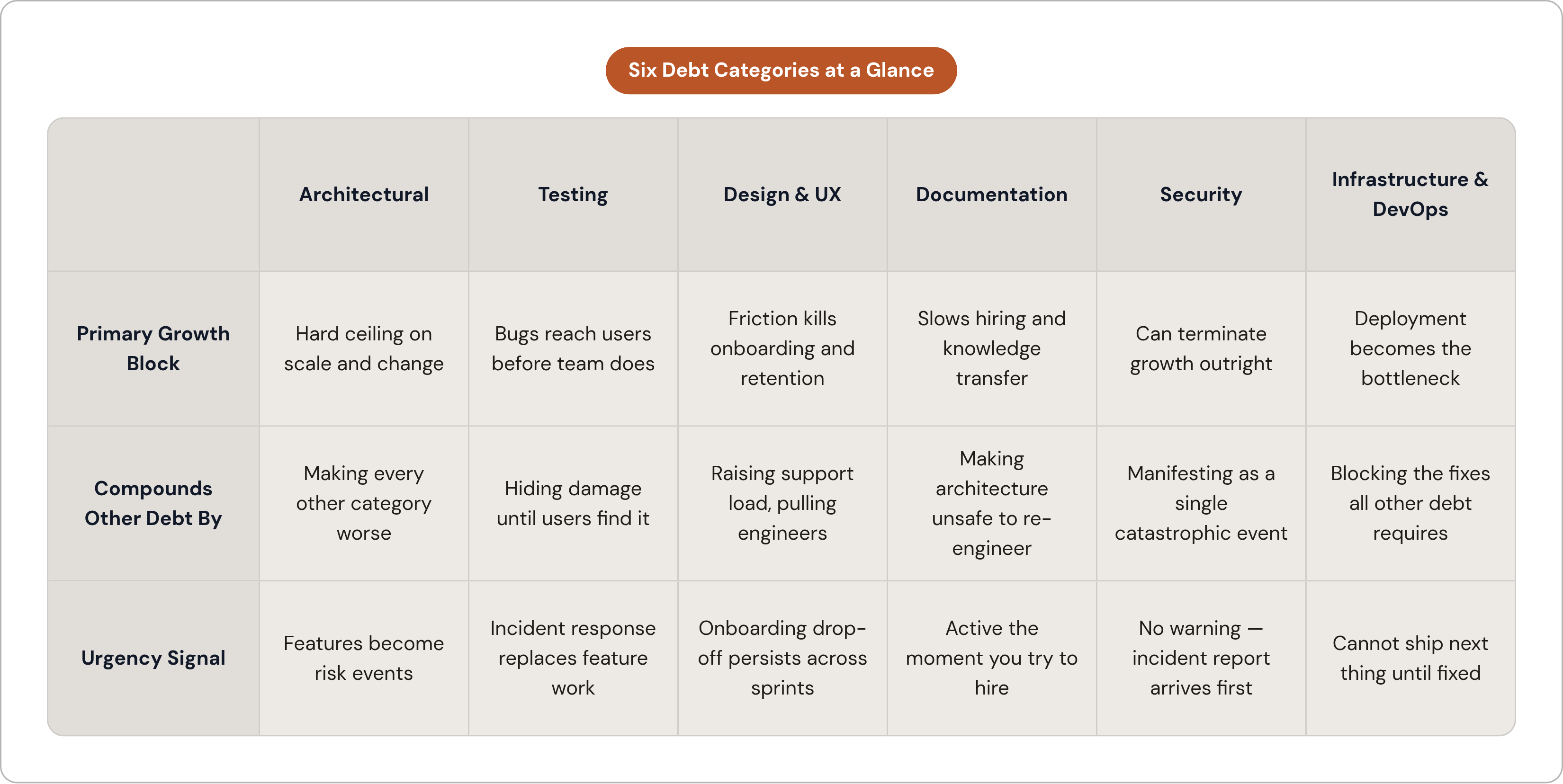
The categories above don't accumulate in parallel. They accelerate each other.
Architectural debt makes testing harder, so more bugs reach production. Design debt worsens the user experience of those bugs. Retention drops. Documentation debt means no one fully understands the architecture, so security vulnerabilities go unnoticed longer, and infrastructure debt can't be modernized because no one has a complete map of what is running. Design debt raises support volume, which pulls engineers away from feature work and debt repayment, which allows every other category to worsen further.
Stripe's 2024 survey estimated $85 billion per year in lost global GDP from developer time consumed by technical debt. The founder-level version of that figure is more concrete: engineers spending roughly a third of their time on debt-related work aren't spending that time on features or fixes that grow the product. That is a competitive disadvantage that compounds quarterly.
The talent signal is the one founders most consistently miss. Technical debt is developers' top frustration, consistently ranking above tool reliability, deployment pipelines, and security concerns in developer surveys. Debt accumulation drives away the engineers who fix it. The teams most capable of resolving the debt are the most likely to leave organizations where it goes unaddressed.
One might argue that addressing debt at the MVP-to-production transition looks like premature investment. The problem is it costs a fraction of what debt remediation costs after it has compounded across multiple categories simultaneously. That's the economic logic that makes timing the central variable.
The nonprofit context: where structural underfunding makes every debt category more acute
The structural conditions facing nonprofit technology are materially different from those facing growth-stage startups, and treating them as equivalent undersells the distinction.
NTEN's 2024 Digital Investment Report found that only 20% of funders provide grantees with money for technology tools and resources, and just 11% of nonprofits report that foundation grants contribute significantly to their technology budgets. Of the technology budgets nonprofits do have, the majority goes to hardware. Software, services, and training receive small shares. The sector is chronically underfunded in its technology infrastructure by design, not by accident, and that underfunding creates distinctive debt patterns rather than merely smaller versions of startup debt.
Donated or low-cost systems patched together without integration expertise produce siloed data and manual workflows. That is documentation and architectural debt by default, not by choice. Staff carrying multiple roles can't maintain or modernize systems proactively; they can only respond to failures. Infrastructure and testing debt accumulate without anyone noticing until something breaks. When it does, the organization enters emergency spending mode: reactive, expensive, and completely disconnected from any strategic roadmap. The cycle repeats.
The ASAE Center has framed this precisely: technical debt in mission-driven organizations is not an IT issue. It is a strategic, operational, and financial challenge that quietly erodes the organization's capacity to deliver on its mission. That framing changes who needs to own the problem. It is not a question for technical staff alone. It is a question for leadership, for funders, and for anyone deciding what a technology investment is actually for.
I'd add something from direct experience working in this space: the structural underfunding isn't backdrop to the technical debt problem. It's an active ingredient in it, which means solutions that ignore the funding reality aren't solutions at all.
Recognizing the ceilings before they close
The thread running through every category here is the difference between debt that raises costs and debt that imposes hard limits on what is possible. A cost increase is manageable; you can budget for it, phase it, negotiate it. A growth ceiling is different. It compounds quietly until users stop showing up, engineers stop staying, and the next feature becomes contingent on fixing the last five shortcuts.
These categories are not equivalent in urgency. Security debt can end a product outright. Architectural debt makes every other category worse. Documentation debt is active the moment you try to hire. But they share a common property: they do not wait. Each one is converting engineering fragility into lost users right now, at a rate that increases with every sprint that doesn't address it.
The founders and organizational leaders who navigate this well are not the ones who avoided debt entirely; no one does. They are the ones who can identify which category is imposing the hardest ceiling at a given moment and allocate toward it before the window for affordable remediation closes. That is a diagnostic skill more than a technical one, and it's worth developing before you need it urgently.