Sustainable Software Engineering Practices for Small Teams
Small teams need predictable time for refactoring to stay productive long-term.

Sustainable software engineering, for a small team, is a question about operational endurance: can a 3-to-8 person team keep shipping reliably for years, beyond just the next two sprints? That's the meaning worth caring about here, and it's the one that decides whether a small team survives long enough for anything else to matter.
There's a separate conversation about data centers and energy use, global greenhouse gas estimates put data centers in the 2-3% range, and that's a real issue. That's a large-organization problem, solved with power purchase agreements and chip efficiency, while the sustainability question for a lean team is operational: can the codebase still be understood a year from now? Can the team ship without someone pulling an all-nighter every other week? Research on the subject makes a point worth sitting with: sustainable practices only work when they're designed with both management and the people actually writing the code, because the tension involves more than technical concerns. Workload matters. Team health matters. So, does whether the humans involved can keep doing this for another year.
That tension, speed to ship versus foundations that actually hold, is what the rest of this is trying to work through.
What unsustainable actually looks like when it catches up with a small team
The symptoms show up in a fairly predictable order. Every new feature takes longer to build than the last one, even though the team hasn't gotten any less skilled. A bug fix in one corner of the app breaks something in a completely unrelated corner. And, there's usually one person, just one, who actually understands how a particular module works, which means the team's velocity is quietly capped by that person's calendar.
This is technical debt, experienced daily rather than tracked as a line item on a spreadsheet.
A 2025 report from CAST, "Coding in the Red," puts numbers on how common this is: 45% of the world's code qualifies as fragile, 32% as bloated, 31% too rigid to change without something breaking somewhere else. Those aren't outlier codebases. That's the default state of most software running today.
What does that cost in hours? At the average company, developers spend about a third of their time dealing with technical debt instead of building anything new. Scale that down to a small team and the arithmetic gets uncomfortable fast: a meaningful share of engineering capacity is effectively consumed by overhead nobody can see or point to on a roadmap.
For a small team, there's no slack to absorb this. There's no rotating bench of fresh engineers to bring new eyes, and no dedicated platform team quietly soaking up the friction in the background. Every hour lost to debt is an hour the founder, who is probably also writing code, isn't getting back.
This doesn't reflect a discipline failure, though. Technical debt is a predictable stage a codebase goes through, especially right after a team sprints hard to get an MVP out the door. The mistake isn't accumulating it. The mistake is pretending it isn't there.
How architectural debt becomes the kind that can't be sprinted away
Debt doesn't all weigh the same. Code-level debt, messy functions, missing tests, thin error handling, is annoying but fixable inside a normal sprint. Architectural debt runs deeper: it's about how services talk to each other, how data actually flows through the system, what assumptions got baked in about scale. There's no refactoring your way out of a bad assumption about scale in an afternoon.
Gartner projects that by 2026, 80% of all technical debt will be architectural in nature. That's the kind that doesn't get fixed easily. It gets rebuilt around.
Here's where it usually gets baked in: at the MVP stage, when decisions get made under a deadline, sometimes by tools optimized for "does this work right now" rather than "will this hold up in six months." AI-generated code and no-code platforms are excellent at the first goal and indifferent to the second. That's the trade everyone makes at MVP stage without quite calling it a trade.
The cost isn't abstract, either. Southwest Airlines' 2022 holiday meltdown, which canceled around 13,000 flights, had technical debt as a contributing factor. That's an extreme case, running at a scale no small team will ever touch. Still, it's the clearest illustration available of what fragile architecture does under load: it holds fine right up until stress finds the seam, and then it doesn't hold at all.
For a small team, this kind of debt carries an extra danger. The people who built the original architecture are usually still the entire team. Nobody's walking in with fresh eyes to spot what's actually wrong, because everyone present already agreed to the assumptions that caused the problem in the first place.
So, if a sprint can't fix it, what actually does?
The practices that keep debt from compounding faster than a small team can manage
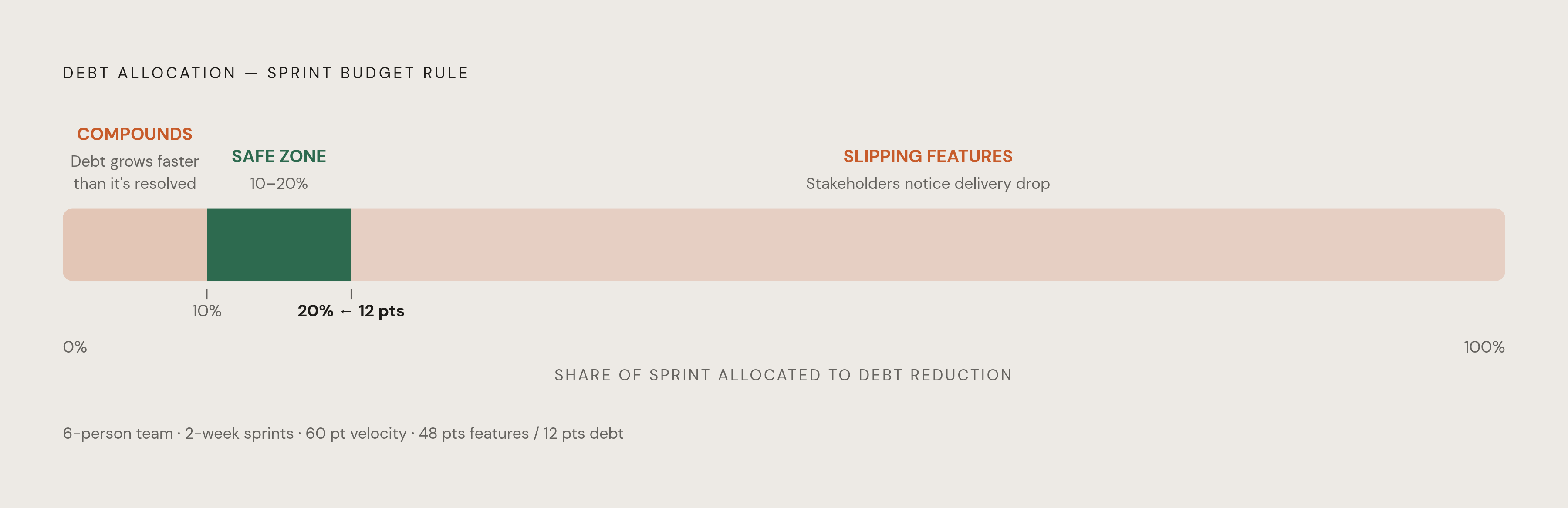
Reserve 15-20% of every sprint for refactoring and debt reduction. Treat it as a floor, something that stays fixed even when things feel slow. That's the number several practitioner sources converge on, and it's narrow for a reason.
Go below 10% and debt piles up faster than the team can work it down. Go above 20% and feature delivery starts to suffer enough that stakeholders notice and start asking questions nobody wants to answer.
Made concrete: a 6-person team running two-week sprints at 60 story points of velocity, with a 20% debt allocation, spends 12 points on debt and 48 on features every sprint. Across 26 sprints in a year, that's roughly 312 story points spent just keeping the foundation from crumbling under its own weight. Framed that way, the work becomes a budget line, something to actually plan around instead of apologize for.
Pair that with the scout rule: leave every module a little cleaner than it was found. It rides along inside normal work instead of requiring a dedicated debt sprint that stakeholders have to approve.
Collective ownership matters here too, and it's the piece teams skip most often. When one person owns a module, nobody else has much reason to improve it, and the team inherits a single point of failure without meaning to. Spreading both the knowledge and the responsibility across the team is what keeps that risk from concentrating in one person's head.
CI/CD deserves a mention that goes beyond speed. Automated tests and continuous integration exist to keep the main branch releasable at all times; that's what "always shippable" actually requires in practice, a mechanical fact about the codebase rather than a slogan on a slide.
None of this is exotic. It's basics, done consistently. The resistance small teams feel toward this stuff usually reflects pressure from outside, a customer, an investor, a deadline, saying "we need this now," more than any real disagreement in principle. The 15-20% rule is the answer to that pressure, and it only works if it survives contact with the first urgent request that tries to override it.
Why the MVP-to-production transition is when most small teams lose the thread
MVPs are supposed to optimize for learning fast, and that's the right call at that stage. The failure is treating MVP-grade code as a permanent foundation without ever going back to check whether it's earned that role.
Whatever got decided at the MVP stage, how data flows, how services are split up, what load the system assumes it'll handle, either holds up under real growth or becomes exactly the architectural debt described above. There's no third option waiting in between.
The transition to production is about knowing where the application's limits actually sit before growth finds them without an invitation: sensible architecture, deployment practices that don't depend on one person's memory, real production monitoring, performance testing under conditions that resemble actual use rather than a demo.
AI-generated and no-code MVPs are a genuinely fast, genuinely legitimate way to get to market. Still, they carry a specific kind of risk: the code wasn't written by someone who's going to be the one maintaining it later, which means nobody on the team necessarily understands why it's shaped the way it is when something finally breaks.
Here's the honest version for founders: getting to launch and staying live are different standards of reliability, and it's easy to conflate them because both feel like "shipping." Once real users depend on the product, "good enough to demo" stops being good enough. Moving changes through a staging environment before final release, rather than pushing straight to production, catches a category of problem that simply doesn't show up until conditions resemble the real thing. It's underused on small teams, mostly because of the same time pressure that created the MVP shortcuts to begin with.
None of this calls for a full rewrite. It calls for a deliberate look: what in the MVP actually holds up, and what needs rebuilding before the next stage of growth exposes it.
Process habits that let a small team stay fast without burning people out
Scope discipline is the least glamorous sustainable practice and also one of the most load-bearing. Teams that stay fast over years are the ones that say no, consistently, to feature creep, to "while we're in there" requests, to scope that quietly expands past what was agreed. That discipline is what protects the sprint allocation for both new features and debt reduction. Lose it, and the 15-20% rule turns theoretical fast.
Documentation matters here too, and it's doing more than satisfying a compliance box. On a 4-person team, institutional knowledge mostly lives in people's heads. When one of those people leaves, or just burns out and needs a break, that knowledge leaves with them. Lightweight documentation, architecture decision records, runbooks, a README that actually reflects the current system, is how small teams de-risk the fact that they're small.
On-call is another place where "unsustainable" has a literal meaning: one person carrying every production emergency, every night, indefinitely. Even a two-person rotation changes that psychological contract. It marks the difference between a team that can absorb an incident and one where every incident doubles as a personal crisis.
On a 4-person team, one burned-out engineer isn't a morale problem off to the side. It's a quarter of total capacity, gone, and there's no fifth person to quietly cover the gap.
Gartner's guidance from mid-2025 points at something relevant here too: AI-enabled tools are reshaping how software gets built, and how teams think about talent is shifting alongside it. For a small team, the useful framing is narrow. Let AI tooling handle routine, repetitive work, and protect human attention for the judgment calls that actually compound: architecture trade-offs, product decisions, the things a model can't reason through the way a person who knows the business can.
Process, in other words, is the mechanism that lets a team stay small and keep shipping. Teams without process tend to substitute heroics for structure, and heroics don't scale, because eventually the hero needs a vacation and nobody covers the shift.
When a small team needs outside technical leadership to stay on track
Some problems don't yield to better habits, and it's worth saying plainly: past a certain point, process fixes are the wrong tool. When the architectural debt has grown past what the team can address while still shipping, when nobody on the team has actually made the specific infrastructure call being faced, or when the founder is functioning as the de facto head of engineering on top of everything else, better habits alone won't close that gap.
A fractional CTO fills a specific role here, distinct from a senior engineer: setting the long-term technology direction, making the architecture calls that will matter in eighteen months, mentoring the team already in place. This tends to make the most sense in early stages, when a full-time hire at that level isn't justified yet. Once a team hits product-market fit and grows, fractional support can still work, but a plan for transitioning to a full-time hire starts to matter.
Cost-wise, a hands-on fractional engagement represents a real but meaningful expense for an early-stage team. That's real money for an early-stage team, but it's a fraction of what a full-time CTO costs in total compensation including equity.
A product engineering studio is a different but related option, useful for teams that need ongoing execution rather than just strategic direction. Quwa Labs, a product engineering studio that assesses AI-generated and freelancer-built MVPs to determine what can be refactored versus what needs a proper rebuild, and then stays on as a continuing technical partner, is one example of this kind of engagement. A long-term engineering partner can rebuild on solid ground and stay through the growth phase that follows, effectively acting as the technical arm of the company so the founder can focus on go-to-market instead of firefighting.
The distinction that actually matters here: an engagement that disappears after handoff leaves the team right back where it started, holding a codebase nobody outside stays accountable for. The value of a long-term partner is continuity, knowing the codebase, knowing the debt map, knowing which trade-offs got made and why, and staying on the hook for what gets built next.
Values alignment matters more than it might seem at first glance. The right technical partner understands the operating reality of the team it's joining, its budget, its mission, its pace, and builds for that reality instead of importing patterns meant for a different kind of company entirely. Fractional CTOs also get brought in for a narrower, time-bound purpose: preparing a company for a Series A or B by auditing the code, the security posture, the infrastructure, ahead of due diligence.
How nonprofit and mission-driven teams face the same engineering pressures with fewer resources to absorb them
Nonprofit technology sits on shakier ground structurally. Staff wear several roles at once, budgets move on funding cycles instead of revenue, and when something breaks, the cost isn't a churn number on a dashboard. It's a missed service delivery to someone who needed it that week.
Fragmentation makes this worse. Something like the vast majority of nonprofits now run three or more core technology applications, and most are juggling five or more at once. Every one of those integration points is a place where something can quietly fail, and every one adds to the maintenance load somebody already stretched thin has to carry.
Manual workarounds and disconnected systems are the nonprofit version of technical debt: staff time spent re-entering the same data across platforms that don't talk to each other, processes that only work because one person remembers the trick that makes them work.
The same practices that help a startup, the 15-20% allocation, collective ownership of systems, apply here too. Yet the starting point is often worse, because the software was chosen for its price rather than its fit, and years of integration hacks have piled on top of that original choice.
The right fix isn't always a rebuild. Sometimes it's consolidation: fewer tools, better documentation, a maintenance plan people actually follow instead of one that lives in a drawer nobody opens. Sometimes a rebuild really is the answer, but done by a partner who understands how a nonprofit actually operates, rather than one optimizing for enterprise features nobody there needs or asked for.
One family services nonprofit based in Brooklyn arrived at exactly this crossroads. Manual tooling had stretched staff thin, disconnected platforms ate into hours that were supposed to go toward the mission, and system upkeep was quietly competing with service delivery for the same limited hours in the day. In a case like that, the engineering problem and the mission problem collapse into one.
What a sustainable engineering baseline actually looks like in practice for a lean team
This isn't a checklist to run through once and file away. It's a set of conditions that either hold or don't. A team is on sustainable footing when someone who didn't write the code can still understand it, when deployments are routine rather than white-knuckle events, when debt gets tracked and budgeted instead of quietly ignored until it isn't quiet anymore, and when no single person is the only one who knows how something actually works.
The 15-20% sprint allocation, CI/CD, collective ownership, lightweight documentation: these function as one system. The benefit comes from doing all of them consistently, not from picking a favorite and doing that one well while letting the rest slide.
For a team coming out of a fast MVP push, the first move is an honest audit, not a panic rewrite. Map what's fragile, what's bloated, what's too rigid to touch without breaking something else three steps downstream. That map is the debt budget going forward.
For founders specifically, the goal was never to become a technical expert personally. It's to stop being the only person who has to understand everything for the team to keep functioning day to day. A sustainable foundation is what lets a founder actually own go-to-market instead of getting pulled back into production firefighting every other week.
The tell that a team has actually crossed over: new features start taking a predictable amount of time instead of an ever-expanding one, production incidents stay contained instead of turning into all-hands events, and a new hire can get up to speed without a month of tribal knowledge passed down verbally over someone's shoulder.
Sustainability, understood this way, works as a growth lever rather than a maintenance cost to minimize. Teams that treat it that way compound their velocity year over year. Teams that don't are just trading tomorrow's speed for today's output, and that trade always comes due, usually at the worst possible moment to pay it.