Technical Debt Created by AI-Generated Code in Production
Unreviewed AI code accumulates hidden maintenance problems that human shortcuts wouldn't create.
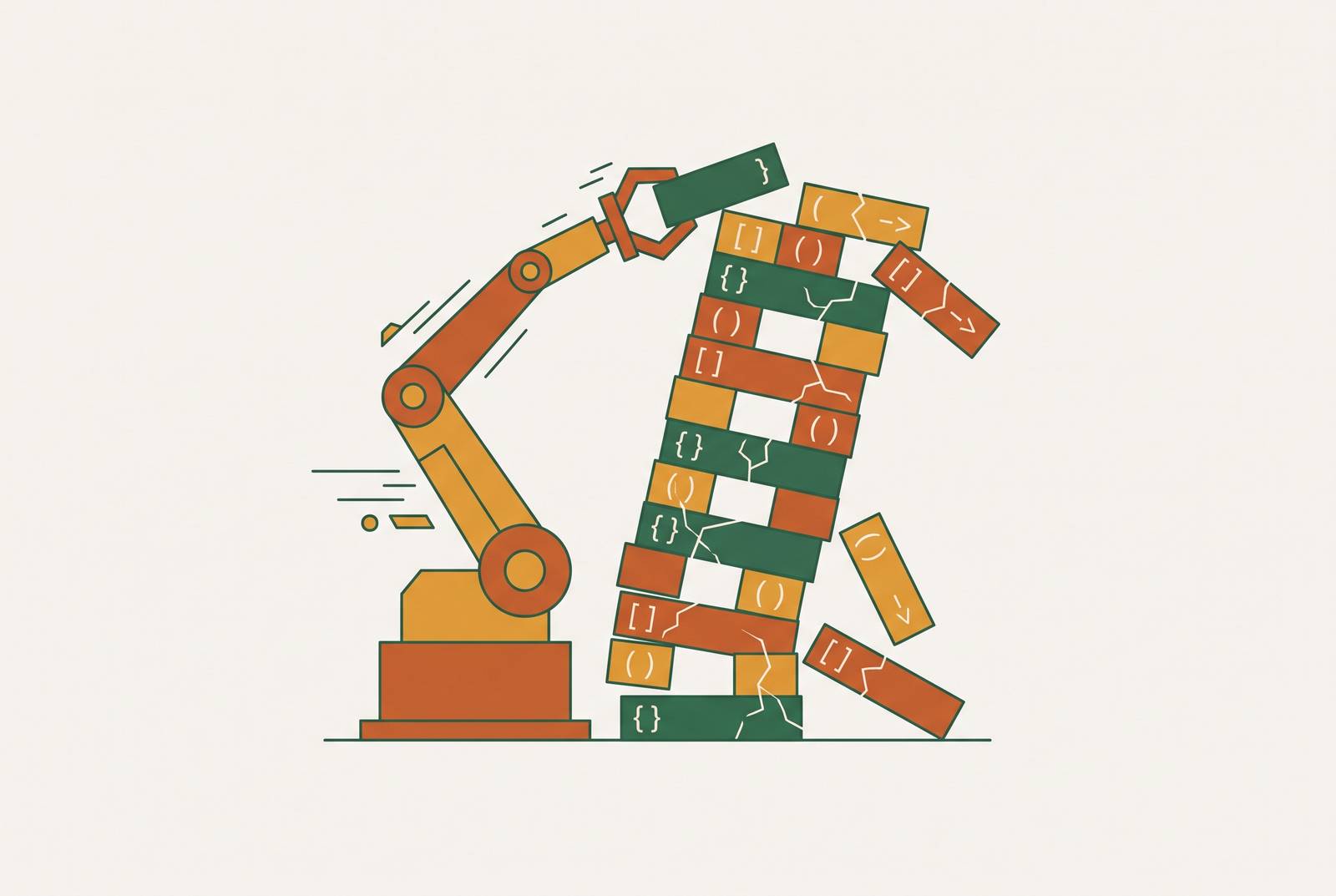
AI now writes 42% of all committed code, and the developers surveyed expect that number to hit 65% by 2027 https://golabstech.com/insights/ai-generated-code-technical-debt-maintenance. Stack Overflow's 2025 developer survey put the number of developers using or planning to use AI coding tools at 84%, up from 76% the year before https://news.designrush.com/ai-assisted-development-technical-debt. GitHub's own data shows over 1.1 million public repositories now pull in an LLM SDK, a count that grew 178% year over year as of August 2025 https://arxiv.org/html/2603.28592v2.
The edge case is where this gets uncomfortable. A quarter of Y Combinator's Winter 2025 batch had codebases that were 95% AI-generated https://masterofcode.com/blog/ai-vibe-coding-startups. That's "vibe coding" pushed to its limit: describe what you want, let the model write it, ship it. It gets a startup through demo day just fine. But a codebase built almost entirely by a language model carries debt of a different character than one built by engineers cutting corners on purpose, and mistaking the two is where most of the trouble in this piece starts. One kind of debt gets chosen. The other just accumulates, unnoticed, until somebody has to live inside it.
How AI-generated code creates debt differently than shortcuts taken by human developers.
Traditional technical debt is a choice someone made on purpose. There's usually a comment in the code, or at least a shared understanding on the team, that says: fix this later. The debt is visible because a person chose it with open eyes. Repayment is at least a known problem with a known owner.
AI-generated debt skips that step. Nobody chose it, because nobody was in a position to. It appears as a side effect of how large language models work: inside a narrow context window, with no memory of the system's architecture, optimizing for whatever the prompt asked rather than the codebase as a whole. Ask a model to write a function: it writes a good function for the prompt sitting in front of it. What it can't do is see the helper function three files over, so it writes a new one. It has no idea what error-handling convention the team settled on six months back, so it invents its own. Multiplying that across a few hundred commits causes the codebase to pile up debt that nobody signed off on and nobody can point to.
An AppScale engineering guide from 2026 names this debt of provenance, not intent. That's a useful distinction: it's a taxonomy built for code that comes from a generator rather than a person, and it covers abstractions that look plausible but are wrong, duplication where reuse should have happened, happy-path logic never tested against failure, phantom dependencies nobody meant to add, idioms that shift from file to file because the model has no memory of its own past choices, and scope that quietly creeps past what was asked for. None of it announces itself. It just sits there.
The review gap: how AI-generated code enters production without genuine scrutiny
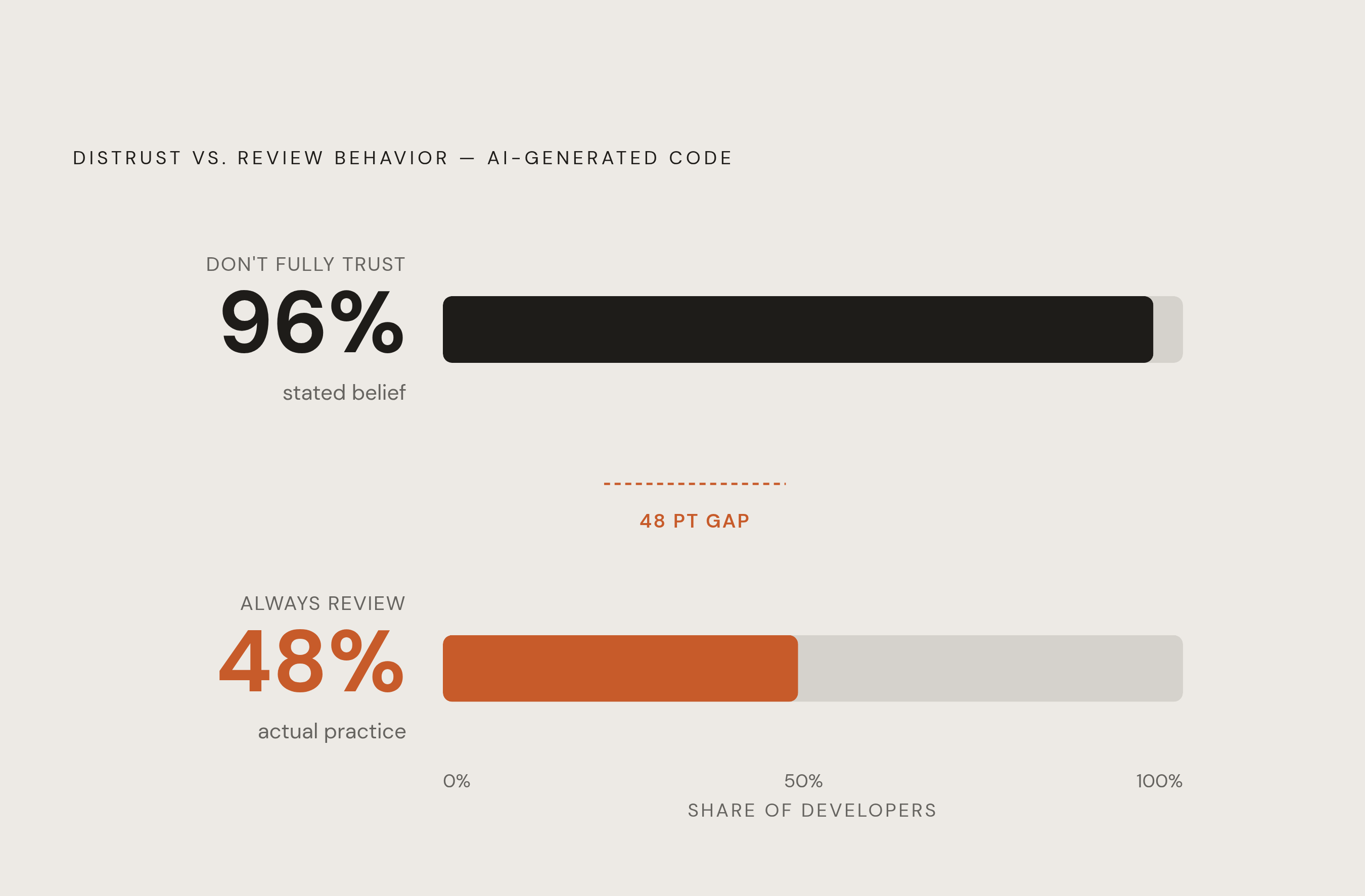
Sit with this tension for a second. In Sonar's survey, 96% of developers said they don't fully trust AI-generated code to be functionally correct https://golabstech.com/insights/ai-generated-code-technical-debt-maintenance. Only 48% said they always review that code before committing it https://golabstech.com/insights/ai-generated-code-technical-debt-maintenance. Almost everyone doubts the output. Fewer than half check it every single time. What explains the gap between what people believe and what they actually do?
Call it the velocity trap. AI writes code fast enough, and that code looks finished enough, that the review step gets skipped or rushed. Variable names make sense. The logic flows. The tests, if there are any, pass. So the reviewer's mental model never fully switches on, because nothing obviously wrong is there to trigger it. Skimming code that looks right is a different mental act from tracing through what it actually does, and the two get confused constantly.
One engineer working with Claude described this without much need to dramatize it. A Claude-generated pull request got merged. The feature worked. The tests passed. Six months later, that same engineer couldn't fully explain how half of the merged code actually worked. Reading code is not the same cognitive task as writing it. Writing forces you to reason through every branch. Reading something that already looks correct lets you skim past the branches you should have questioned.
GitClear's analysis, built on over 100 million lines of changed code, backs this up with a number that should worry anyone shipping fast: churn, meaning lines reverted or rewritten within two weeks of being written, rose 39% in projects leaning heavily on AI coding tools https://dev.to/alexcloudstar/ai-generated-code-is-creating-a-technical-debt-crisis-nobody-is-auditing-4cjc. Code got shipped before anyone, human or otherwise, actually understood it.
The four debt types AI assistants reliably generate (and how each hides)
An empirical study nicknamed "Debt Behind the AI Boom" looked at 302,600 commits across 6,299 repositories, and its findings line up with a separate Drexel review and a May 2026 analysis from Janea Systems https://golabstech.com/insights/ai-generated-code-technical-debt-maintenance.
Maintainability debt is the big one, and it isn't close. It accounts for 89.3% of all AI-introduced issues in the dataset. Bare except blocks that quietly swallow errors. File operations that skip explicit encoding. Calls to functions deprecated years ago. Variables declared and never used. None of it breaks the program today. All of it makes changing that program later miserable. GitClear's separate 211-million-line analysis shows the trend at scale: refactored or moved code dropped from 25% of changed lines in 2021 to under 10% by 2024, while copy-pasted lines climbed from 8.3% to 12.3% over the same stretch, alongside an eightfold jump in duplicate blocks of five lines or more since 2022 https://innovativegroup.io/blog/ai-code-technical-debt/. ArchiveBox, a project with more than 28,000 GitHub stars, took in a Claude Code commit that correctly updated its metadata loading logic while also quietly introducing a bare-except trap and a file open call with no encoding specified. The commit worked. The failure just got deferred to whenever that code path finally broke.
Comprehension debt is the second category, and it might be the most unsettling because of how it behaves. Addy Osmani, Director of AI at Google Cloud, coined the term in March 2026 to describe the growing gap between how much code exists in a system and how much any human genuinely understands. This kind breeds false confidence, because the system looks healthy while it's running fine right now. Stack Overflow's 2026 survey found 76% of developers using AI tools had generated code they didn't fully understand, at least sometimes, and this wasn't a beginner problem. Experienced developers reported it just as often https://dev.to/alexcloudstar/ai-generated-code-is-creating-a-technical-debt-crisis-nobody-is-auditing-4cjc. Sonar's survey of more than 1,100 developers found 88% reporting at least one negative effect from AI-generated code: 53% pointed to code that looks correct but isn't reliable, and 40% pointed to code that's redundant or unnecessarily duplicated https://www.appverticals.com/blog/ai-technical-debt/. The bill for comprehension debt tends to come due at 2am, during a production incident, staring at code that was approved six months earlier but never actually understood.
Architectural drift is the third type, and it's sneaky because each individual decision looks fine on its own. An AI assistant reads the files sitting inside its context window and follows whatever pattern it sees there. Reasonable, in isolation. String together dozens or hundreds of these generated changes, though, and small inconsistencies pile into something structural: one agent uses a repository pattern for data access, another writes direct queries, and each choice made sense on its own terms while the sum of them doesn't. One engineer working through this found four different patterns for handling API errors scattered across a single codebase, the product of four separate sessions each making its own reasonable call. Traditional linters and tools like SonarQube mostly miss this kind of debt entirely, because the failure is inconsistency across files, not wrong code inside any one file. That's a different category of problem than what those tools were built to catch.
The debt costs when it compounds, the maintenance numbers by year two.
Developers using AI tools felt about 20% faster. Measured against actual task completion time, they were 19% slower than developers working without AI help at all, a perception gap running somewhere between 39% and 44%. Speed felt real. It wasn't there in the data.
LinearB's Software Engineering Benchmarks Report, built from 8.1 million pull requests across 4,800 teams, found AI-generated code carries 1.7 times more issues than human-written code, with technical debt rising between 30% and 41% in the year following AI tool adoption https://news.designrush.com/ai-assisted-development-technical-debt. Incidents per pull request rose 23.5% over the same window https://www.buildmvpfast.com/blog/ai-generated-code-technical-debt-management-2026.
Velocity went up. Reliability went the other way. That trade is easy to miss right up until the incident count starts climbing, and by then it's a much more expensive problem to unwind than it would have been to prevent. According to the State of Software Delivery report from Harness, the majority of developers spend more time debugging AI-generated code and more time resolving security vulnerabilities.
The production cliff: why AI-generated MVPs fail when real users arrive
Vibe coding is genuinely good at the first part: getting something in front of people fast enough to test whether the idea has legs. For a prototype, that speed is the whole point, and the debt trade-off is rational at that stage.
The bill comes due at the production transition. Products that looked flawless in a demo start failing once real users show up: real data with edge cases nobody anticipated, real concurrent load, real traffic patterns the happy-path tests never accounted for. Getting to launch and staying live turn out to be two different reliability standards entirely, and the gap between them is where most of these failures live.
With traditional technical debt, an engineer wrote a quick fix, knows it was quick, and knows roughly what fixing it properly would take. With vibe-coded debt, the code works, but nobody fully understands why, and when it breaks at 2am, whoever's on call is debugging logic they never wrote in the first place. That's a much harder position to debug from. Familiarity with your own shortcuts functions as a kind of documentation. Debt inherited from a model carries none of that built in.
Nonprofits encounter an amplified version of the same problem
Every mechanic described above occurs for nonprofits too, and it occurs in the same order. LLMs can't see the existing helper function three files over, so they write a new one. They don't know the error-handling convention established six months ago, so they invent one, and the result is the same four patterns for handling API errors seen elsewhere, produced by four different sessions each making its own reasonable call.
BizTech Magazine described technical debt in this context as a hidden tax on mission delivery. That framing matters because the costs aren't only operational. A breach at a nonprofit costs donor trust, invites regulatory exposure, and disrupts recovery in ways a for-profit company might absorb more easily.
There's a specific trap here. Layering AI tools on top of systems that are already fragmented, without real integration underneath, doesn't produce efficiency. It produces faster mistakes. AI without the systems to support it just runs the chaos at a quicker pace. Forcing a generic AI tool into operations it was never designed for produces integration friction, a workaround culture forming around the gaps, and technical debt that eats away at whatever return on investment the tool was supposed to deliver.
Managing AI-generated debt: detection, process, and the partner question.
Start with what current tools can actually catch, because the honest answer is: not much of what matters most. The Drexel review found SonarQube is the most commonly used tool for detecting technical debt indicators, and research prototypes like CodeSmellEval are emerging to assess LLM-specific contributions. No standardized benchmarks or LLM-specific metrics exist yet, though. The tooling is chasing the problem, not ahead of it.
That gap matters most for exactly the debt types hardest to catch. Comprehension debt and architectural drift are cross-file, cross-session problems, and a per-file linter is structurally incapable of seeing either one. Catching that kind of debt takes human review at the system level: someone looking across the whole architecture, not at one diff at a time.
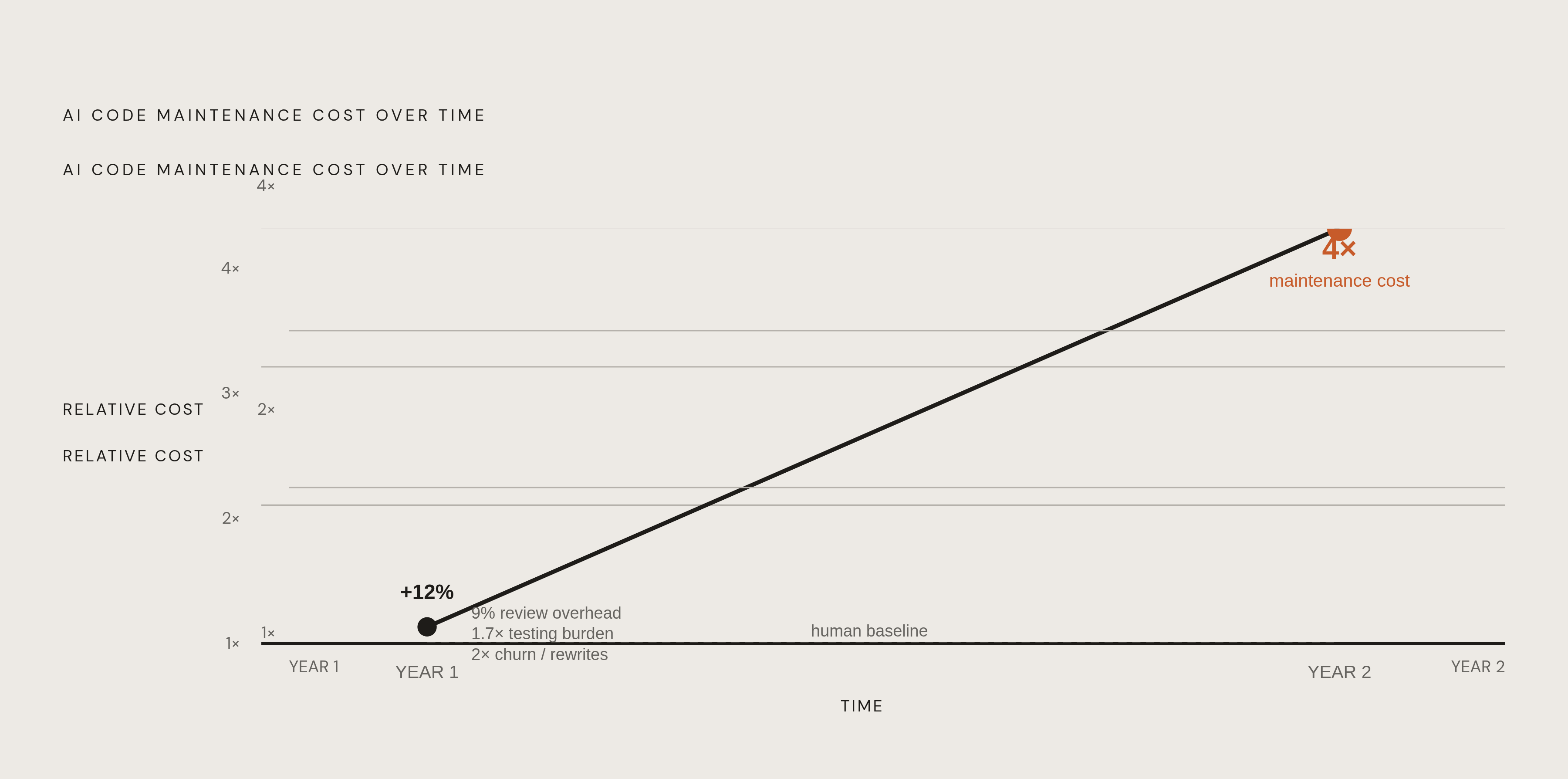
Verification debt deserves its own mention, because it hides even when someone is looking straight at the numbers. Test coverage can climb while the tests themselves grow tautological, confirming a function does what it does without ever confirming that what it does is correct in the wider context of the system it lives in. A green test suite and a correct system are not the same claim, and treating them as interchangeable is how comprehension debt slips past review undetected. The scale of what's unresolved backs this up: unresolved technical debt introduced by AI tools grew to over 110,000 surviving issues by February 2026, out of 484,366 distinct issues identified across AI-authored commits in the underlying study https://news.designrush.com/ai-assisted-development-technical-debt https://golabstech.com/insights/ai-generated-code-technical-debt-maintenance. More than 15% of commits from each assistant studied introduced at least one issue, and 22.7% of issues were still sitting in the repository's latest revision, unresolved https://golabstech.com/insights/ai-generated-code-technical-debt-maintenance. On security specifically, the numbers get worse, not better: roughly 44% of AI code generation tasks introduced a risky vulnerability, with an overall pass rate of just 56% on security tasks https://golabstech.com/insights/ai-generated-code-technical-debt-maintenance. SQL injection passed 83% of the time, cryptographic implementation passed 87% of the time, and log injection, the one that should worry security teams most, passed only 12% of the time https://golabstech.com/insights/ai-generated-code-technical-debt-maintenance. Whatever tool or partner handles this work, that's the bar it needs to clear, not the bar most current tooling is built to check. Unmanaged AI-generated code drives maintenance costs to 4x traditional levels by year two https://www.buildmvpfast.com/blog/ai-generated-code-technical-debt-management-2026. First-year costs run 12% higher when factoring in code review overhead, testing burden, and code churn https://www.buildmvpfast.com/blog/ai-generated-code-technical-debt-management-2026. Code review overhead is 9% https://www.buildmvpfast.com/blog/ai-generated-code-technical-debt-management-2026. Testing burden is 1.7x traditional levels https://www.buildmvpfast.com/blog/ai-generated-code-technical-debt-management-2026. Code churn requiring rewrites is 2x traditional levels https://www.buildmvpfast.com/blog/ai-generated-code-technical-debt-management-2026.
Sources
- AI-Generated Code Is Creating a Technical Debt Crisis Nobody Is Auditing
- What Is Technical Debt in AI Coding? Types & Impact Explained - Janea Systems
- AI Generated Code Technical Debt: How to Manage It
- AI-Generated Code & Technical Debt: The Cleanup Bill
- AI-Generated Code and Technical Debt: The 2026 Data