Production Readiness Checklist for Funded Startups
Funded startups need production-ready systems before customers arrive.

A funding round changes what "working" means. Before the check clears, the bar is: does it run. After, investors and paying customers start asking whether the system can be watched, scaled, and pulled back from the edge when something breaks. Most founders don't find out they're being graded on that second question until it fails in front of a customer.
What changes when funding arrives
Funding tends to land on a specific kind of company: seed-to-Series-B SaaS, an engineering team somewhere between five and fifty people, running on cloud infrastructure, about to take real customer traffic for the first time. That's the group where a readiness checklist matters most, because everything hits at once. User counts spike, enterprise contracts show up in the pipeline, and costs that were invisible at low volume stop being invisible.
A system that handled early user loads without complaint can start buckling at an order of magnitude more traffic, simply because nobody had a reason to test that far out before. Once the cracks show, every deploy starts to feel like defusing something live. That feeling is a signal, not bad luck: the architecture wasn't built for this phase, and pretending otherwise only delays the reckoning.
Investors check for this directly now. Most tier-one funds build a security diligence pass into the standard term sheet process, and at Series A investors commonly ask whether the company has had a penetration test. A report from within the past twelve months, with documented remediation, is the cleanest answer a founder can give. Without it, and without evidence of access controls, encryption, and an incident response plan, deals don't die, they stall. The startup ends up running a gap assessment, fixing what's found, and going through a readiness review while the term sheet clock keeps ticking. That's a worse position than having the report ready before anyone asks.
Compliance follows the same logic, only earlier than most founders expect. GDPR applies the moment the first EU user's email address gets stored, funding stage or not.
The real hinge point sits here: the shift from MVP to production is where an engineering org either earns its next round of growth or starts quietly building the debt that defines the next two years. Treating the transition as a formality creates a good chance that the deal stalling six months from now traces straight back to this decision.
How technical debt from the MVP stage compounds after funding
Technical debt gets talked about like it's always a mistake. Technical debt gets talked about like it's always a mistake, but most shortcuts a startup takes while moving fast to find product-market fit were the right call at the time. Every startup that moves fast to find product-market fit takes on shortcuts, and most of those shortcuts were the right call at the time. The damage comes later, when nobody tracks the debt while the company scales around it.
By some recent estimates, engineering teams spend between 23% and 42% of their time dealing with technical debt instead of shipping new features. Onboarding a new hire into a high-debt codebase takes two to four times longer than onboarding into something clean and documented. Most businesses lose somewhere between 10% and 20% of their IT budget to debt every year, and that cost is absorbed into everything taking longer than it should rather than appearing as its own line item. It just gets absorbed into everything taking longer than it should.
A sharper version of this risk is visible right now, and it's the one most founders underestimate. Codebases that were already hard to extend are becoming close to impossible to adapt for AI features, the same features competitors are shipping in a matter of weeks. A codebase that resists change used to just slow a team down. Now it puts them out of the race.
Integration debt makes the mechanism easy to see. Shortcuts taken during the MVP stage mean every customer who integrates is depending on a design that was never meant to hold weight. Fixing it later means coordinating changes across every partner who built on top of it, a far bigger project than doing it right the first time would have been.
McKinsey research found that organizations actively managing technical debt free up engineers to spend up to 50% more time on work tied directly to business goals. That's the upside case, and it raises the real question: when does a founder actually go after the debt?
Chasing it too early wastes runway a startup needs to find product-market fit. Waiting until after the first serious incident is worse. The right moment sits in between: when real users show up and the cost of an outage stops being theoretical.
The operability checklist: what funded startups need to verify
Each item below works as a gate. A release can pass every unit test in the suite and still fail in production if any of these are missing.
Security and access control come first, and this is the category most founders underrate until an investor asks about it directly. MFA needs enforcing on every admin account and every path into production, with SSO covering internal tools like Google Workspace, GitHub, and the cloud provider console. IAM roles should follow least privilege, service accounts need auditing and rotation on a quarterly basis, and every API key belongs in a secrets manager (AWS Secrets Manager, Vault, Doppler) rather than sitting in an environment variable checked into git. Databases need encryption at rest, every connection in transit needs TLS 1.2 or better, and PII has to be identified, classified, and access-controlled, with GDPR or CCPA compliance documented wherever it applies. This is roughly the baseline investors check for during security diligence. Skipping any piece of it is the fastest way to stall a term sheet.
Monitoring isn't an uptime ping every five minutes. Real observability means metrics, logs, and distributed traces working together to show what the system is actually doing, not what it's supposed to be doing. Alerts need verifying as firing, tested against real or replayed traffic, rather than assumed to work because the config looks right on paper. Someone on-call who never touched the codebase should look at a dashboard and understand the system's state without a translator. Error rates, latency percentiles, and saturation all need tracking beyond a binary up-or-down signal.
The 3-2-1 rule still holds for backup, recovery, and rollback: three copies of data, on two different media types, with one stored off-site. A backup strategy without explicit RPO and RTO targets is a hope dressed up as a plan. Restoration needs testing, because a backup that's never been restored is an assumption, not a backup. The same goes for rollback, and an untested rollback is the kind of ordinary, boring gap that is one of the most common causes of extended production incidents. Boring, precisely because nobody thinks to check it until the moment it's needed.
Performance validation under realistic load matters just as much. Moving from MVP to production means knowing where the system's limits sit before growth finds them first. Load tests need to mirror real traffic patterns and run against expected peak hourly volume. Some checklists call for a full 24-hour longevity test with zero errors as the bar, and a scheduled test is always a better place to find a weak point than a live traffic spike.
Authentication, authorization, and permissions architecture round out the technical side. RBAC or ABAC should be in place, so users touch only what they're explicitly allowed to touch. Role design needs to stay simple enough that a new engineer reads through it and understands who has access to what, without a walkthrough. Security scanning, including dependency checks and static analysis, belongs in the CI/CD pipeline itself, automated on every run rather than something someone remembers to do occasionally.
Documentation and runbooks belong on this list too, and treating them as optional is a mistake teams tend to make right up until the outage that proves them wrong. Modern, AI-assisted engineering teams treat documentation readiness as a release gate on equal footing with test coverage. Every critical failure mode needs a runbook: what triggers the alert, what the responder checks first, what the escalation path looks like. Without that, on-call response depends on institutional memory, and institutional memory walks out the door the day that engineer leaves. Technical debt resurfaces here too: a high-debt codebase already takes two to four times longer to onboard into, and a solid runbook is one of the few things that offsets that cost.
Enterprise buyers bring their own checklist on top of all this, including SSO, role-based access, audit logs, data retention and residency policies, accessibility standards, integration standards, disaster recovery documentation, security testing evidence, and support SLA commitments. For AI products specifically, obligations shift depending on risk classification, and rules for general-purpose AI systems became applicable in August 2025. Enterprise sales cycles surface every gap on this list faster than anything else does, so the readiness work has to start before those conversations begin, not during them.
Triaging what needs fixing before it blocks growth
Not every gap needs fixing at the same time, and treating them all as equally urgent is how a team burns a sprint on the wrong problem. The goal is enough visibility to know what's likely to break first, and enough preparation that the response isn't a scramble when it does.
Start with a debt inventory, tagging each known issue with a business impact score. Research into this approach has found that 70% of developer pain typically traces back to just 15% of total debt. Concentrating repayment effort on that narrow slice produced a real jump in velocity, no full rewrite required.
A sustainable cadence matters too. Dedicating 15% to 20% of each sprint to maintenance, refactoring, and cleanup keeps debt from reaching crisis levels, while most of the team's capacity still points at forward progress.
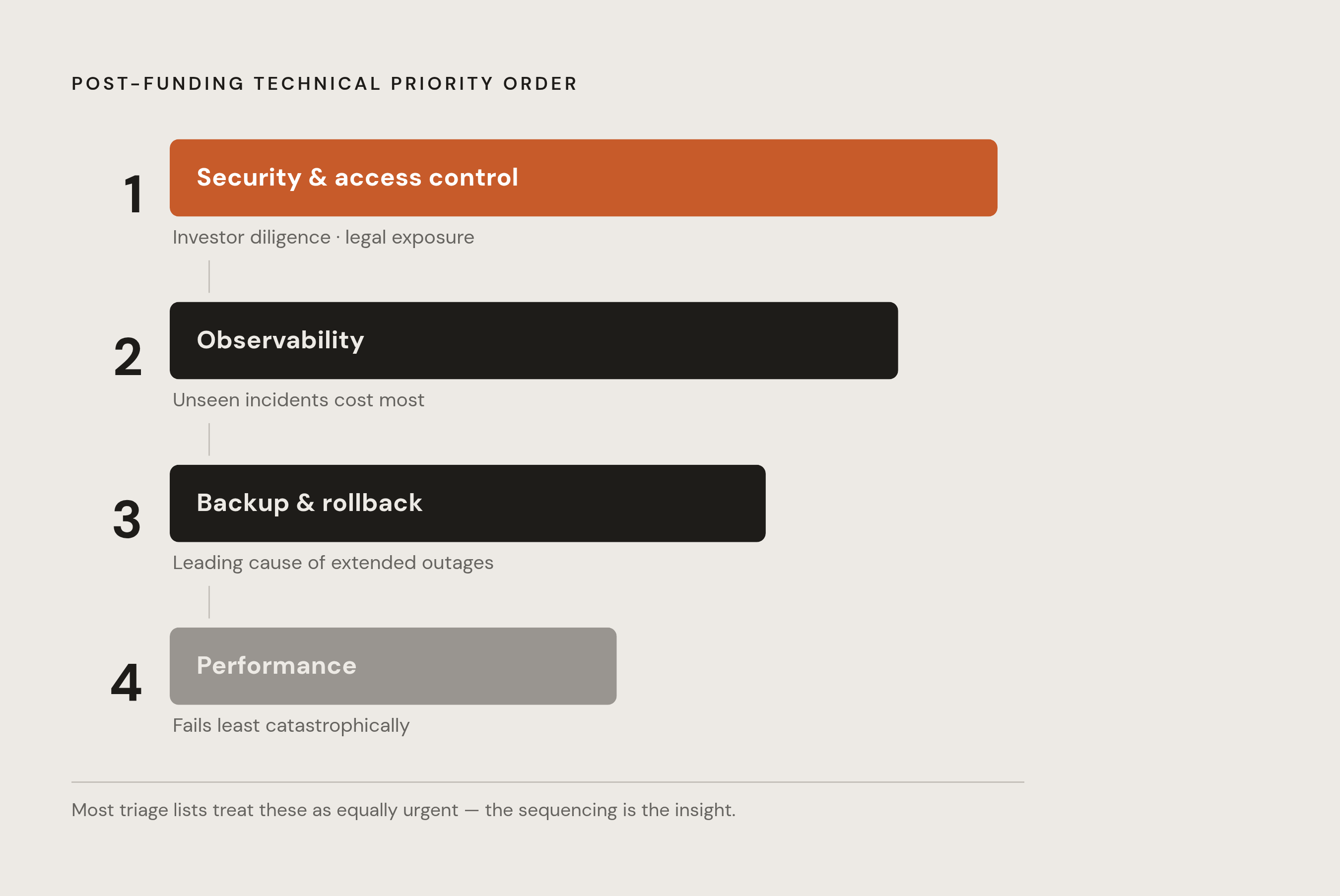
Sequencing is where most triage lists get the order wrong, usually by treating every category as equally urgent. Security and access control come first, since they're what investors check and what carries real legal exposure. Observability comes next, because an incident nobody sees coming is the most expensive kind. Backup and rollback follow, and performance comes last, because it fails less catastrophically than the categories ahead of it.
Teams that built their first version fast, using AI tools or no-code platforms, owe those components an honest assessment before anyone assumes they'll scale as-is. An evidence-led review, one that actually looks at what's there instead of guessing, decides what stays, what gets hardened, and what needs a controlled rebuild.
None of this works as tribal knowledge. The debt list, the impact scores, the fix costs: all of it needs to live somewhere visible to the whole team, not sitting in the head of whichever engineer happens to remember writing the shortcut.
When a founder needs a technical partner to own engineering, not just advise on it
The moment money lands, attention is supposed to shift toward go-to-market and closing customers. The engineering demands of this stage don't shrink to make room for that. If anything, they grow.
A technical co-founder isn't the only way to solve this, and founders who wait around for one often lose months they don't have. What most founders actually need is a partner who owns engineering outright, freeing the founder to run GTM without splitting focus. That's the gap fractional CTOs and engineering studios exist to fill: a part-time voice in architecture meetings won't be the one paged at 2 a.m. when the rollback fails.
Owning engineering means being accountable for the checklist itself: alerts that actually fire, runbooks that actually exist, rollback that's actually been tested, security posture that actually passes investor diligence. Getting a product to launch and keeping it reliably alive under real customer load are two different jobs with two different standards. Once paying users are on the product, "good enough to demo" stops being a defensible bar.
A founder evaluating a partner should look for someone willing to rebuild on solid foundations where needed, instead of patching over debt just to keep things moving short-term, and someone who sticks around through ongoing maintenance instead of handing off a finished build and disappearing. The partner also needs to understand the operating reality of a funded startup specifically: limited runway, investor diligence timelines, and enterprise sales cycles all landing on the calendar at the same time. Values alignment counts for more than most founders expect going in, enough that choosing an engineering partner deserves the same scrutiny as choosing a co-founder.
The readiness checklist becomes the ongoing standard a good engineering partner holds the product to, quarter after quarter, long after the first funded launch has come and gone.