Database Migration Best Practices for Live Production Apps
Keeping data safe requires strategy, sequencing, and separate deployments.
A failed deployment rolls back in minutes. A failed migration can corrupt or lose data that no longer exists anywhere else. That asymmetry is the whole argument for why database migration on a live production system deserves its own discipline, its own sequencing, and its own vocabulary of risk.
Users are on the system right now. Transactions are in flight. Sessions are active. Writes are happening. The schema change you push doesn't wait for a quiet moment; it lands in the middle of all of that.
How Production Databases Get Into the State That Requires Migration
Most production databases didn't start as production databases. They started as the simplest possible data model that would get something in front of users, and they got promoted to production the moment someone's credit card went through or a real user signed up. That's not a failure; that's the logic of early-stage product development. The problem is what happens next.
The data model fitted for an MVP tends to encode assumptions about scale, feature scope, and user behavior that don't survive contact with reality. A users table that works fine for a thousand rows develops opinions about normalization at ten million. A schema designed around a single-tenant workflow becomes a constraint the moment someone wants multi-tenancy. The features that come after launch are almost always more structurally demanding than the features that enabled it.
This pattern is accelerating. AI-generated and no-code MVPs are reaching production faster than ever, which is useful for founders and concerning for the engineers who inherit them. A CodeRabbit analysis of 470 open-source pull requests found AI-generated code contains 1.7 times more major issues and 2.74 times higher security vulnerability rates than human-written code. Consistent architecture, error handling, and testing infrastructure tend to be the gaps, not because AI tools are careless but because they optimize for the same thing their users do: speed to something that ships.
Technical debt is the structural pressure underneath all of this. McKinsey has found that a majority of CIOs report their technical debt has grown materially over the past several years. The debt doesn't block launch; it blocks scale. And the schema is almost always where the pressure surfaces first, because the data model is the one thing in the system that every feature touches and almost nobody refactors until they have to.
The moment migration becomes unavoidable is identifiable: it's when the data model can no longer be patched around. New features stop being workable with application-level workarounds and start requiring structural changes to the database itself. That's the inflection point where the discipline below actually matters, because you're not working on a greenfield schema with no users. You're working on a production system that real people depend on, right now.
What to Audit Before Writing a Single Migration Script
The pre-migration audit is risk mapping. Its goal is to surface every dependency that will break silently if the schema changes, before anything changes. Teams that skip this step don't avoid the discovery; they just make it at 2 a.m. under pressure instead of in advance under control.
The inventory has to cover more than the obvious. Start with every environment: production, staging, development, backup instances. Note the database version and patch level of each, because schema changes that apply cleanly to one version sometimes behave differently on another. Understand your table sizes. A migration that runs in ninety seconds on a small table can lock a large table for forty-five minutes. That distinction determines whether your migration window is measured in minutes or hours.
Go deeper than tables and columns. Stored procedures, triggers, functions, and any custom automation scripts that interact with the database all need to be inventoried. Report every application or service connecting via a connection string, not just the primary app. BI integrations, reporting tools, background jobs, and third-party APIs that read the database directly are the most common blind spots. They don't appear in the application repository, so they don't appear in the developer's mental model of what depends on the schema.
The column-dependency problem deserves particular attention. Any column participating in calculations, indexes, or external integrations typically requires more than a single migration script to change safely. A practical technique, drawn from field work on production systems: flag every read and write of the affected field across the codebase before touching the schema at all. Update the application to stop using the old field, observe for a full sprint, then drop. This feels slow. It is slow. It is also the reason you don't lose data.
Documentation debt compounds everything. Teams without institutional knowledge of why the schema is shaped the way it is make more dangerous assumptions when they write migration scripts. If the reasoning behind a design decision is lost, the cost of changing it goes up considerably, because you can't fully predict what you might be breaking.
The Expand-Contract Pattern: How to Change a Schema Without Breaking the Running Application
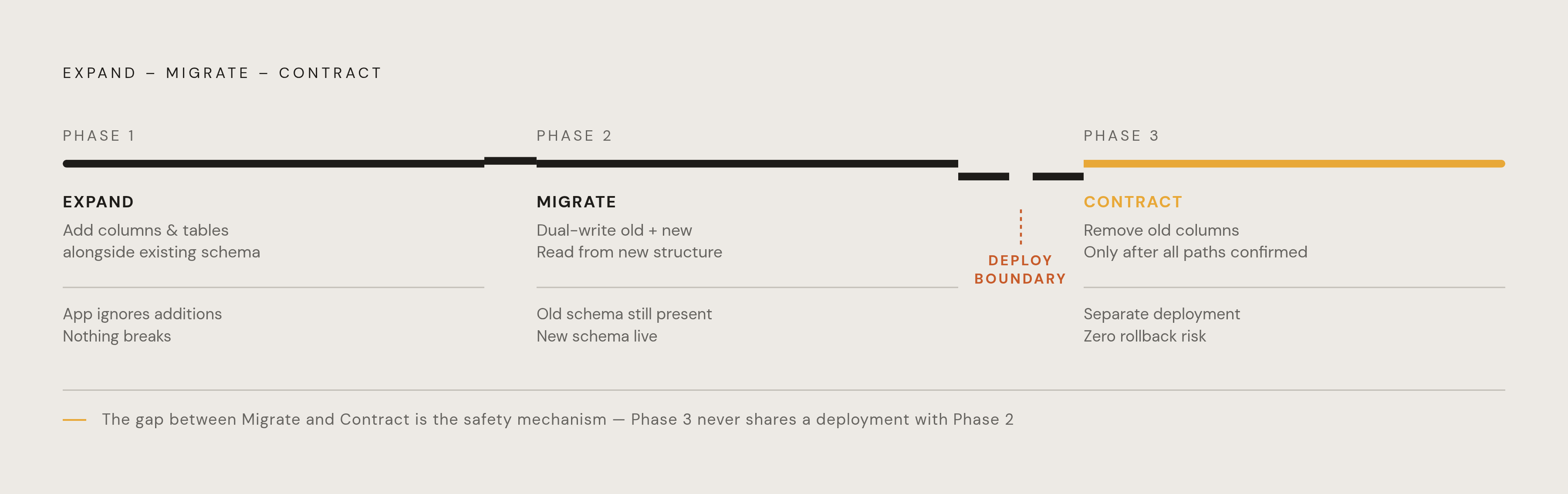
The central rule of expand-contract is simple enough to state: do not delete a column in the same release you add a new one. The reasoning behind it is worth unpacking.
When you deploy an application change and a schema change together, you have a problem during the transition window. The old version of the application code and the new version are both running against the database simultaneously, even if only for a few minutes. If the schema no longer contains what the old code expects, you get errors. If the schema doesn't yet contain what the new code expects, you get errors. The only way to avoid both is to keep the old structure intact while you introduce the new one.
The three phases of expand-contract give you the sequencing to do that.
In the expand phase, you add new columns or tables alongside the existing structure without removing anything. The running application ignores the new additions and continues working normally. Nothing breaks.
In the migrate phase, you move data from the old structure to the new one, with both coexisting in the schema. The application is updated to write to both locations simultaneously, which is called dual-writing, and then to read from the new structure. The old structure still exists; it's just no longer the primary path.
The contract phase is where you remove the old structure. Critically, this is a separate deployment, not bundled with the migrate phase. You run it only after confirming that every application path is reading from and writing to the new schema, and only after you've had enough time in production to be confident.
Shopify uses this pattern to migrate massive MySQL databases through peak traffic periods without downtime. That's not incidental; it's the point. Expand-contract works precisely because it avoids the moment of breakage entirely.
What it can't handle: data type changes that can't be made additive, and large structural rewrites where incremental steps aren't feasible. For those cases, you need a different approach.
When to Use Blue-Green Deployment and How It Fits Alongside Expand-Contract
Blue-green deployment runs two identical production environments in parallel. One, call it blue, serves live traffic. The other, green, runs the new version of the application and schema. Traffic switches when green has been validated. The key operational characteristic is that the switch is instant and the old environment remains available as a fallback.
What blue-green solves that expand-contract doesn't: type changes that can't be made backward-compatible, structural rewrites too large to phase incrementally, and situations where a clean cutover is safer than managing a dual-write period in the application layer. These cases exist, but they're rarer than most teams assume.
The decision rule, supported by analysis of PostgreSQL migration patterns in the field: default to expand-contract. It's simpler, requires less infrastructure overhead, and works with standard migration tooling. Use blue-green only when the incremental path isn't feasible, because the hidden costs of blue-green are real. You're running double the infrastructure for the duration of the transition, and keeping two environments synchronized during that window is its own coordination problem.
Facebook's approach during major MySQL upgrades is worth studying as a reference model: shadow testing by duplicating live production traffic to the new environment and comparing results side-by-side without affecting users. This validates the green environment under real conditions before any traffic actually shifts to it.
There's a middle path worth considering for situations where neither approach fits cleanly. LinkedIn's Kafka infrastructure migration routed a small percentage of live traffic to the new system while keeping the old as a fallback, then gradually increased that percentage as stability was confirmed. Canary deployments of this kind give you production validation without full commitment, which is useful when your risk tolerance sits between a phased schema change and a hard cutover.
Feature Flags and Deployment Sequencing as Migration Safety Mechanisms
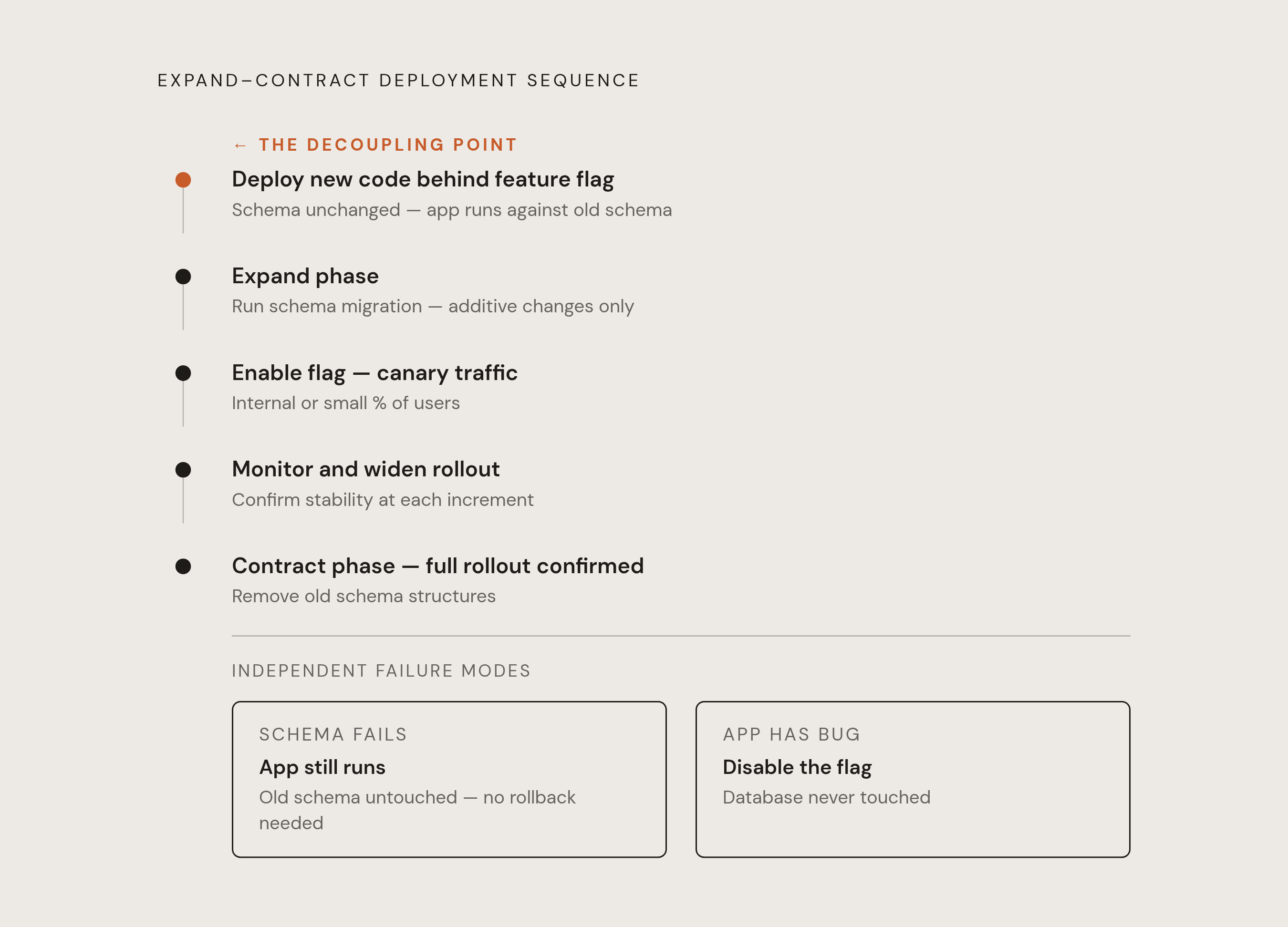
The coordination problem at the center of live migration is this: schema changes and application deployments don't happen atomically. There's a window where old code runs against a new schema, or new code runs against an old one. Feature flags are the mechanism for managing that window deliberately rather than hoping it's short enough to be harmless.
The idea is straightforward. New code paths that depend on the migrated schema are gated behind a flag. When you deploy the application, those paths exist in the codebase but do nothing until the flag is enabled. This lets you deploy the application ahead of the schema migration without risk; the new paths are dormant. Once the schema migration is complete and validated, you enable the flag, first for internal users or a canary percentage of traffic, then progressively wider.
Stripe's approach to new database changes involves shadow testing against real payment transaction volumes before promotion. This validates that new schema paths handle production data correctly before any user sees them, which is a meaningful standard to hold yourself to: the new structure should prove itself against real data, not just the subset you remember to include in a test fixture.
The sequencing that follows from all of this:
Deploy the application with new code paths behind a flag while the schema is still unchanged. Run the expand phase of the schema migration. Enable the flag for internal or canary traffic. Monitor. Widen the flag rollout as stability is confirmed. Run the contract phase only after the full rollout is confirmed stable.
This sequencing converts what would be a single joint failure mode into two separate, recoverable events. If the schema migration fails, the application still runs against the old schema. If the application has a bug, you can disable the flag without touching the database. That separation is the highest-leverage discipline in zero-downtime migration.
Testing at Production Scale and Why Staging Environments Mislead
Staging environments are not production environments. This is obvious when stated plainly and routinely forgotten when planning migration timelines. The gap isn't just about data volume; it's about query patterns, concurrency profiles, and the edge cases that only surface when many users are doing many things simultaneously.
A migration validated against a staging database containing a few thousand rows may work perfectly, then stall or lock tables when run against hundreds of millions of rows with concurrent writes landing during the operation. A query plan that looks efficient on a small dataset may scan the entire table at production scale because the query planner's statistics don't account for the real distribution of values. Neither of these problems is visible in staging, which is precisely the problem.
What a production-representative test environment actually requires: matching data volumes, not just schema structure; matching query patterns, including the edge cases; and matching concurrency, meaning simultaneous reads and writes during the migration, not sequential validation after the fact.
Post-migration validation is its own phase, not a checkbox at the end. Row count and checksum comparison between source and target verifies that data moved correctly. Query execution plan comparison before and after catches performance regressions that appear silently when indexes or statistics are stale following a bulk data transfer. Index rebuilds and statistics updates after migration are standard practice, not afterthoughts.
Slack's approach during its Amazon RDS migration is instructive: automated backup validation scripts that continuously restored backups to temporary instances and verified data consistency. This treated backup integrity as an ongoing confirmation rather than a one-time assumption made before the migration window opened.
Build more time into migration timelines than your initial estimate suggests. What tests reveal at scale is almost always more complex than what the planning conversation anticipated. This is a consistent pattern across practitioners who run migrations regularly, not a counsel of pessimism.
Rollback Readiness as a Prerequisite, Not a Fallback
Rollback is only possible if you designed for it before writing the first migration script. A migration that cannot be reversed should not run in production. That framing sounds obvious and is violated constantly, usually because rollback planning is treated as something to figure out if things go wrong, rather than a condition that must be satisfied before the migration starts.
What rollback readiness actually requires: a verified, restorable backup taken immediately before the migration begins, not assumed to exist but tested; a documented rollback procedure with named steps, not "restore from backup" as a single line; and at least one team member who has executed that rollback procedure in a non-production environment before the migration window opens. The last requirement is the one most often skipped, and it's the one that matters most at 2 a.m. when the decision has to be made quickly.
Expand-contract has a structural advantage here. Because the old schema is preserved through the expand and migrate phases, rolling back the application to the previous version doesn't require a schema rollback. The old code still works against the expanded schema. You're reverting an application deployment, which is fast and well-understood, rather than a data operation, which is slow and risky.
Rollback becomes impossible in predictable ways. Destructive operations, column drops or table drops, run before validation is complete. The contract phase bundled with the migrate phase, eliminating the stable intermediate state. A backup that exists but hasn't been tested before the migration window. These aren't exotic failure modes; they're the standard way migrations go wrong.
The rollback plan should define explicit go/no-go criteria and a time limit. If validation is not complete by a specific point in the migration window, rollback is triggered automatically, not debated in the moment. Decision-making under pressure with incomplete information is where human judgment performs worst. Remove the decision.
How Production Migration Discipline Fits Into Ongoing Engineering Ownership
Schema migration is not a one-time event. As a product grows, structural changes to the database are continuous. The discipline either becomes embedded practice or it doesn't, and the gap shows up in production at irregular but predictable intervals.
The founder's version of this problem is worth naming directly. Technical debt isn't a failure of discipline; it's a predictable stage in the lifecycle of a product that moved fast enough to reach real users. The right moment to address it is not before launch, when the product might not survive long enough to need the refactor, but when real users have arrived and the cost of getting migration wrong has become concrete. The choice then isn't between a perfect schema and a messy one. It's between migrating with the discipline described here or migrating under the pressure that compresses every timeline and removes every margin for error.
The post-migration period requires its own sustained attention. Monitoring for query regressions and index drift in the weeks following a migration surfaces the slow-moving problems that don't announce themselves. Documentation should reflect the new schema, especially when the original was underdocumented, which it usually was. If the contract phase was deferred, it needs a committed timeline before it gets lost in the backlog.
Teams that lack dedicated engineering ownership tend to defer migrations until they're forced. By that point, the timeline is compressed, the audit is abbreviated, and the rollback plan is underspecified. QUWA Labs works with founders at exactly this inflection point: rebuilding on solid foundations after an MVP has outgrown its original architecture, then staying on through ongoing maintenance so that future schema changes are managed as recurring practice rather than periodic crises.
The measure of a migration done right is simple. Nothing wakes anyone up at 2 a.m. Users notice nothing. The schema is in a better position for the next change than it was before the last one.