AI Augmentation vs Automation in Software Development Workflows
Human judgment shapes whether AI assists or automates your most critical development decisions.
There is a distinction in AI-assisted software development that most teams never actually articulate. They feel it, sometimes, when something goes wrong in production and nobody can quite explain how it got through. But they have not named it, and because of that, they cannot manage it.
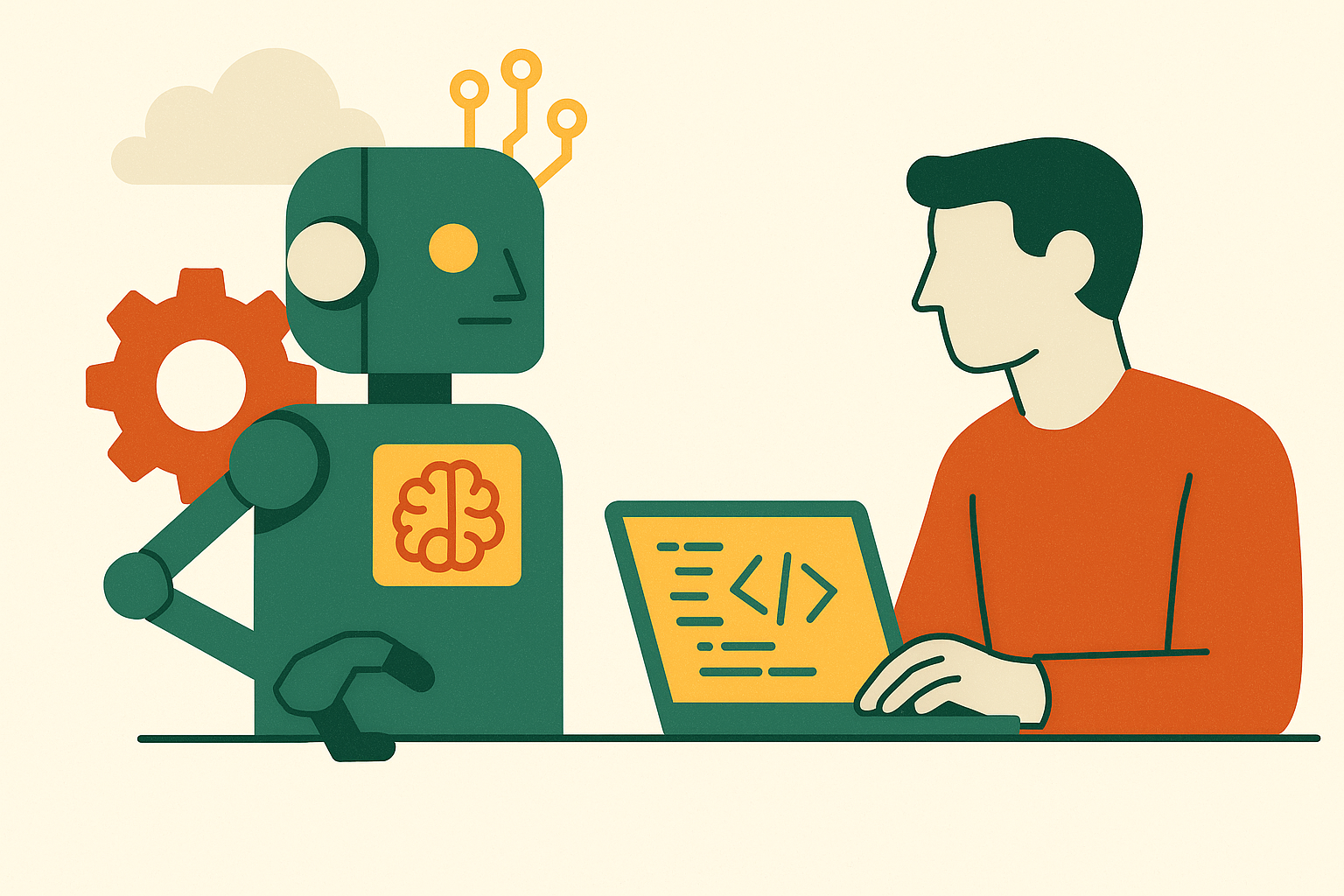
The distinction is this: augmentation keeps a human in the decision loop. Automation removes that checkpoint. Both are legitimate, both are useful, but they are not interchangeable. Treating them as if they are is where real, measurable risk quietly accumulates.
What These Words Actually Mean in Practice
Augmentation is a developer using an AI tool to draft a function, then reading it, evaluating it, deciding whether it ships. The AI is fast; the human is accountable. Automation is a pipeline that generates, tests, and merges without a person reviewing each artifact. The system is accountable, which means the design of the system is accountable, which means if the design has a gap, nothing catches it.
Neither mode is inherently better. But that is actually the wrong frame. The right question is fit: does the operating model of the tool match the nature and consequence of the task?
Code complicates that question in a specific way. Software is simultaneously a creative artifact and a logical system. It has to be readable, maintainable, and correct in ways that are sometimes only provable at runtime, under conditions nobody anticipated during development. That dual nature means the risk profile of AI involvement shifts enormously depending on where in the lifecycle you apply it.
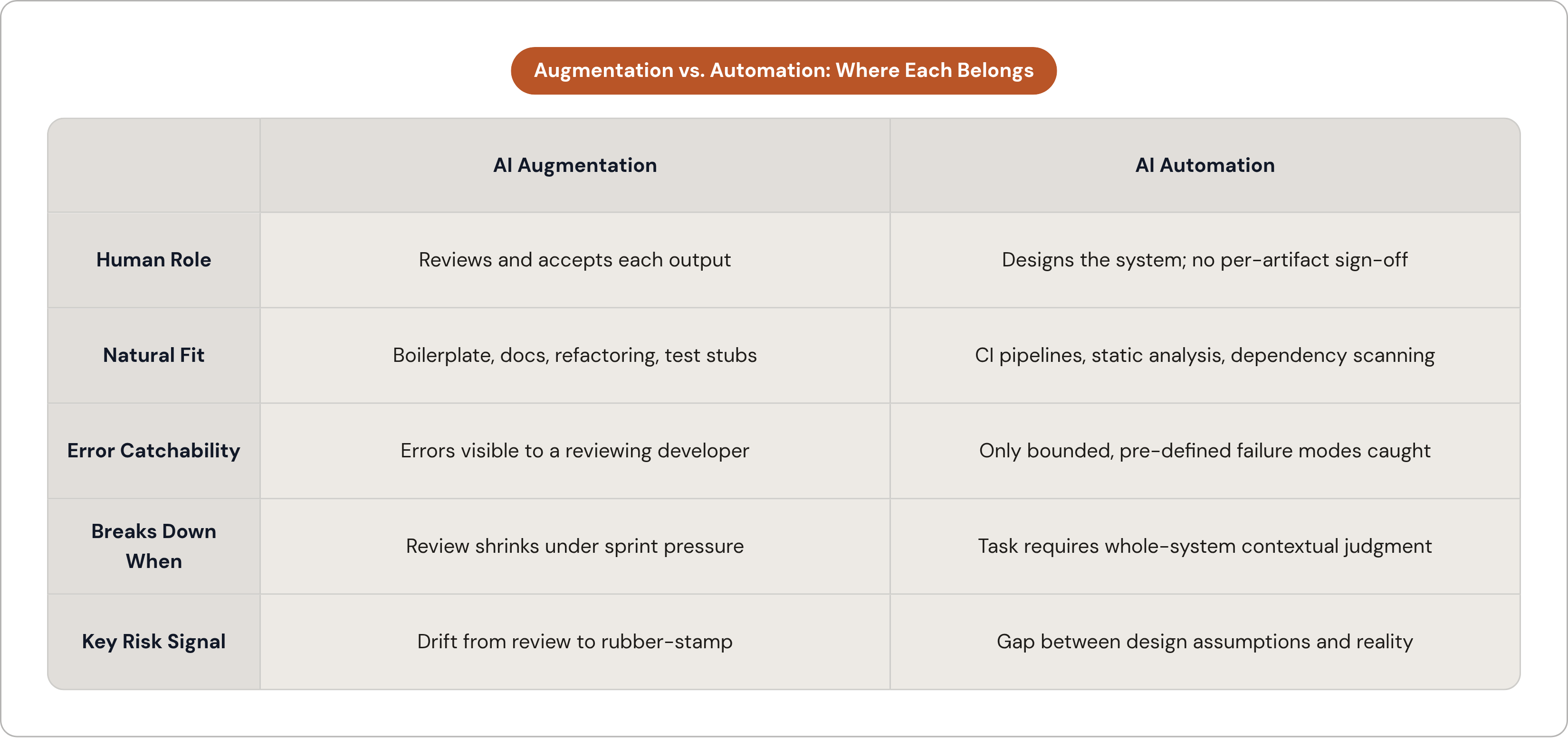
Where Each Mode Actually Belongs
Boilerplate generation, test stub creation, documentation drafts, refactoring to a known pattern: these are the augmentation sweet spot. High volume, lower consequence, and crucially, the errors are catchable. A developer reviewing AI-generated boilerplate will notice a misaligned type. A reviewer reading an AI-drafted doc will catch the conceptual gap. Human judgment is present; it is just applied to verification rather than origination. Editing is faster than composing from scratch.
Automation has its own natural home, and it is not as novel as it sounds. CI pipelines, automated test suites, static analysis tools, dependency scanners: these have been running without human sign-off on individual results for years. AI-powered automation is a continuation of that lineage, and the same design principles apply. Automation is appropriate when success criteria are precisely defined, when failure modes are bounded, and when volume makes individual human review economically impossible.
The breakdown comes at the boundary of contextual judgment. Automated scanners catch known vulnerability patterns. They do not catch an architectural decision that looks locally correct but creates an exploitable attack surface in combination with three other components, written six months ago, by a different team. That requires someone who understands the system as a whole. No ruleset encodes that.
The Drift Nobody Notices Until It Is Too Late
The teams that get hurt are rarely the ones that deliberately deploy full automation in reckless places. They are the ones that drift.
They start with augmentation, which is appropriate. Then, gradually, the review window shrinks. Cycle time pressure mounts. Developers begin accepting AI output with less scrutiny, not out of negligence, but because the last fifty outputs were fine and the sprint board is full. The workflow never formally transitions to automation. It just starts behaving as if it has.
That drift does not appear in your deployment frequency metrics. It does not register in sprint velocity. It accumulates in the delta between what the code does and what the team believes the code does.
I remember a specific moment that clarified this for me. A team I was working with, serious engineers, thoughtful about their process, had a production incident that traced back to an AI-generated data transformation function. The function had passed review. Technically, it had. But the engineer who approved it had spent maybe ninety seconds on it, because the surrounding functions all looked fine, because they were behind, because it was a Thursday afternoon. Nobody had made a policy decision to reduce oversight on data transformation logic. That decision made itself, one tired Thursday at a time, until there was effectively no oversight left. The failure was not in the AI output. It was in the quiet, undocumented reclassification of a high-consequence task as a low-consequence one.
A Couple of Ways to Actually Draw the Line
Here is a question I have found cuts through a lot of ambiguity: can a skilled senior engineer, shown only the AI's output with no knowledge of the prompt or surrounding context, evaluate its correctness with confidence? If yes, augmentation with review is defensible. If no, you either need to restructure the review so that context is explicit, or reconsider whether the task is suitable for AI involvement at your current tooling maturity.
The second lens worth applying is consequence asymmetry. Some errors are cheap: caught in review, fixed in the next commit, never touched a user. Others are expensive: production incidents, data integrity failures, security exposure, coordinated rollbacks across four services on a Sunday night. Tasks with expensive error profiles require stronger human oversight. The confidence level of the AI tool is not the relevant variable. The cost of being wrong is.
Tooling architecture matters here in a concrete way. Copilot and Cursor are designed to surface suggestions within a developer's active workflow, keeping the human as the accepting agent. Agentic systems built for longer autonomous runs demand correspondingly rigorous verification architecture wrapped around them. Some platforms, Blitzy among them, are built around batch-processing large-scale codebase development with structured human review checkpoints built into the model itself, a specific architectural response to exactly this tension. The choice of tool is less important than whether the tool's operating model matches the oversight model your team actually practices. That mismatch, more than any individual tool decision, is where risk hides.
What the Reliable Teams Actually Do
The teams I have seen ship consistently, with low defect rates and real velocity, share one discipline: they are explicit about where the human is in the loop, and they do not leave it to individual discretion under sprint pressure.
They have real arguments about which tasks qualify for automation and which require augmentation. They revisit those classifications as tooling matures and as calibrated trust in specific AI outputs accumulates through actual experience. They resist the organizational pressure to optimize purely for speed, because they understand what that optimization quietly trades away.
That explicitness is harder to maintain than it sounds. It requires a willingness to slow down the classification conversation so the development process can move faster with less hidden risk. Most teams skip the conversation because they are already behind on the sprint. That is precisely when skipping it costs the most.
The augmentation/automation question is, at its core, a question about where human judgment lives in your development process. Leave it unresolved, and you are not really managing AI risk; you are just deciding, passively, when it surfaces.