Application Modernization Strategy for Bootstrapped Products
Cutting through technical debt without venture capital requires choosing which pieces to fix first.

Application modernization is a $19.82 billion market this year, and MarketsandMarkets expects it to nearly double to $39.62 billion by 2029. But almost everything written about it assumes you have an IT budget, a dedicated engineering team, and years to run a phased program. That assumption doesn't hold for the 99.95% of startups that never raise venture capital, per Fundera's numbers, and this piece is about what modernization actually looks like when you're bootstrapped: no parallel engineering track, no pause button on feature work, and real users who showed up before the foundation was ready.
How technical debt accumulates differently when you ship to survive
Technical debt isn't a mistake. It's what happens when you build under deadline pressure with a small team and not much runway, and every shortcut you take to hit a launch date is a decision that nobody revisits, because once the product starts working, there's always something more urgent to build.
A few patterns show up over and over in early-stage products. No automated tests, because manual QA is faster when you're shipping your first version and don't have much to test yet. Hardcoded configuration and credentials, because it's faster to write and nobody's thinking about staging environments on day one. No real permissions system, just access checks scattered across individual screens, which means "let's add a new user role" turns into a multi-week slog once someone actually asks for it. And a data model that reflects whatever the first use case needed, not the second or third one that showed up later.
AI-assisted development adds a new wrinkle here. GitClear's 2025 research tracked the share of copy-pasted code lines rising from 8.3% in 2020 to 12.3% in 2024, a 48% relative jump. Over the same stretch, the share of code that got moved or refactored dropped from 24.1% to 9.5%, meaning teams are reorganizing and simplifying their code less than they used to, and an AI-built MVP can look polished on the surface while carrying structural weaknesses that only show up once real users start hitting it hard.
Here's the thing worth sitting with: technical debt, like financial debt, isn't automatically bad. Debt taken on deliberately, with some sense of when and how you'll pay it down, is often the right call. It's the debt nobody tracked, the debt with no plan attached, that turns into a problem, so the real question isn't whether you have debt. You do. It's whether you know when the interest payments start costing more than the shortcut ever saved you.
The signals that tell you modernization can't wait any longer
There's a specific stretch between MVP and scale where the same decisions that got you to your first users start working against you. Recognizing when you've entered that stretch matters more than any framework for what to do once you're there.
The warning signs tend to show up in a rough order. First, velocity drops: features that used to take a few days start taking twice as long, and nobody can quite explain why. Then regression bugs creep in, where fixing one thing breaks something else that seemed unrelated, and every release starts to feel like a small gamble. Somewhere around the same time, you'll hear your engineers describe the work as "fighting the codebase" instead of building on it, and the sharpest signal of all shows up soon after: a single broken user flow starts costing you customers. Reliability isn't a nice-to-have at that point, whether you've framed it that way or not — it's a growth lever.
The financial case for paying attention to these signals is not small. Deloitte's 2026 Global Technology Leadership Study estimates technical debt eats up 21% to 40% of total IT spending, meaning for every $100 a company spends on technology, somewhere between $21 and $40 goes toward servicing debt instead of building anything new. McKinsey's research adds a useful data point on the upside: companies that actively manage technical debt free up engineers to spend up to 50% more time on work that actually generates value, and the companies carrying the least debt see revenue growth roughly 20% higher than their peers.
For a bootstrapped founder, that math gets compressed into a much smaller window. SaaS gross margins typically run 70% to 85%, so there's some room to reinvest, but only if that reinvestment is deliberate rather than reactive.
One more trigger worth naming directly: AI. Agents and AI features don't quietly work around a fragmented data model the way a human user might — they fail visibly, in production, often faster than you'd expect. If you're planning to add AI-driven features to a product sitting on inconsistent data, that reckoning tends to arrive sooner than planned.
Once these signals show up, the question isn't whether to modernize anymore. It's what to modernize first, given what you actually have to work with.
The sequencing logic: what to modernize first when you can't modernize everything
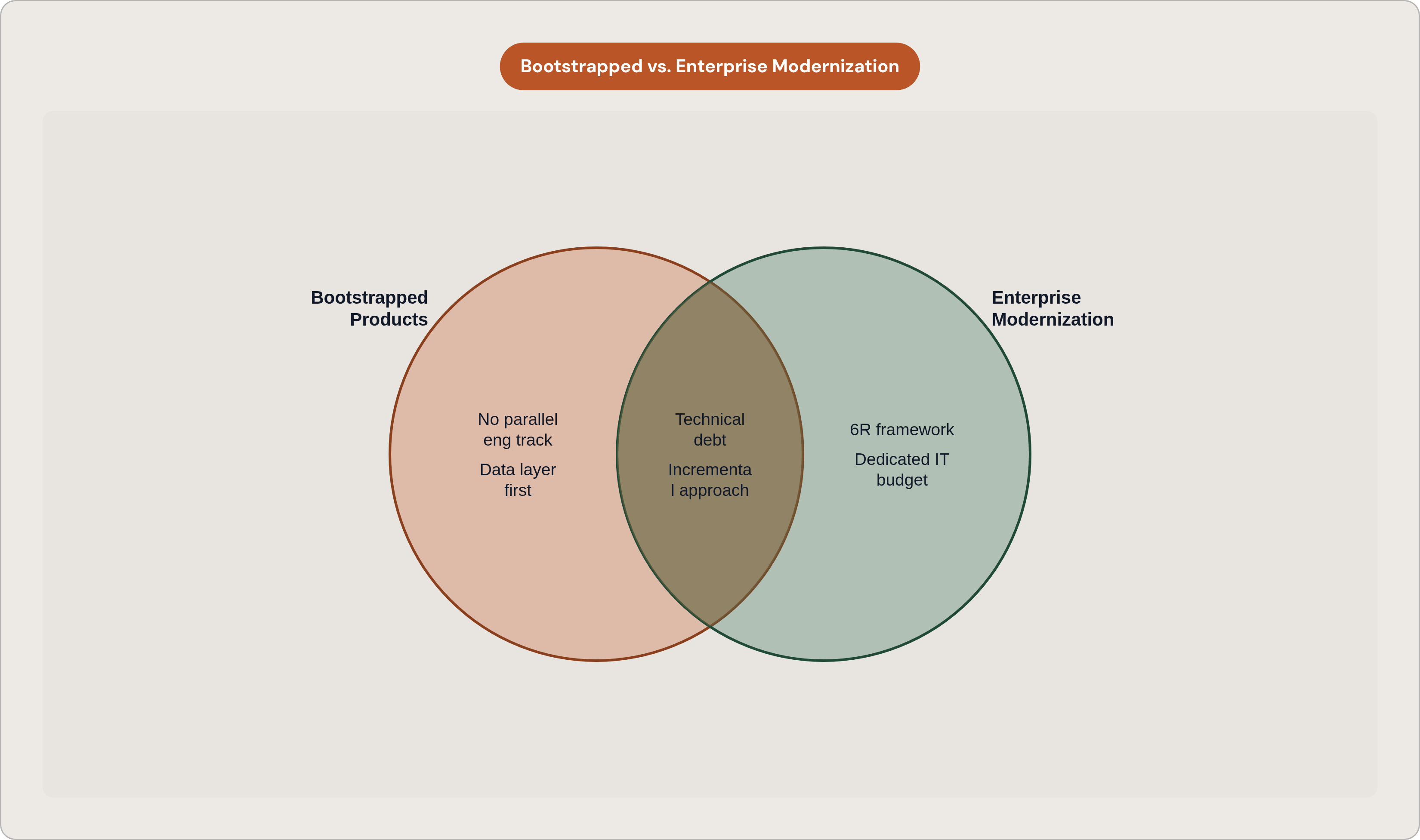
A full rewrite sounds appealing when the codebase feels broken, but it's expensive, slow, and risky in its own right: you're rebuilding things that already work while hoping nothing breaks in the process. For a bootstrapped product, a full rewrite is rarely the right call.
The better principle: target the specific things blocking whatever's coming next, whether that's a scaling event, a new user segment, or a key integration, and let the rest of the roadmap keep moving around it.
In practice, that looks like a rough hierarchy. Stabilize what's actively breaking in production first; anything causing customer-facing failures or data loss doesn't wait, full stop. Next, clear the debt that's standing between you and your next growth move — if your next milestone needs a new user role, a payment integration, or a third-party API, and your current architecture makes that hard, that's your target. After that comes the foundation for repeatability: automated tests, separated environments, real configuration management, the stuff that stops every release from being a coin flip. Structural refactors and deep data model cleanup come later; important, yes, but survivable to defer while you handle what's actually blocking you right now.
The standard "6 R" framework you'll see in enterprise modernization literature (rehosting, refactoring, rebuilding, and its variants) was built for enterprise portfolios with dedicated teams managing dozens of systems. For a bootstrapped product, the question is simpler than any framework needs to make it: does this change lower the risk of your next release, or does it unlock your next revenue milestone? If it doesn't do either, it can probably wait.
What "incremental" means in practice: find the module or service causing the most friction right now, modernize it behind the existing interface so the rest of the product keeps running, ship it, validate that it actually helped, then move to the next target.
Zoho and Atlassian both stayed bootstrapped for years before scaling, and both had to make exactly this kind of staged call as their user bases grew. Atlassian ran 40 consecutive profitable quarters before ever taking outside capital, which says something about what deliberate constraint management looks like over a long stretch of time.
This sequencing logic doesn't stop at code. It applies just as directly to tooling, especially the data layer, which tends to be where bootstrapped products are most exposed.
When the data layer is the bottleneck: moving beyond spreadsheets and Airtable
For a lot of bootstrapped products and nonprofits, the data layer is where technical debt is easiest to see and hardest to live with. An Airtable base built for one specific use case. A Google Sheet quietly running an entire operational workflow. No single place anyone can point to and say "that's the source of truth."
None of that is a judgment call gone wrong. It's what happens naturally when you build fast with accessible tools, because Airtable and Sheets are genuinely good tools for getting something running quickly. The trouble starts when those tools become load-bearing infrastructure for a product that's outgrown them.
A few signs the data layer has become the bottleneck: automation breaks the moment someone renames a field. Multiple team members are manually keeping duplicate records in sync. Reporting means exporting to yet another tool because nothing lives in one place. Onboarding a new type of user means rebuilding views across three or four different bases by hand.
The fix isn't always "rip out Airtable and build a real database." Sometimes it's restructuring what's already in Airtable so it actually holds together, and sometimes migrating to something more structured genuinely is the answer. Worth evaluating on their own merits: Grist, an open-source tool with a spreadsheet-familiar interface but a real relational data model underneath, well suited to teams that want control and self-hosting, including nonprofits with real data privacy concerns. SmartSuite, which sits closer to Airtable in feel but leans harder into workflow automation. Notion databases, which work fine for early-stage content and light data management but aren't built for operational data at real scale. And, when data volume or permissions complexity or integration needs have genuinely outgrown no-code tools, a purpose-built internal tool or lightweight web app backed by an actual database.
The same modernization principle applies here as anywhere else: don't try to migrate everything at once. Find the one workflow causing the most operational pain and start there.
This matters especially for nonprofits. Recent research puts the number of nonprofit leaders who believe they're using technology in advanced ways at just 19%. The data layer is often the first place, and the highest-leverage place, to start closing that gap.
The nonprofit operating reality and why standard modernization advice doesn't fit
Nonprofits deal with the same MVP-to-production gap as any bootstrapped startup, plus a few layers of structural weight on top. Staff wear multiple roles at once; the person managing the CRM might also be running programs on the ground. There's no dedicated technical staff to own a modernization plan even if one gets written, and funding cycles rarely line up neatly with technology investment timelines. Rising operating costs have squeezed whatever budget might have gone toward modernization even further.
The technology gap here is structural, not a matter of attitude or effort. It's common to find staff using personal email for organizational communication, documents scattered across personal cloud storage accounts, no centralized place for collaboration, and informal or nonexistent policies for handling sensitive community data. Many nonprofit leaders point to siloed data, a lack of technical expertise, and limited training capacity as the main roadblocks standing between them and digital transformation.
And the AI adoption gap is opening up fast. Recent reports indicate nonprofit AI adoption has grown sharply in recent years. That's a real jump, but adoption without a solid data foundation underneath it tends to produce fragile, unreliable results, which raises the stakes on getting the foundation right first.
The sequencing framework from earlier still applies, with one adjustment. For a nonprofit, "what blocks the next growth move" often becomes "what's creating the most staff burden right now," and automating manual data work is usually the highest-leverage place to start.
This pattern shows up repeatedly in practice: manual tools spread across disconnected systems, staff time going into data management instead of program delivery, and an entry point for modernization that starts with consolidating the data layer rather than rebuilding the whole stack.
Mission-driven organizations need a technology partner who actually understands budget constraints, grant cycles, and the real cost of disrupting staff mid-program, not one who hands over an enterprise roadmap and moves on to the next client.
What it actually costs to modernize incrementally, and what it costs not to
Start with the cost of doing nothing. IBM's research found a typical organization spends just 23% of its tech budget on work that actually generates revenue; the rest goes toward maintaining and fixing what's already there. For a bootstrapped team operating on thin margins, that ratio isn't just inefficient — it's close to existential.
For scale, some rough benchmarks (these are not enterprise-size figures): system replacement, migration, and training for a modernization project typically runs $60,000 to $155,000. Annual savings from Year 2 onward, combining reduced maintenance with productivity gains, usually falls between $60,000 and $135,000, with payback landing somewhere between 12 and 36 months depending on scope.
Deloitte's modeling found infrastructure modernization cuts technical debt by about 18% over five years, while data transformation produces a 52% improvement in latent potential over that same stretch. That gap says something important: the data layer is often the higher-leverage place to put your first dollar, not the infrastructure layer.
The incremental approach shrinks these numbers considerably. Modernizing the one module or workflow causing the most friction costs a fraction of a full rewrite, and it can pay for itself within a single product cycle rather than several years.
Here's the reframe worth holding onto: this isn't really an infrastructure cost. It's the cost of getting engineering off the critical path so you, as the founder, can spend your time on go-to-market instead of putting out fires in production. That shift in how engineering time gets spent is ultimately what modernization is buying.dicts that by 2025, organizations that formally track their Technical Debt Ratio will ship new functionality 35% faster than those that don't. Measurement, it turns out, is the first real step toward treating your backlog as a business asset instead of a liability that just keeps growing quietly in the background.
Choosing a modernization partner when you don't have an internal engineering team
Here's the trap that catches most bootstrapped founders: modernization stalls out not because nobody wants to do it, but because there's no one inside the company to actually own it. The plan sits in a backlog, and it never becomes a sprint.
A few things worth looking for in a modernization partner. Real experience with bootstrapped or resource-constrained products specifically, not just a portfolio of enterprise migrations. A willingness to work incrementally, module by module, rather than insisting on a full-scope engagement before anything starts. Someone who stays involved after the initial work wraps, because a model where a team hands off a deliverable and disappears just puts you right back in firefighting mode within a few months. And a partner who understands that the actual goal is freeing you from engineering decisions, not creating a new dependency that looks a lot like the old one.
It's worth addressing the technical co-founder question directly, because it comes up often. Most bootstrapped founders don't actually need a technical co-founder — what they need is someone who owns engineering decisions so they can fully own go-to-market. A long-term partner with real ongoing accountability can fill that role, without the equity cost or the hiring risk that comes with bringing on a co-founder.
Price shouldn't be the deciding factor here, and it's worth saying plainly: the cheapest modernization engagement on the table is rarely the right one. What matters more is whether the partner's incentives line up with yours, whether they understand what it actually means to build under real constraints, and whether they're still going to be there six months from now when the next bottleneck shows up.