Retainer vs Project-Based Contracts for Ongoing Engineering Support
Retainers lock in institutional knowledge; project contracts reset context with each phase.

A retainer is a recurring fee, paid monthly, for one of three things: a reserved block of hours, a defined set of outcomes, or standing access to a team. Most terms run three to twelve months, and shorter terms buy you flexibility but cost more per month, while longer commitments usually get you a better rate and a steadier team, since your partner isn't reshuffling engineers onto someone else's fire drill mid-sprint.
Retainer rates typically land 10 to 20% below project rates per hour. That's the trade: the partner gives up some margin for income certainty, and you get priority access plus a team that isn't quietly pricing out your replacement while your project winds down.
One thing worth settling early is what happens to unused hours. Use-it-or-lose-it versus rollover sounds like a footnote, but it shapes how a team plans sprint capacity. I'd push hard on this one before you're three months in, staring at an invoice, wondering where the hours went.
Project-based contracts work differently. Scope, deliverables, and timeline get fixed upfront, with payment tied to milestones or a lump sum at the end. Anything outside that scope needs a change order, which is really just a renegotiation in disguise, and it stalls momentum. It usually carries a price bump too, since the partner is pricing in work they didn't originally plan for. Once the deliverables ship, though, the relationship ends clean, with no lingering obligation either way.
Revenue leakage, meaning work delivered but never billed properly, is meaningful industry-wide according to recent benchmarking, and it cuts both ways on a retainer. Watch for overbilling on scope that was never pinned down. But also watch for underbilling, which quietly makes the retainer unsustainable for the partner and drags down the quality of who they staff on your account.
How scope creep and institutional knowledge tip the comparison
Scope creep is where project contracts show their age. Standish Group's CHAOS research has found scope creep hitting well over half of all projects, with less than a third finishing on time and on budget. That's not an edge case; that's the median outcome.
Every change order resets the negotiation. It breaks whatever momentum the sprint had, and it comes with a price nobody budgeted for at the start. A retainer handles scope evolution differently: new work gets absorbed into the next sprint through redirected priority, not a fresh negotiation or a pause in delivery.
Institutional knowledge runs the opposite direction, and it compounds. A partner embedded in your product for months starts to actually understand your users, your data model, the edge cases nobody ever wrote down, the design call that made sense at 2am in March but looks strange now. None of that transfers cleanly through a handoff doc. I've read plenty of handoff docs, and they always miss the one thing that actually matters. That accumulated context means faster execution and fewer rounds of revisions over time. When a project ends, all of it walks out the door with the team, and the next vendor starts from zero.
So the asymmetry is real. Scope creep punishes project contracts hardest, while institutional knowledge rewards retainers most, and both effects grow the longer the relationship runs.
Retainers aren't immune to their own failure mode, though. Vague scope on a single project is annoying enough on its own, but spread across twelve billing cycles, that same vagueness quietly drains margin through ad hoc meetings and undefined support nobody agreed to pay for. The fix is a backlog, reviewed regularly, so both sides know what's actually being worked on instead of a contract trying to cover everything in vague language.
Why the MVP-to-production transition changes the contract calculus entirely
Building an MVP and running a live product are two different jobs, and it's worth being honest about that instead of pretending one contract fits both. An MVP can be scoped: defined features, a defined timeline, a defined deliverable. Project contracts work cleanly here because the work is actually bounded.
Post-launch is a different animal entirely. Dependency updates, bug fixes, performance regressions, feature iteration, security patches: none of that fits into a fresh project scope, because none of it is a project. It's ongoing operations, and it behaves like ongoing operations.
Once real users show up, "good enough" stops being good enough. The engineering work that follows doesn't look like a project anymore; it looks like keeping the lights on while also building whatever comes next. A founder who tries to run that through a string of project contracts ends up paying a premium on each one, restarting context every single time, and losing the compounding benefit a partner who actually knows the codebase would give them.
A few production-readiness signals are worth building into the contract at this stage, regardless of which model you pick:
- Structured logs with a request ID that propagates across service boundaries, so you can trace one user's request through your whole system.
- Metrics covering latency, traffic, errors, and saturation, the four golden signals.
- Traces covering, at minimum, your critical user paths.
That's the baseline for knowing your product broke before a user has to tell you.
If your product direction is still shifting, and that describes most early-stage SaaS and AI products I've worked with, locking into fixed-price contracts too early creates friction every time the roadmap moves. A retainer absorbs that evolution without a renegotiation every quarter. This is exactly the situation QUWA gets called into: founders who shipped something fast with AI tools or a freelancer, and now need it rebuilt for production reliability. That's an ongoing relationship, and the retainer model fits it structurally, not just conveniently.
Technical debt as the variable that makes the contract choice economic, not just structural
The scale of technical debt globally is hard to hold in your head. CAST's research on billions of lines of code puts global technical debt in the tens of billions of workdays in repair time. Accenture's Digital Core research puts the annual cost to U.S. companies in the trillions. These are abstract numbers, until you look at what they mean for a ten-person team.
Developers at the average company spend roughly a third of their time dealing with technical debt instead of shipping new features. On a ten-person engineering team, that's more than three full-time engineers consumed by overhead that never shows up on a roadmap. McKinsey has found teams carrying high technical debt running about 30% slower than teams managing it actively. That's a third of your velocity gone, and it's not a rounding error.
AI-assisted development seems to be making this worse, not better. GitClear's research tracked the share of copy-pasted code climbing sharply over the past few years, while moved or refactored lines dropped by more than half over the same stretch. Codebases are getting reorganized and cleaned up less often, even as the volume of code written keeps climbing. Sit with that for a second: more code, less refactoring.
This is where the contract model stops being a philosophical question and turns into an economic one. Under a project contract, debt risk lands squarely on the client. A feature that should take three days takes two weeks because the data model is fragile and the edge cases were never written down anywhere, and the founder eats that as an overrun or a change order. Under a retainer, an embedded partner has both the context to know where the debt actually lives and the incentive to chip away at it inside normal sprint cycles, instead of letting it pile up until it becomes an emergency.
Accenture's research suggests allocating something like 15% of IT budget to debt remediation as a baseline. That number only makes sense, though, if your engineering relationship is structured to actually use it. A one-off project has nowhere to put that 15%, while a retainer does.
When a project-based contract is actually the right choice
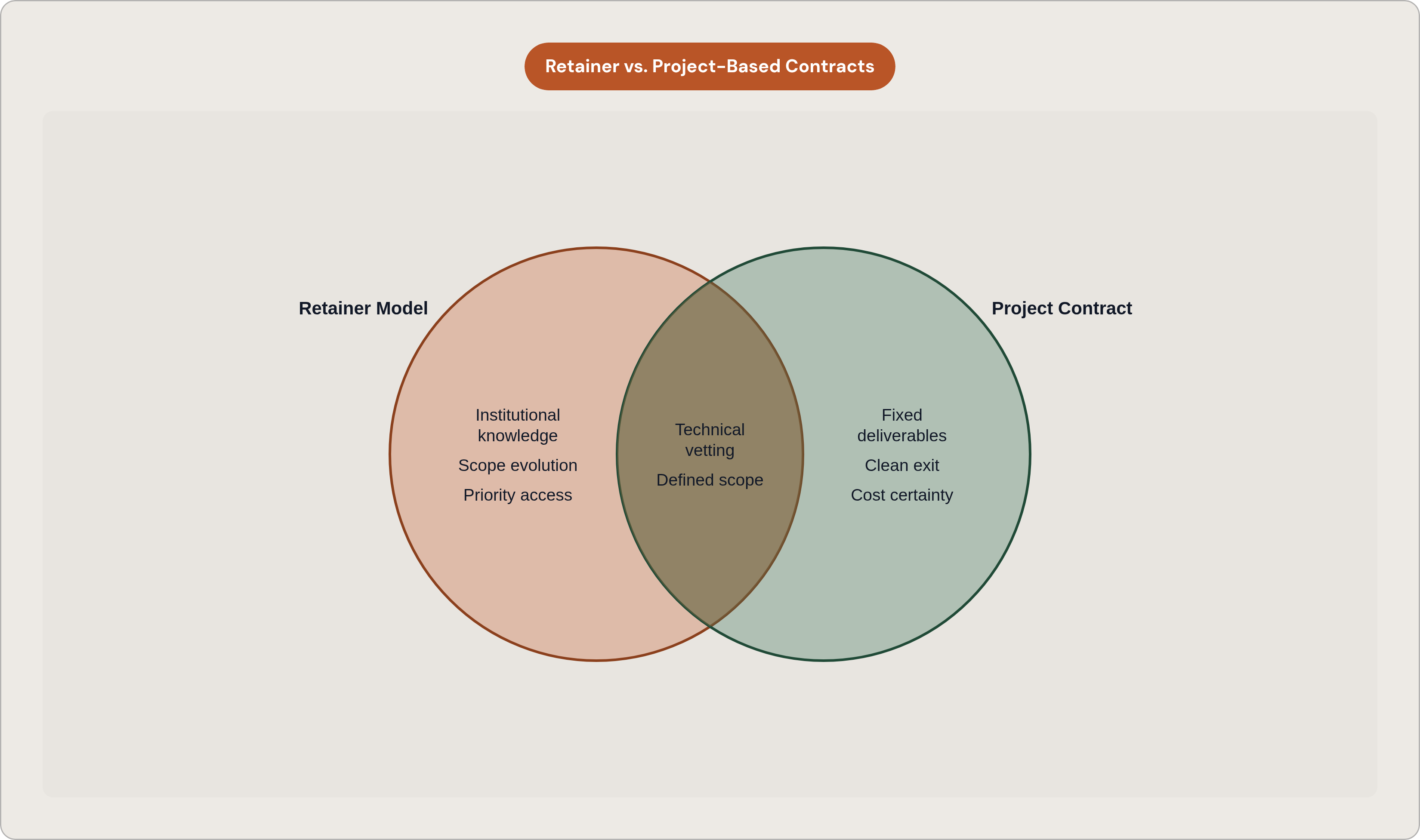
None of this means retainers win by default. Project contracts are the right call when the work is genuinely bounded, and pretending otherwise just adds contract complexity nobody needs.
A defined audit or discovery phase is a good example: an architecture review, a security assessment, a technical debt inventory, each with a clear input and a clear output. A one-time build where scope is stable and you've got internal capacity to maintain it afterward fits too. So does a specific integration or feature with hard edges that isn't going to change shape six weeks in.
There's also a legitimate "test drive" case here. Working with a partner on a project basis first lets you evaluate their technical judgment, how they communicate, whether the working relationship actually feels right, before committing to anything ongoing. The project becomes due diligence as much as a deliverable. That's a smart way to de-risk a longer commitment.
Sometimes, though, the honest answer is that you don't know yet whether you need ongoing support. Forcing a retainer onto a product that might not need monthly engineering attention wastes money for both sides. The partner staffs for work that doesn't materialize, and you pay for access you're barely using.
Project contracts offer a clean exit, cost certainty per engagement, and zero obligation to keep going. These are real advantages, when the situation is actually bounded. But watch for this signal: if you find yourself commissioning a third, sequential project with the same partner, your workflow is already behaving like a retainer, minus the structural benefits that would come with one. That's the moment to renegotiate.
The hybrid structure most engineering relationships actually converge on
Most experienced partners land on the same pattern eventually. A fixed-fee project for the initial build, audit, or migration, then a transition into a monthly retainer for maintenance, iteration, and new feature work. It reflects something simple: the two phases of a product's life need different structures.
The project phase gives you cost certainty and a defined deliverable when scope is genuinely knowable, which it usually is before launch. The retainer phase absorbs everything after: the bug that only shows up at scale, the feature request that comes from actual users instead of a spec doc, the dependency update that can't wait a quarter. None of that fits cleanly into a new project scope. Trying to force it there just recreates the change-order problem, over and over.
A couple of more advanced variations are worth knowing. Tiered pricing with growth triggers ties scope and fee adjustments to business events, like a funding close or a new market launch, so the retainer scales without a full renegotiation every time something changes. A defined exit clause, commonly around 60 days, paired with explicit KPIs, protects you from feeling locked in while giving the partner enough runway to actually deliver instead of scrambling to prove value in week one.
The market's been moving this direction for a reason. Recent industry surveys put retainers as the primary model for a strong majority of agencies now, up sharply from just a few years back. Agencies with retainer-heavy revenue report meaningfully more predictable monthly income, and retainer clients tend to carry a lifetime value several times higher than one-off project clients. That matters to you as a founder in a way that isn't obvious at first: a partner's financial stability directly affects whether the same team stays on your product for a year, or scatters to whatever project pays next.
What distinguishes an engineering partner from an agency in this context
A retainer with the wrong partner doesn't fix anything. It just locks in mediocrity on a recurring billing cycle, which might be worse than a bad project, because now it's a bad project every month.
The real distinction is what the partner does with the relationship. An agency delivers what's requested. An engineering partner shapes technical direction and flags the problem you didn't know to ask about, because they've been in your codebase long enough to see it coming. When a project-based agency exits, whatever they learned about your product leaves with them. An embedded partner's entire value rests on that knowledge sticking around.
There's a structural difference worth understanding too: staff augmentation versus a managed engineering partner. Staff augmentation adds individual engineers onto your internal team, and you're still running sprint planning, code review, task assignment, quality checks. A retainer-based engineering partner takes on managing the team and the delivery process itself; you set product direction and priorities, they handle the how. For a founder without a technical co-founder, that second model is the more practical one, since it lets you own the roadmap instead of running engineering day to day.
One vetting question worth asking directly: will the partner share their client retention rate? That number tells you how much product context tends to survive over time, and a high retention rate is a decent proxy for whether a studio is built for long relationships or just structured to land the next deal. QUWA is one example of a studio built around this model: rebuilding products on a stable foundation, then staying on through an ongoing maintenance plan, acting as the technical partner so the founder can spend time on go-to-market instead of firefighting production issues. Values alignment gets treated as an actual selection criterion there, not a line in a pitch deck.
The questions a founder should answer before choosing a contract model
This isn't a checklist to run through mechanically. It's a short set of honest questions about where your product actually stands.
Is the scope of work genuinely bounded, or will it keep evolving as users show up and the market responds? Bounded work points toward a project, while evolving work points toward a retainer, because otherwise you're renegotiating constantly.
Does the product need engineering attention continuously, or in defined bursts? Continuous need is a retainer conversation, while well-defined bursts of work are a project conversation.
Do you have internal technical capacity to manage delivery, or do you need a partner who manages the engineering process itself? That answer alone often decides between staff augmentation and a managed partner relationship.
And underneath all of it: are you optimizing for the lowest cost on this one engagement, or for a partner who understands your product well enough, six months from now, to catch the problem before your users do? That's really what the whole comparison comes down to. Quwa Labs, a product engineering studio that rebuilds early-stage products for production reliability and stays on as a long-term technical partner, is one place founders land when they reach that question.