Engineering Partner vs Freelancer vs Agency for Early-Stage Startups
Each model solves a different problem, not a quality hierarchy.

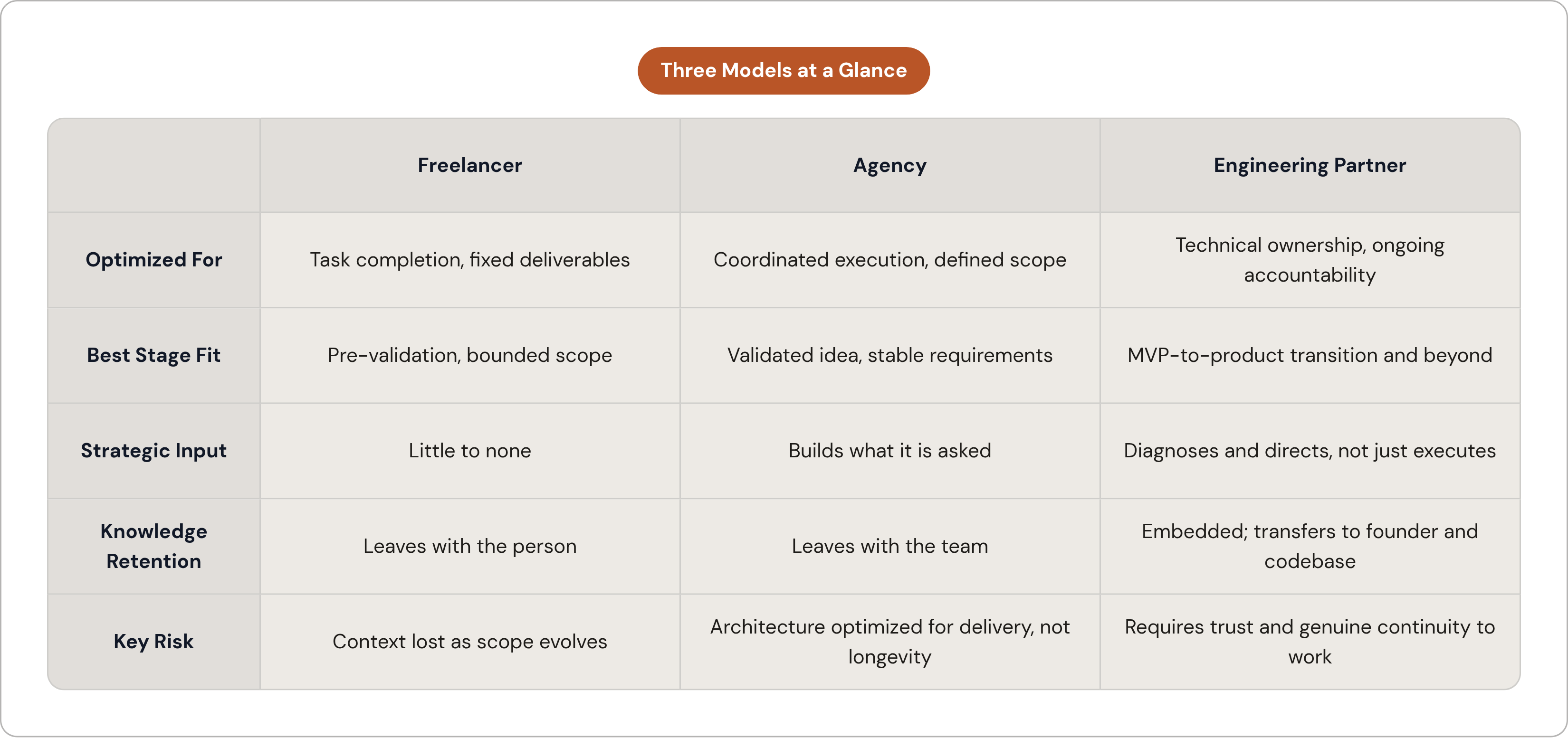
These three models are not tiers on a quality ladder. They are structural answers to different questions, and confusing the structure is more expensive than getting the rates wrong.
Freelancers are individuals hired for a defined deliverable against a defined scope. They are optimized for task completion, not product ownership. Even a senior full-stack contractor carries blind spots, usually across DevOps, security hardening, and performance at scale, because no single person covers the full stack at real depth. When the scope ends, the context walks out with the person. That is not a flaw in the model; it is the model.
Agencies are coordinated teams: developers, designers, QA, a project manager. Their strength is execution across a defined scope with built-in specialization. The problem is that agencies are excellent execution resources and are rarely configured for strategic ownership. They build what they are asked to build. The incentive structure does not reward telling a client their requirements are wrong, and when the engagement closes, the institutional knowledge of why things were built a certain way leaves with the team.
Engineering partners, including fractional CTO arrangements, embed inside the organization. They attend standups, live in the same channels, take ownership of technical outcomes rather than deliverables. The goal is a product that can eventually run without them, and a team capable of running it. That is a different relationship than a co-founder on the cap table, but it rhymes with one in the ways that actually matter day to day.
The hybrid that appears less often than it should: an engineering partner overseeing an agency, senior judgment directing execution capacity. For pre-Series A companies not yet building a full in-house team, this combination is frequently the most functional structure available. Founders frame the decision as either/or, which is how they end up with too much execution and not enough direction, or the reverse.
When a Freelancer Is the Right Call and When It Stops Being One
Freelancers earn their place in a specific window. The product is still a hypothesis. The scope is clearly bounded. Speed and flexibility matter more than continuity. In that window, they make complete sense: a landing page built to test demand before committing to a real build, a single-feature prototype assembled to show investors something tangible, a defined integration on a product already owned and managed by an in-house team.
The trap that catches a lot of founders is conflating a freelancer's rate with their actual cost. A lower-rate contractor requiring constant direction can consume more founder time and produce more rework than a more expensive one who works independently. The hidden cost is founder bandwidth, and in the early stages, every hour spent on coordination is an hour not spent talking to customers. That is the trade that actually kills companies, not the invoice.
The model breaks in predictable ways. When scope evolves mid-build, freelancers optimized for fixed deliverables struggle with moving targets. When the product needs cross-functional depth simultaneously across frontend, backend, and DevOps, no single person covers that at depth. And when real users arrive, reliability expectations shift from "works in a demo" to "works under pressure, consistently," and those are meaningfully different bars.
The signal that the window has closed is usually this: you are spending more time coordinating and reworking than you are learning from users. Most founders miss it because the cost accumulates gradually rather than announcing itself.
When an Agency Fits and What to Watch for When It Doesn't
The agency's core value is coordinated execution across a defined scope. The quality difference between a solo developer and a coordinated team shows up in exactly the places early users notice most: load times, payment reliability, error handling. Not glamorous features, but the ones that determine whether a user comes back.
The model works when the idea is validated and requirements are documented; when the founder has enough technical context, or an advisor who does, to evaluate what is being delivered; when the scope is stable enough that mid-engagement pivots won't blow the retainer or reset the architecture.
Where agencies create problems for early-stage startups is more structural than personal. When requirements are unclear, the agency builds what it is asked to build, not what the product actually needs. Architectural decisions optimize for project completion rather than long-term maintainability, because a coherent codebase for the next engineer to inherit is not their primary incentive. Retainer structures commit the founder to significant monthly spend regardless of whether that month's output matched its cost. When the engagement ends, the reasoning behind key decisions goes with the team.
A recognizable red flag: multiple agencies making conflicting architectural decisions with no one arbitrating between them. A fragmented tech stack is a predictable outcome when execution capacity is hired without strategic leadership above it. This is not an indictment of agencies. It is a structural observation about what they are not configured to do.
The Vibe-Coded MVP Is Its Own Category of Problem Now
AI coding tools created something new: the ability for a non-technical founder to ship a working product in days. That is a real unlock. A meaningful share of recent Y Combinator batches shipped codebases that were substantially AI-generated, and the growth reflects something true about what these tools make possible.
The problem surfaces at scale. Audits of AI-generated codebases consistently reveal a recognizable cluster of issues: inconsistent architecture, missing error handling, no testing infrastructure. Security vulnerabilities appear at meaningfully higher rates than in human-written code, not because AI is uniquely careless, but because it optimizes for the happy path. It produces code that works under the conditions it was tested in. It does not anticipate the conditions it was not.
These issues are essentially invisible during validation. They become acute the moment real users arrive in volume.
What makes the vibe-coded MVP its own category is that it does not fit cleanly into the standard freelancer or agency model. A freelancer hired to add features on top of a vibe-coded base inherits the debt without a mandate to address it. An agency scoped to build new features will build them on the same unstable foundation. Neither is structurally positioned to say "we need to rebuild this before we add anything else." That sentence requires both the authority and the continuity to follow through on it.
The straightforward framing for founders in this position: launching was the right call. The harder question is whether the foundation can carry the product where it needs to go. That is a different question from "what feature should we build next," and conflating the two is how teams end up firefighting production while competitors are shipping.
QUWA Labs works specifically with founders at this juncture, not patching on top of the original build, but re-engineering on a foundation capable of supporting real users and a real roadmap, then staying on as a long-term partner through what comes next.
Technical Debt at the Transition from MVP to Real Product Is the Moment the Model Choice Becomes Consequential
Here is what I have watched happen repeatedly: founders who find early traction build on top of the MVP rather than rebuilding it. The short-term logic is sound. The long-term outcome often is not.
A small senior team that knows the codebase can paper over weaknesses with targeted fixes, for a while. As the team grows or changes, institutional knowledge disperses; the workarounds become load-bearing infrastructure. Eventually the low-quality MVP becomes core architecture with no clear path to replace it. Martin Fowler described this dynamic precisely: technical debt is not a one-time mistake but a compounding structural condition, and by the time it feels urgent, it has usually been expensive for some time.
The concrete cost: teams carrying heavy debt spend a disproportionate share of engineering time on maintenance and fire drills rather than product development. For a startup, that is not an efficiency loss. It is a growth blocker. Gartner research suggests a significant portion of startups using no-code tools rebuild their MVP within a couple of years. The rebuild was coming. The question is whether it happens on the startup's terms or the product's.
What this means for the model decision is specific. Whoever is responsible for the product at the transition moment needs both the authority and the continuity to say "we stop here and fix the foundation." A deliverable-oriented engagement cannot produce that, because the incentive points toward shipping the next feature. No one in a task-completion arrangement has the standing to call a halt before a broken flow costs a real customer.
How to Match the Model to Where the Product Actually Sits Right Now
The mapping is not rigid, but it holds up under pressure.
Still validating, testing whether real people want this thing: a freelancer or an AI-assisted build for a bounded deliverable. Keep spend low, learn fast. Speed to signal matters more than code quality here, and over-engineering for scale that never comes is the specific failure mode to avoid.
Found traction and rebuilding for real users: an engineering partner with ongoing accountability, someone who can audit the existing build, make the rebuild case clearly, and own the outcome past the handoff. Continuity and the willingness to say the hard thing about the codebase matter more at this stage than any individual technical skill. Adding features on top of an unstable foundation, or hiring an agency without anyone arbitrating architectural decisions above it, is what goes wrong. QUWA Labs works specifically at this stage, re-engineering on solid foundations with an ongoing maintenance relationship, so founders can stay focused on go-to-market instead of firefighting production.
Scaling deliberately, with a stable product and growth as the constraint: the right model depends on whether the gap is execution capacity (an agency makes sense), strategic leadership (an engineering partner or fractional CTO), or both (the hybrid structure). Clear ownership of technical direction, not just delivery, is what the stage requires.
The non-technical founder's specific risk runs through all three stages. Without someone who can evaluate what is being delivered, any model can fail. The engineering partner model addresses this structurally because the partner's role includes translating technical reality into founder decisions, not just executing them.
What a Long-Term Technical Partnership Actually Looks Like in Practice
Most founders approach this decision as a procurement question: who can build this fastest, cheapest, most capably? That framing is the first mistake. The engineering model you choose is a product strategy decision, and the variable that actually determines whether it works is continuity, specifically who owns your product's technical direction between now and your next milestone, and what happens to that ownership when the engagement ends.
The structural difference that matters most is presence. The partner attends standups, lives in the same channels, owns technical outcomes rather than deliverables. That means they are there when scope shifts, and they can course-correct before a decision becomes a constraint. That presence is not a courtesy; it is the mechanism by which the model works.
What stays after the engagement differs in ways that compound over time. With an agency, you have deliverables, a codebase, and documentation if it was scoped into the contract. The reasoning behind architectural decisions lives in the agency's team and leaves with them. With an engineering partner, you have an architecture the founder understands well enough to make decisions about, a codebase the next hire can actually work in, and a relationship that can flex as the company's needs change.
The practical markers of a real partnership versus a vendor relationship are not subtle. The partner tells you things you do not want to hear about the codebase, not just what you asked them to build. The engagement structure allows scope to evolve without renegotiating the relationship from scratch. There is a shared view of what the product looks like in twelve months, not just what ships next sprint.
The founders who grow fastest have asked a different question than freelancer versus agency: not who can build this, but who will own it with me. Trust and preference shape that choice, but the distinction is structural before it is personal. It does not optimize for the cheapest sprint. It optimizes for the right next twelve months, which is where most early-stage companies actually win or lose.