Red Flags in a Software Development Proposal
How to spot whether a vendor has actually thought through your project or is just hoping to wing it.

A software development proposal is a document, and it's also a test. It tells you how a vendor thinks under pressure, before any pressure actually exists yet. Most founders read it for the number at the bottom. That's a mistake, one that shows up later as a missed launch date or a codebase nobody can explain.
Here's the thing about a proposal: it's written before a single line of code exists, before any real trade-off has forced anyone's hand. It's the vendor at their most composed, with time to think and no client breathing down their neck yet. So if the thinking is sloppy here, in the one moment where sloppiness has no excuse, what happens once things get hard? I've seen this play out enough times to trust the pattern: a large share of software projects miss their original scope, timeline, or budget, and the causes for most of those failures start well before the first sprint. They start in a document that got skimmed and approved in an afternoon.
Non-technical founders are especially exposed here. You often can't audit a stack diagram or push back on an architecture decision. What you can read is whether someone communicated clearly, structured their thinking, and answered the hard question instead of dodging it. For a lot of founders, that's the only form of due diligence available, and it happens to be a good one.
What a proposal that skipped discovery actually means
If you send a brief and get a full proposal back within a day or two, with no real questions asked, something's off. That vendor isn't pricing your project. They're pricing a story they've told a dozen times before, and hoping yours fits the mold closely enough.
Real scoping is specification work before it's ever execution work. It means sitting with your user flows, asking about the systems you already have running, figuring out what "done" even looks like for launch. Skipping that means skipping the hard thinking and hoping it works out.
Two things tend to happen when discovery gets skipped. Either the vendor is guessing at scope and plans to make up the difference later through change orders, or they genuinely don't know what they don't know. Neither is a good foundation for a six-figure engagement.
A real discovery process asks about existing systems, technical constraints, launch criteria, what support looks like after the thing ships. The absence of those questions is the signal, not a footnote to it. A vendor who's done this many times before knows exactly how much they don't know yet, and says so.
There's a corollary worth naming, one that took me longer to see than the first pattern: a vendor who agrees with everything you say in a sales call is making the same mistake in reverse. Real expertise surfaces friction, pointing out where your idea and reality don't line up. Agreement on everything usually means nobody's actually thinking. And watch for the vendor who claims mastery across ten different platforms and frameworks; no shop is excellent at everything. Most strong teams own two or three technologies deeply. A long list of buzzwords across the stack is a size claim, not a competence claim, and it's worth asking which one.
How pricing structure tells you whether a vendor understands your project
A single number at the bottom of a page, with nothing underneath it, doesn't mean your project was simple to price. It means the vendor didn't do the work of breaking it down, and that's worth sitting with for a second.
An honest proposal shows its bones. Look for phases or milestones priced individually, a named team with defined roles and timing, and specific risks or dependencies called out instead of glossed over. Discovery, QA, and testing environments should show up as their own line items, not folded quietly into "development" where they can vanish. And the estimate should state its assumptions: what it's based on, and what would change it.
That last piece matters more than people give it credit for. No listed assumptions means the vendor can claim scope changed whenever it's convenient for them, and charge you for the privilege of their own oversight.
Suspiciously low bids run on the same logic from the other direction. If one quote comes in well under everyone else's, the vendor is probably planning to recover that margin through change orders, or cutting corners you won't see until the product's already live and something breaks under real users. Working through the math on this one changes how it looks: in practice, the total cost of a cheap build often lands above what a fairly priced one would've cost, once you add in the recovery sprint, the integration that failed at scale, and the three months of delay nobody budgeted for.
Payment terms are pricing too. If a vendor wants a large chunk of the budget upfront with nothing tied to actual deliverables, that's a structural red flag no matter how good the sales call felt. Milestone-based payment tied to something you can actually verify, a working feature, a passed test, a completed phase, is standard in this industry for a reason. It protects both sides.
Portfolio claims that don't hold up when you ask the right question
Screenshots and Figma files can be built without a single user ever touching working software. So can a polished PDF case study, and neither proves a team can ship and support something that runs in production, under real traffic, for real people.
The only proof that actually counts is working software, live, right now, with users on it. So ask directly: can I see a live version of something you shipped recently? Can I talk to a client whose product is running in production today? If the answer gets vague, or the vendor changes the subject, that hesitation is the answer.
There's a cousin to this problem, one worth sitting with separately: the senior engineer who runs the sales call might not be the person who writes your code. Ask who the project manager is by name. Ask which developers are assigned to your specific engagement, and who's making the technical calls day to day. A team confident in its own composition answers this without flinching. A vague or deferred answer here is worth treating as seriously as a vague answer on scope, because it usually means the same thing: nobody's fully decided yet, and you're the one who'll find out the hard way.
What vague IP and contract terms actually cost a founder
IP and source code ownership terms tend to hide in the boilerplate. Sometimes that's an accident, and sometimes it's not.
What happens when this stays ambiguous isn't hypothetical. Founders end up locked out of their own repository. Founders discover they can't switch vendors without starting over from scratch, because the code they paid for doesn't legally belong to them. A founder mid-dispute realizes the thing they built their company on isn't actually theirs, and by then the terms are already signed.
The acceptable version of this is simple: you own the code and the IP outright once you've paid for it, you have full access to the repository the entire time, and you can hand the codebase to a different team whenever you want, without needing anyone's permission. Anything short of that, ownership that's conditional, deferred, or tied to staying with the same vendor indefinitely, isn't a minor gap. It's a term that benefits exactly one party.
Ask directly, before you sign anything: what happens to the codebase if this engagement ends tomorrow? Watch the response closely, since hesitation or hand-waving here tells you what the contract, written more carefully, would've told you anyway. And check whether the contract addresses what happens if the vendor disappears mid-project, or how change requests get priced once they come up. If it doesn't, that's not a small oversight. That's exposure you're carrying alone.
Why a proposal with no plan for after launch is incomplete
Getting a product to launch and keeping it stable under real usage are two completely different jobs, and most proposals only plan for the first one. That gap is where a lot of good-looking projects quietly fall apart.
A proposal that stops at "delivery," with nothing said about maintenance or what happens when something breaks, is describing a product that gets abandoned at the exact moment it starts to matter. Call it the handoff-and-disappear model: the vendor delivers, sends the final invoice, and moves on to the next client, while you're left holding a codebase you don't fully understand, with no one left to call.
A proposal worth taking seriously answers a few plain questions. Who fixes bugs that show up after launch? How does the team get engaged for future changes or new features? What does the ongoing relationship actually look like, a retainer, hourly support, a defined next phase? If none of that's addressed, it's a preview of how the vendor sees their own role: a transaction rather than a partnership.
What no mention of scalability says about a vendor's technical judgment
The most expensive stretch for a lot of early-stage products sits between MVP and a system that's actually mature and stable. That's where the shortcuts taken early start charging interest, and the bill tends to come due right when you can least afford it.
There are tells that a codebase has hit this wall. Simple features start taking far longer to build than they reasonably should, and fixing one bug quietly breaks something else three files away. The dev team starts describing their work as "fighting the codebase" instead of building in it. A good proposal names this risk ahead of time, instead of pretending it won't happen.
Technical debt isn't a moral failing, and it's not always avoidable; early speed genuinely requires trade-offs, and there's nothing wrong with that on its own. The problem is debt nobody names. A vendor who never flags the trade-offs they're making, never says what will need revisiting once you're at scale, is either not thinking that far ahead or not telling you what they see.
A proposal with zero mention of architecture review, test coverage, or what happens at ten times your current load is a proposal optimized for the demo, not for growth. And the cost of catching these issues late, in a recovery sprint, a rebuild, a launch pushed back another quarter, runs well above the cost of catching them here, on paper, before anyone's written a line of code. This is part of why a long-term partner who stays on after launch tends to build differently than a vendor who's gone the moment the invoice clears. Someone who knows they'll be maintaining this system in a year has a direct reason to build it so it holds up. QUWA's model leans into exactly that: staying close to the product past launch, because the incentive to build it right doesn't expire when the contract does.
The specific red flags nonprofits need to read that for-profits can skip
Every dollar in a nonprofit's tech budget is a dollar that didn't go to a program. That changes the stakes of a bad vendor choice from operational to something closer to mission-level, and it's worth naming plainly.
The failure pattern here has a specific shape: a vendor quotes a fixed price, builds exactly to spec, and walks away, leaving a staff with a system nobody on the team knows how to run. Watch for a few things in particular. Does the proposal show any real evidence the vendor has worked with limited staff, no dedicated IT team, and programs that come before infrastructure every time? Does it assume a technical owner on your side who doesn't actually exist? Does the architecture require the vendor to stay involved just to keep the thing running, which locks you in rather than building your own capacity? Is there any plan for training staff or writing documentation, or does the software get delivered to a team that can't use it on their own?
Pricing matters here too. A proposal that assumes your budget moves like a corporate IT budget, instead of the grant cycles that actually govern nonprofit spending, is a proposal built for a different kind of client.
The right vendor for a nonprofit gets that staff wear five roles at once, that big decisions move through a board and a funder before anyone signs off, and that "we'll figure it out after launch" isn't a plan anyone can afford to accept. Ask directly: have you built for organizations with no internal technical staff? What does handoff actually look like when there's no one on the other end to hand off to?
How to use a proposal as a screening tool before any conversation goes further
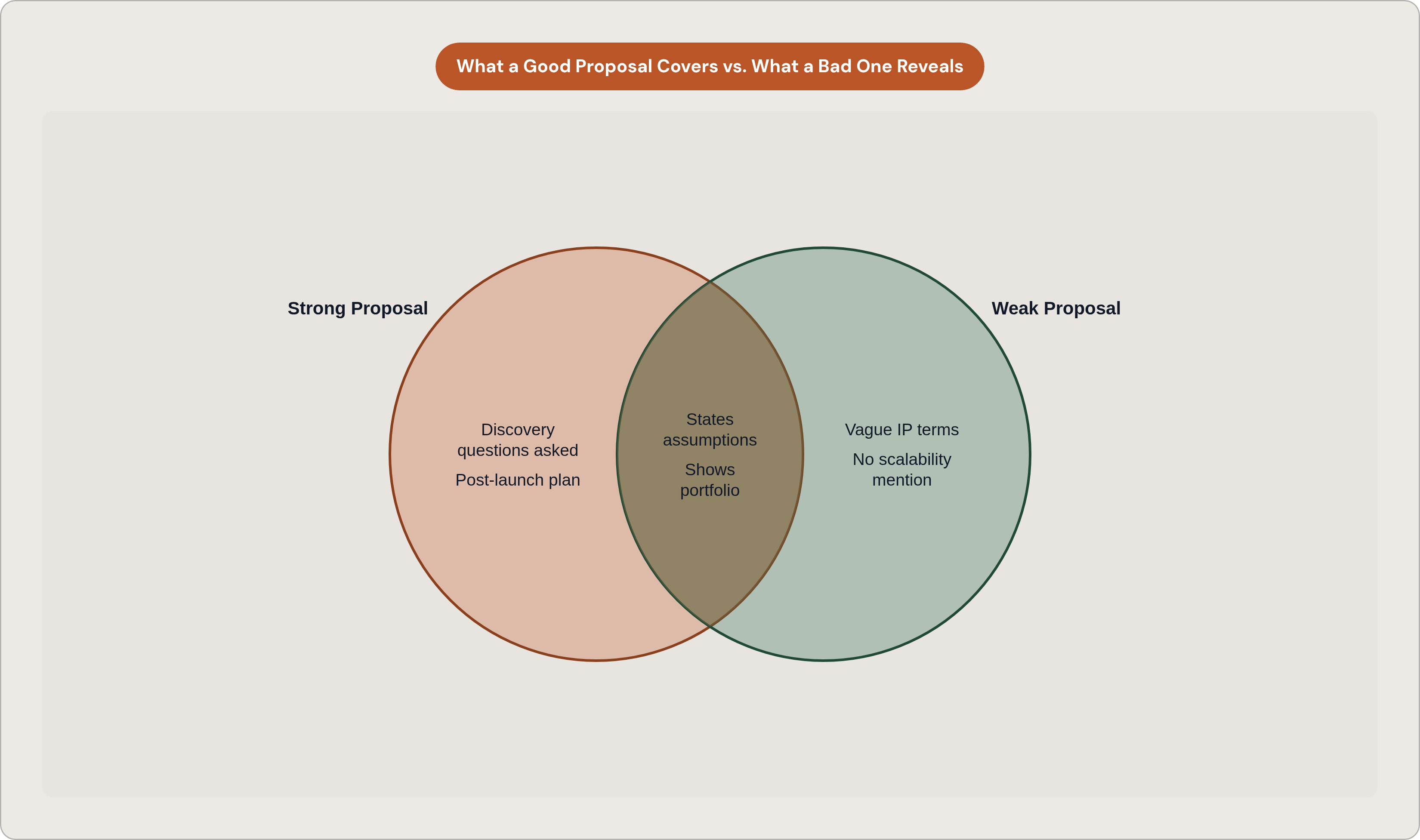
The proposal stage is the one moment in the whole engagement where you have full information and the vendor is on their best behavior. If the red flags are showing up now, before any real pressure exists, they don't get better once deadlines and budget overruns enter the picture.
Reading a proposal well means noticing what a document reveals when nobody's trying to reveal anything on purpose. A short sequence helps: did they ask real questions before naming a price? If not, that price is closer to fiction than to an estimate. Is the pricing broken down with assumptions stated plainly? If not, expect scope disputes down the line. Is there production-shipped work you can actually see and verify, not just slides? Are the IP and ownership terms spelled out in plain language? Is there an actual plan for what happens after launch? And does the proposal name the trade-offs it's making, or does it only list deliverables and leave the hard parts unsaid?
Run it the other direction too. A vendor who asked hard questions before quoting a number, broke the cost down with named assumptions, showed you real production work without flinching, and has a clear answer for what comes after launch, that vendor is showing you exactly how they'll behave once the build gets underway. For founders without a technical background, that kind of reading is the due diligence you actually have access to, and it holds up better than trying to argue architecture with someone who's spent a decade in it.
The goal was never a flawless proposal. It's a partner whose proposal reflects real thinking about your specific problem, not a template that got reused for the last five briefs that landed in their inbox.