Vendor Lock-in Risk and Portability as an Ethical Product Decision
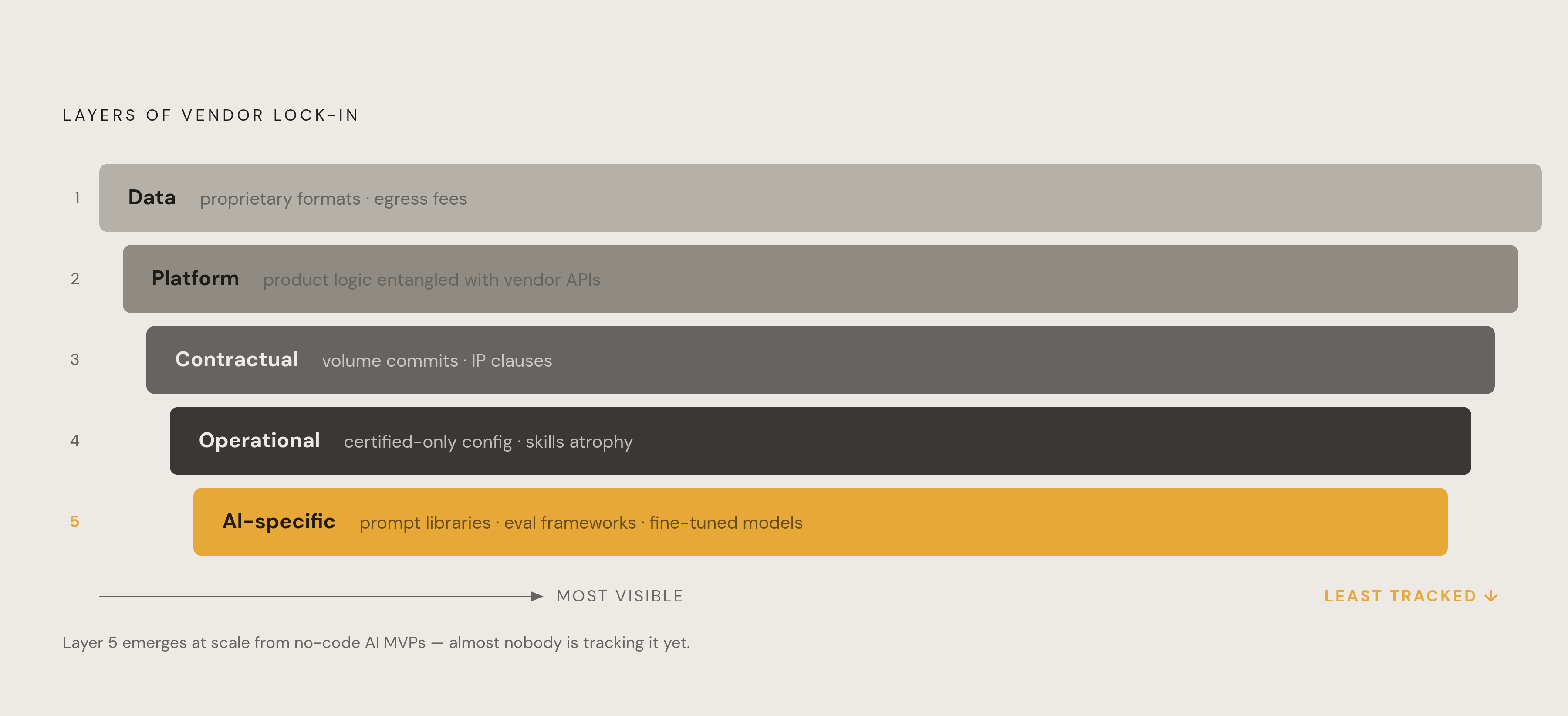
Builders make five layers of lock-in decisions, most tracking only one.

Vendor lock-in gets talked about as a financial risk: migration costs, egress fees, contract penalties that make leaving expensive. That framing is incomplete. Lock-in is an ethical decision, made the moment a builder picks a platform that traps someone else's data and workflows, whether or not anyone calls it that at the time.
What lock-in actually is (and why it has more layers than most builders track)
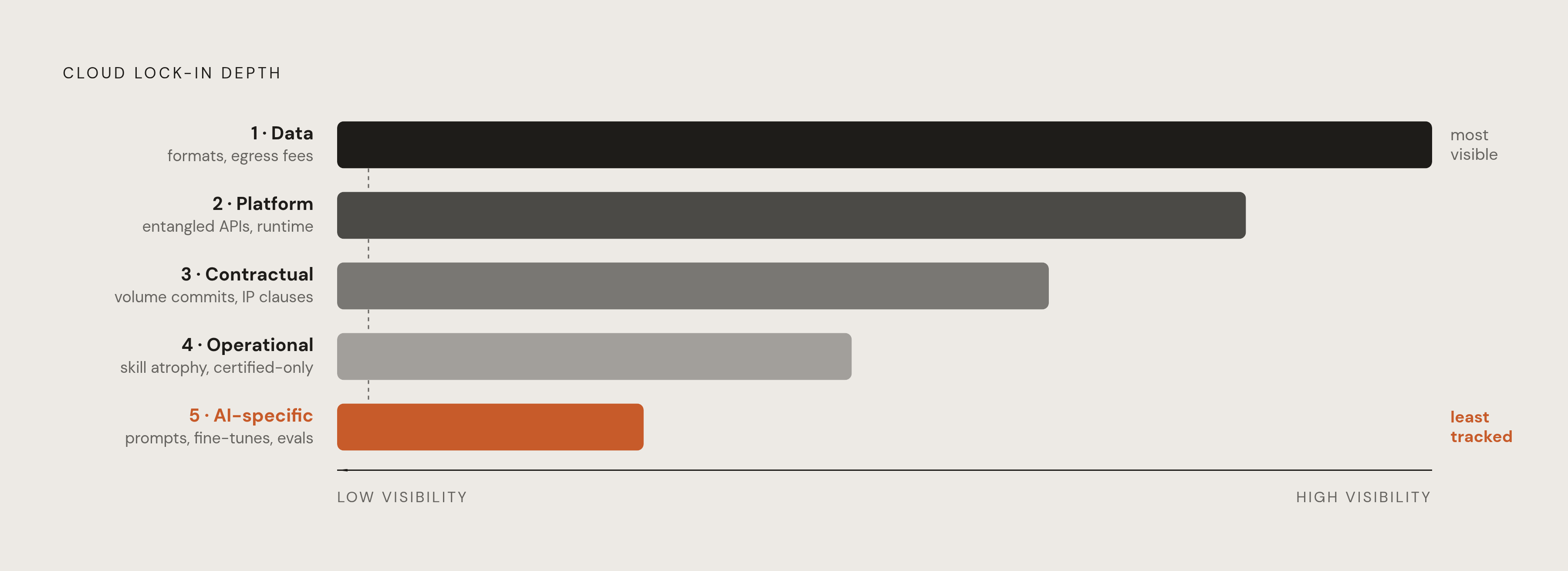
Most people picture lock-in as one thing: you can't get your data out. That's real, but it's only the first of at least four layers, and treating it as the whole picture is how the other three sneak up on you.
Data lock-in is the most visible. Proprietary formats and egress fees make leaving a technical problem before it's ever a financial one. But platform lock-in runs deeper: your product logic gets entangled with one vendor's APIs, one vendor's runtime, one vendor's way of doing things, until untangling it means rewriting, not exporting.
Then there's contractual lock-in. Volume commitments, bundled pricing, ambiguous IP clauses. These create legal friction that outlasts whatever technical relationship you thought you had. And underneath all of it sits operational lock-in, the quiet kind: when only a vendor-certified consultant can touch your configuration, your team's internal skills atrophy. Eventually nobody in-house remembers how the system actually works.
A fifth layer is showing up now, and almost nobody is tracking it. AI-specific lock-in lives in the prompt libraries, evaluation frameworks, and automated workflows tuned to one model's particular behavior, quirks and all. This work is rarely documented and almost never portable. Fine-tune a model on your own data inside a vendor's environment, and that model typically doesn't leave with you when you do. ITAM Review has flagged this as a distinct category most organizations aren't tracking yet. Think of it as a preview: the next wave of no-code AI MVPs will produce this exact trap at scale, unless the lesson gets learned now instead of later.
The point isn't that every layer applies to every product. It's that most builders only think about layer one, if they think about any of them at all. You can't design against a risk you've never named.
How lock-in hardens: the pattern from practical decision to structural trap
Lock-in rarely starts as a vendor's grand strategy to trap you. It starts as a reasonable call made under deadline pressure. You need to ship, the tool is right there, and it solves today's problem. Nobody sits down and decides to get trapped.
But it hardens. Contract by contract, renewal by renewal, integration by integration, the cost of staying stays flat while the cost of leaving climbs. Most organizations have the exit conversation far too late, usually when a renewal negotiation turns ugly. By then the architectural dependencies are already load-bearing, and you're negotiating from the weakest possible position. Exit planning belongs at the architecture stage, before production data ever lands in a proprietary format. Wait until the renewal fight, and you've already lost the leverage you needed to have.
Two recent examples make this concrete. Builder.ai's reported 2025 collapse left organizations that had built their entire development workflow on the single vendor facing a rebuild from scratch, on a timeline nobody chose. AWS deprecated CodeCommit in 2024, and teams with CI/CD pipelines tightly wired into it inherited a migration deadline that wasn't theirs to set either.
Same ethical shape both times: the people depending on these platforms had no meaningful exit option when the decision got made for them. That's the thing about the hardening pattern. It's what makes the early choices matter so much, because by the time the trap is visible, the person paying to escape it is never the one who built it.
The MVP-to-production inflection point is where lock-in becomes permanent
Speed is the right value during an MVP. Nobody should argue otherwise, and no-code or low-code tools are genuinely well suited to early validation. The problem was never using them. The problem is what happens after.
Real users show up, and the standard quietly shifts. "Good enough to ship" and "good enough to depend on" are not the same bar, even though they can look identical from inside a sprint. The tools you picked for speed become the walls of the room you're now standing in: moving off a no-code foundation usually means rebuilding the functionality from zero, not migrating a database.
Technical debt and vendor lock-in feed each other here. Debt is just interest on shortcuts, and it compounds the normal way: velocity drops, regressions multiply, your developers get quietly furious. But when that debt lives inside a vendor-controlled environment, you can't pay it down on your own schedule. You pay it down on the vendor's, whenever they decide to let you.
The AI version of this trap moves even faster. An agent or workflow built fast inside one vendor's tooling looks great in a demo, then turns immovable the moment the organization needs to audit it, govern it, or scale it past a proof of concept.
Here's the ethical hinge, and it's worth sitting with. A founder who ships an MVP knowing they'll rebuild later is making a reasonable bet. A founder who never revisits that bet, once real users are depending on the product, is quietly moving the risk off their own books and onto someone else's. Nobody signs a document that says this. It just happens, one unexamined sprint at a time, until the values decision gets buried under whatever's due Friday.
Nonprofits as the clearest illustration of what lock-in costs people who can least afford it
Want to see what lock-in costs when it lands on people who can't absorb it? Look at nonprofits. They combine every condition that makes lock-in dangerous: mission-critical data, a skeleton-crew IT team, and close to zero tolerance for downtime or migration cost.
The median U.S. nonprofit IT operation runs one to three people, often with nobody dedicated to security at all, while managing thirty or more SaaS tools across the organization. That's not a hypothetical strain; per Omatic's 2025 Nonprofit Integration Report, 48% of nonprofits say they're considering switching CRMs in the next twelve months. That number alone tells you the anxiety around lock-in in this sector isn't abstract. It's active, and it's pressing on real operations right now.
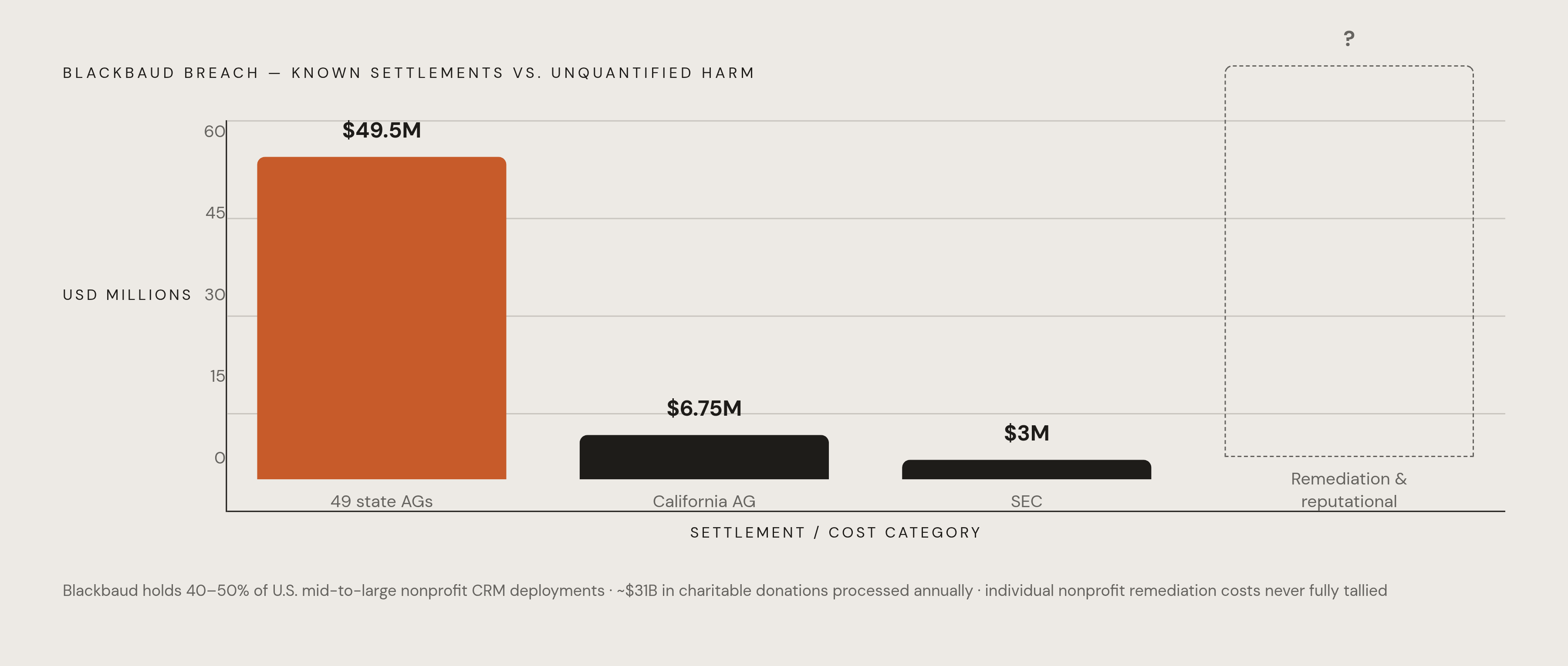
Blackbaud holds something like 40 to 50% of U.S. mid-to-large nonprofit CRM deployments, processing close to $31 billion in charitable donations a year. That concentration is itself a structural risk, independent of whether Blackbaud does anything wrong. And then something did go wrong: the Blackbaud breach resulted in $49.5 million in settlements to a coalition of 49 state attorneys general, another $6.75 million to California separately, and $3 million to the SEC. Those are the numbers that got quantified. The remediation costs, the donor notifications, the reputational damage absorbed by individual nonprofit customers, never got fully tallied anywhere.
Here's the part that matters most: those nonprofits had no meaningful way to exit the ecosystem before the breach happened. The dependency wasn't a choice they kept renewing. It was structural, baked in from the start. Layer on top of this that nonprofits are among the most targeted sectors by nation-state actors, with Cloudflare's Project Galileo measuring a 241% increase in DDoS attacks against civil-society organizations between 2024 and 2025, and you start to see the real shape of the risk.
When a builder concentrates mission-critical data in a non-portable system for an organization that can't afford the exit, the harm from a breach doesn't land on the vendor's balance sheet. It lands on the mission. It lands on the communities the nonprofit exists to serve, who never signed up for any of this and never got a vote.
The engineering partner relationship as an overlooked lock-in vector
Lock-in doesn't need a SaaS vendor to happen. A software partner can produce the exact same structural dependency, if the client can't move their own product without delay, extra cost, or a gap in service.
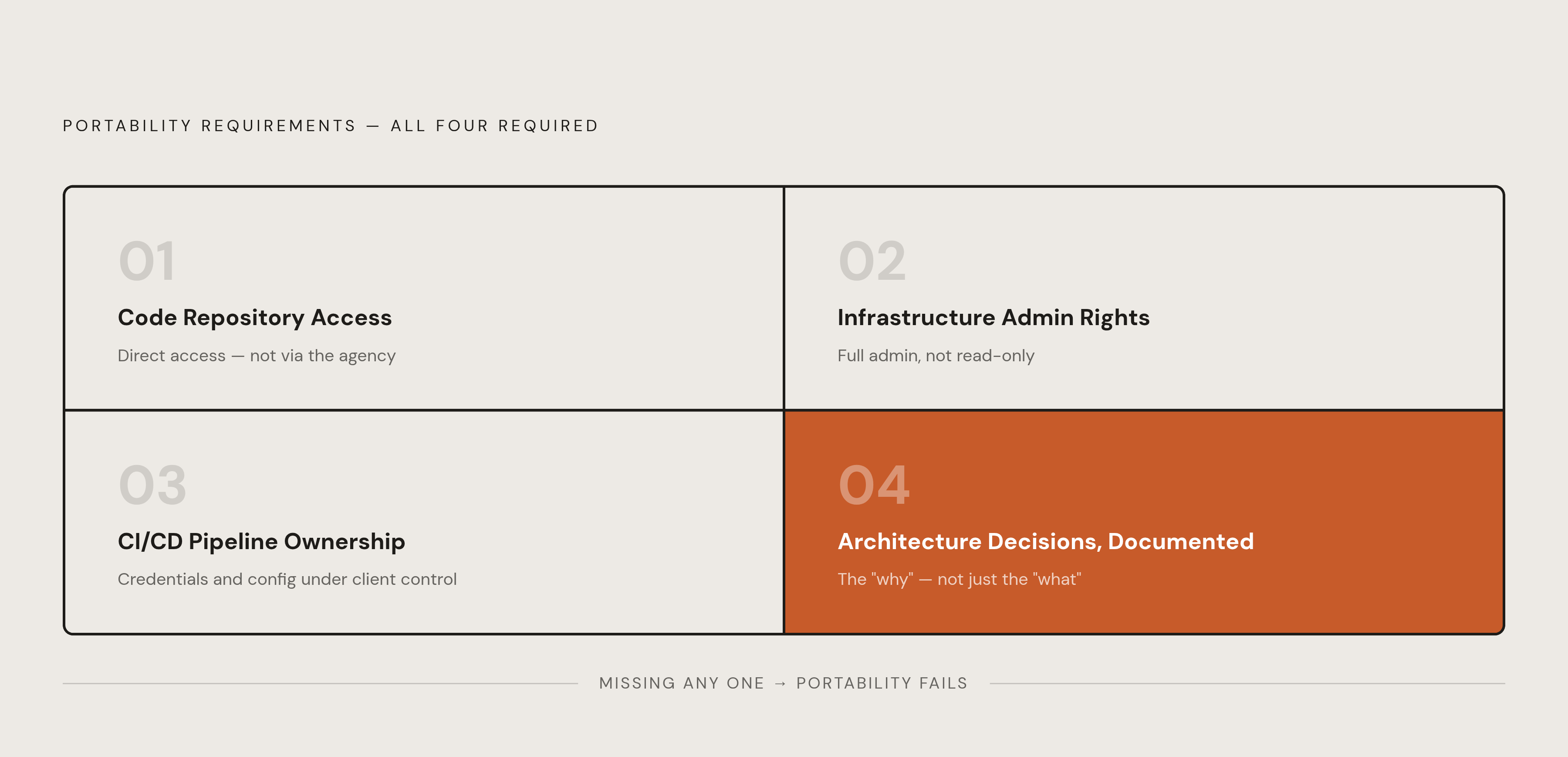
There are four things a client needs to hold to have real portability: direct access to the code repository, admin access to the infrastructure, ownership of the CI/CD pipeline, and documented architecture decisions. Miss any one of these, and it doesn't matter what the contract says about deliverables. If one partner holds the admin keys, controls the deployment flow, and keeps the handover notes in their own head, the client doesn't actually control their product.
The ACM/IEEE Software Engineering Code of Ethics addresses this directly: engineers are required to "ensure that there is a fair agreement concerning ownership of any software" they contribute, and to act consistently with the public interest, not just the interest of whoever's paying the invoice. That's a professional standard, not a suggestion.
Worth knowing: a lot of template MSAs and development agreements don't actually transfer IP ownership to the client the way people assume. Work-made-for-hire language by itself is not enough. It needs an explicit assignment provision sitting right next to it, or the ownership question stays murky long after the invoice gets paid. AI contracts add a further wrinkle: agreements should spell out obligations to return or delete data, provide real transition assistance, and where it applies, escrow the trained models themselves.
What does a safe setup actually look like? Shared repo access from day one. Infrastructure admin access, not "we'll get you access when you need it." Documented architecture decisions as they happen, not reconstructed after the fact. Clear IP transfer language. An exit plan attached to the delivery model itself, visible before scale even starts.
A long-term partnership model, where the engineering team stays through maintenance and growth while the client keeps their own infrastructure access and code the whole way through, is the structural opposite of lock-in. Values alignment with a partner isn't a vibe. It shows up in whether you can walk away cleanly if you ever needed to.
Airtable as the canonical example of how invisible the trap looks from the inside
Airtable is probably the single most common tool to show up in a nonprofit's or early-stage team's stack as a "temporary" fix that quietly becomes permanent infrastructure. And the lock-in here isn't buried in a terms-of-service document nobody reads. It's built into the product itself.
You can export data as CSV, one table at a time. Fine. But Interfaces, Automations, and Views don't export at all. Every single day spent building inside Airtable produces logic, workflow, and interface work that exists only inside Airtable, full stop. There's no self-host option either, so the moment a compliance requirement or data-residency rule shows up, Airtable becomes a non-starter, and you discover that fact only after your data is already sitting there.
Pricing scales right alongside utility. The moment a base actually becomes useful (more records, more collaborators), the cost structure shifts hard, and there's no exit path that lets you keep what you built. You either pay up or you rebuild from nothing.
This generalizes past Airtable specifically. Tools built around a freemium model tend to make the free tier sticky and the exit expensive, on purpose, because the real switching cost was never just financial. It's the loss of work that was never made portable in the first place. That's a design decision the tool's builders made. Calling it a business model doesn't make it ethically neutral; it's still a choice about who holds power over your data once you're a few hundred records deep.
For any builder choosing tools that their own users will depend on: the question worth asking is whether you're reproducing this exact pattern, one layer down, on people with even less leverage than you have.
What designing for portability looks like as a practice, not a principle
Portability isn't a principle you nod at in a planning doc. It's a practice, and it shows up in specific decisions made before the product exists, not as a hedge against doubt but as a commitment to whoever ends up depending on the thing.
At the architecture stage, that means preferring open data formats and standards-based APIs over proprietary SDKs wherever you actually have the choice. It means documenting architecture decisions as you make them, not scrambling to reconstruct them for a handover document later. Ask "how would we leave this platform if we had to?" while you're still building it. The honest answer to that question tells you things a feature comparison never will.
At the contract stage, IP ownership clauses need both the work-made-for-hire language and an explicit assignment provision sitting together. Data return, deletion obligations, and transition assistance belong in any AI or SaaS agreement from the first draft, not bolted on after a dispute. And what happens if the platform gets deprecated or acquired? That's a negotiation point up front, not an afterthought you discover the hard way.
At the sprint level, there's a genuinely simple operational fix: set aside 10 to 20% of each sprint for technical debt repayment. That buffer is what keeps lock-in from compounding quietly in the background. It turns portability into routine maintenance instead of a crisis project you scramble to fund after the fact.
For AI-specific work, prompt libraries, evaluation frameworks, and fine-tuned models should be treated as organizational assets. Owned, versioned, documented, the same as any other piece of intellectual property you'd protect. Not leftover byproducts of whatever vendor relationship happened to produce them.
None of this is heroic. That's worth saying plainly: it's the baseline of responsible product engineering, done visibly, before scale ever starts.
Why naming this as an ethical obligation changes what builders actually do
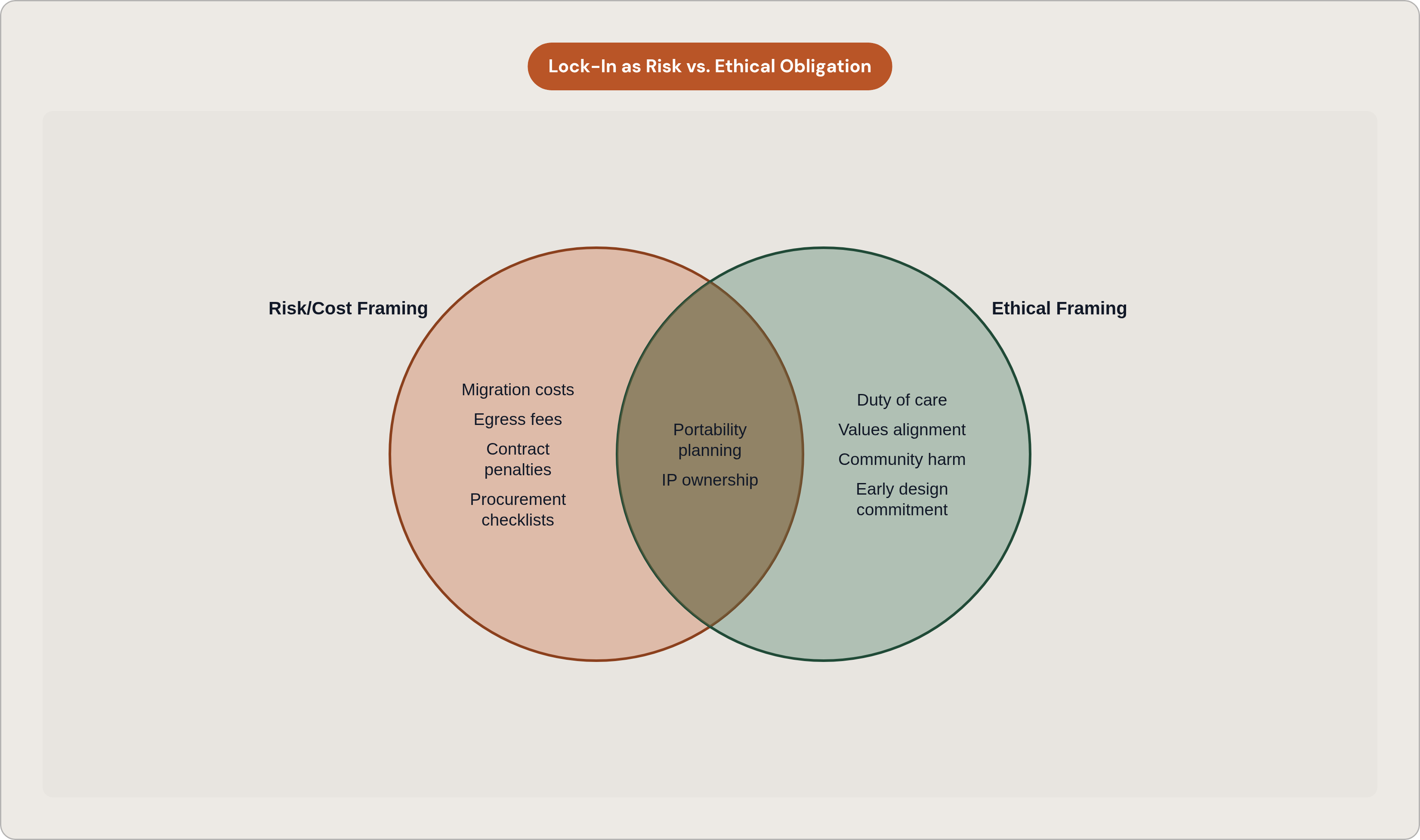
Frame lock-in as a cost problem, and you get a cost problem's response: risk mitigation, procurement checklists, contract review, all of it happening after the choices that mattered are already locked in. That's not nothing, but it's damage control dressed up as strategy.
Frame it as an ethical obligation instead, and the response changes shape entirely. Portability becomes a commitment that shapes the early decisions, not a remediation project you fund once users are already stuck depending on you. The question "can my users actually leave if they need to?" is the product version of a basic duty of care. Builders who've never asked it aren't neutral on the matter. They've already made the choice, they just haven't said it out loud.
For founders rebuilding on more solid footing after an MVP, the rebuild is the exact moment to name that duty directly, and to design against the lock-in patterns inherited from the first version rather than reproducing them in cleaner-looking code. For engineering partners, the real test of values alignment isn't in the pitch deck. It's whether the client holds their own product: the code, the keys, the architecture records, the IP, free and clear. Or whether the relationship itself has quietly become the lock-in.
The organizations and communities depending on mission-driven products rarely get a say in how these decisions get made upstream. That's exactly why the people who do get a say owe them the honest question, asked early: when this needs to end, can you actually leave?