Responsible Scope Decisions When Building for Vulnerable Populations
How scope decisions invisibly shift risk onto vulnerable people who can't absorb failure.
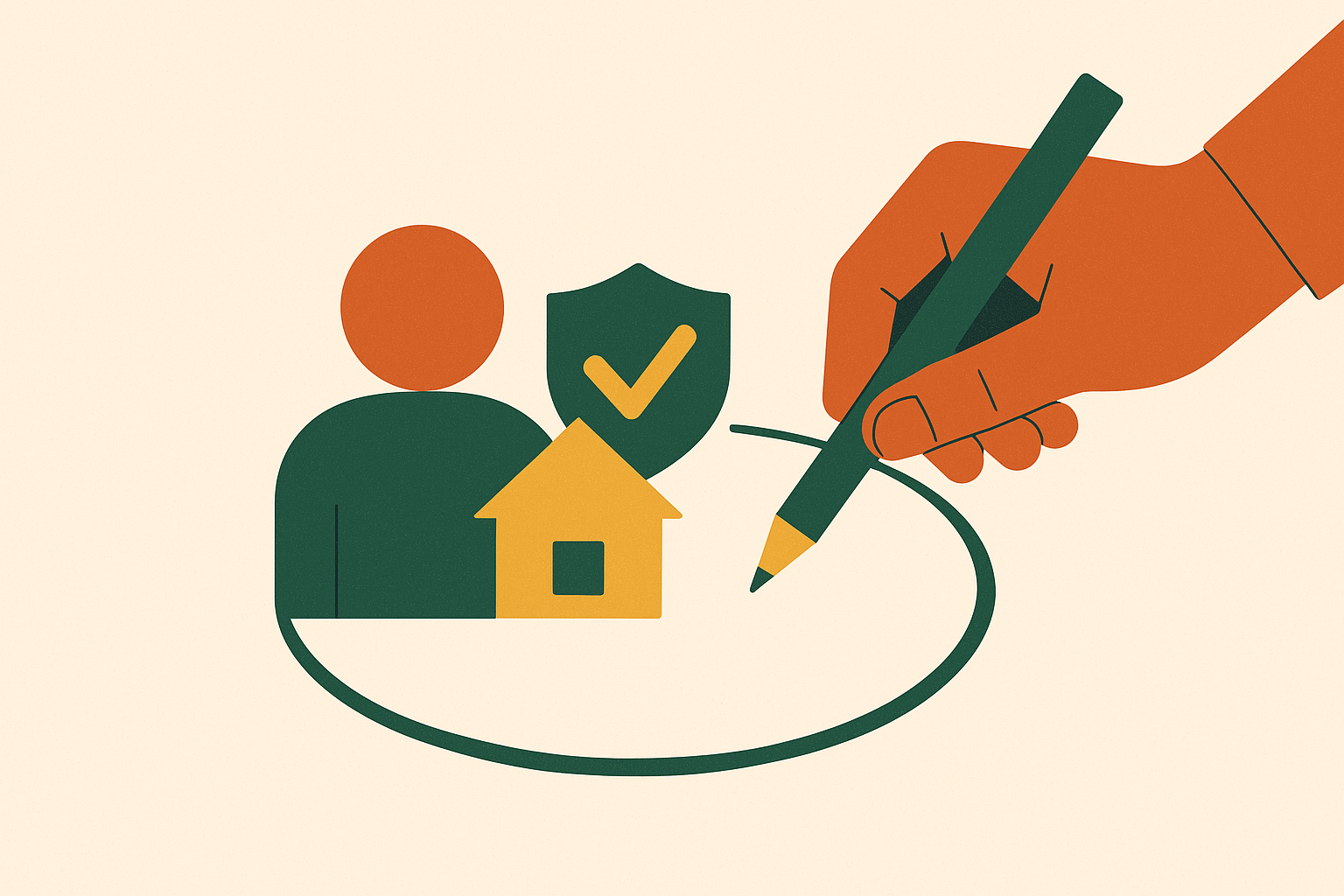
Every scope decision in a nonprofit product build, what to collect, what to automate, what to defer, is also a decision about who eats the cost if it goes wrong. For a consumer app, that cost is a churn number on a dashboard. For a tool serving people experiencing homelessness, minors in foster care, patients, or migrants, that cost can be a missed benefit, a broken trust, or a data leak that lands in the wrong hands. This piece is about making that transfer of risk visible, so the people making scope calls are doing it on purpose instead of by accident.
The structural conditions that make scope discipline harder for nonprofits
Most mission-driven organizations still treat technology as overhead. Not infrastructure, not a program in its own right, just a cost center that sits next to rent and printer paper. That classification shapes everything about how scope conversations happen, or don't happen, inside these organizations.
NetHope's 2024 Digital Nonprofit Ability assessment found that a majority of nonprofit leaders point to staffing and operational capacity, not funding, as the biggest barrier to scaling impact. Read that carefully: it's not that the money isn't there. There's often no one on staff whose job it is to sit in the room and hold the scope conversation.
Picture the person running the CRM at a mid-size nonprofit. Same person doing program coordination. Same person doing grant reporting. Same person doing client intake on Tuesday afternoons because someone called in sick. That person cannot easily tell the difference between a normal product growing pain and a warning sign of scope creep, because they don't have the bandwidth to step back and look.
So, scope gets decided by default. A funder asks for a new feature, it gets built. A grant deadline hits, the timeline gets squeezed. A spreadsheet has an empty column, so a new field gets added to the intake form, because why not, it's just a column. None of this is negligence. This is what happens when a resource structure was never built to support product governance in the first place. Any approach to scope that hopes to work here has to fit inside that reality, not assume a dedicated product team that doesn't exist.
How technical debt compounds when the end user cannot absorb failure
Technical debt is the cost you push into the future by taking a shortcut today. That's not automatically bad; it's a real tool for moving fast early on. The standard startup logic goes: ship something rough, learn from it, clean it up once you've got revenue or traction. That logic works fine when your users can shrug off a bad experience and go use something else instead.
What if the user can't go anywhere else? A parent using a broken intake portal for childcare subsidies doesn't have five other options open in browser tabs. A missed notification isn't an annoyance, it's a missed court date. A lost document isn't a bug ticket, it's a gap in someone's legal record that might matter years later.
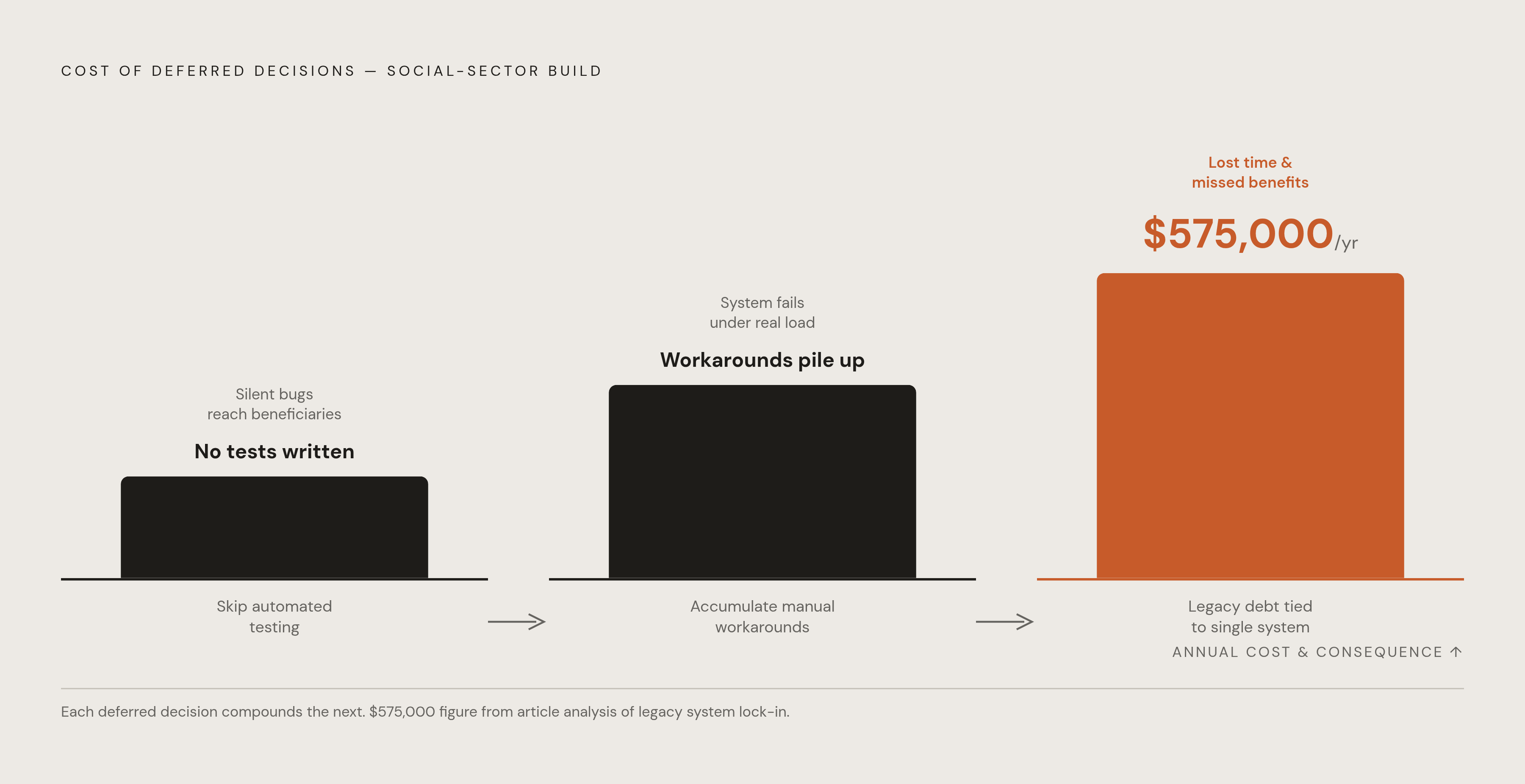
I've seen the same debt patterns show up again and again in social sector builds. Automated testing gets skipped because the timeline is tight, and small bugs that would be shrugged off elsewhere turn dangerous once caseloads climb into the hundreds. Manual workarounds pile up, patchwork scripts staff invent to plug a gap, and everyone treats them as normal until they fail silently under a load nobody planned for. Architecture that looked fine at ten users starts cracking at a hundred, because nobody built it to hold more than a pilot.
This isn't abstract. ASAE's 2025 case study on one nonprofit association found technical debt tied to a single legacy system was costing them an estimated $575,000 a year in lost time and missed opportunity. For most community-serving organizations, that number isn't a rounding error, it's an existential threat.
AI makes this worse before it makes it better. A clean codebase gets sharper AI-generated suggestions and fewer mistakes. A messy one gets a new layer of AI-generated fragility stacked on top of debt that was already there. Adding an AI feature to a system nobody's maintained in two years doesn't multiply your capability, it multiplies your risk.
The cybersecurity exposure that bad scope decisions create
Nonprofits are not low-value targets. That assumption gets people hurt. Organizations serving vulnerable populations hold health records, legal documents, housing histories, immigration status, financial data, exactly the kind of information that's valuable on the black market and devastating if it leaks.
Cloudflare's Project Galileo tracked a dramatic jump in cyberattacks between 2024 and 2025, with human rights and civil society organizations landing as the second most targeted sector. That's not a distant statistic. It's the organization down the street.
Where does scope come into it? Every field you collect "just in case" is a field that can be stolen. Every integration added without a hard look at the vendor's security practices is a new door left unlocked. Every access control pushed to "phase two" is a phase-two problem that becomes a phase-one breach. And every time staff reach for a consumer AI tool or a shared spreadsheet to manage sensitive case notes because it's faster than the sanctioned system, that's a scope failure hiding in plain sight.
The PowerSchool breach in December 2024, which exposed data on 62 million students, is worth sitting with. PowerSchool is a large, well-funded vendor with real security resources, and it still happened. The lesson isn't that vendors can't be trusted. No vendor relationship replaces the basic discipline of deciding, upfront, what data actually needs to be collected and where it actually needs to live. For an organization that can't absorb the cost of a breach, financially or in the eyes of the community it serves, keeping the collection scope small is a defense strategy, not a nice-to-have feature.
What compliance frameworks actually demand at the scope level
HIPAA and FERPA aren't things you bolt on once the product works. They're architecture decisions: access controls, encryption, audit logs, role-based permissions. Try retrofitting those into a system built on patchwork scripts and you'll find out fast how expensive "later" actually is.
The compliance surface keeps growing, too. As of 2025, more than 121 state laws protect student privacy beyond what FERPA covers. Expand your product into a new state and you might be walking into an entirely new regulatory regime you hadn't scoped for at all.
Nonprofit status doesn't buy you an exemption anymore, either. State privacy laws in Delaware, Minnesota, and New Jersey generally don't carve out nonprofits. An assumption baked into a lot of early scope conversations, "we're a 501(c)(3), this doesn't apply to us", is now flatly wrong in a growing list of places.
HIPAA enforcement in 2026 looks nothing like it did five years ago. A single incident can now trigger an OCR inquiry, consumer litigation, an FTC look, and state attorney general scrutiny, all at once. Scope decisions that push off security hygiene or skip vendor vetting aren't quiet, low-odds bets anymore. Compliance needs to sit in the first planning document as a scope requirement, not get filed away as a backlog item for someday.
Where scope creep does its specific damage in social sector projects
Scope creep is what happens when requirements keep expanding past the original plan, usually because of late requests from stakeholders, funder conditions, or a staff workaround that quietly becomes a permanent feature. In commercial software, that wastes investor money and slows down a roadmap. The company absorbs the hit.
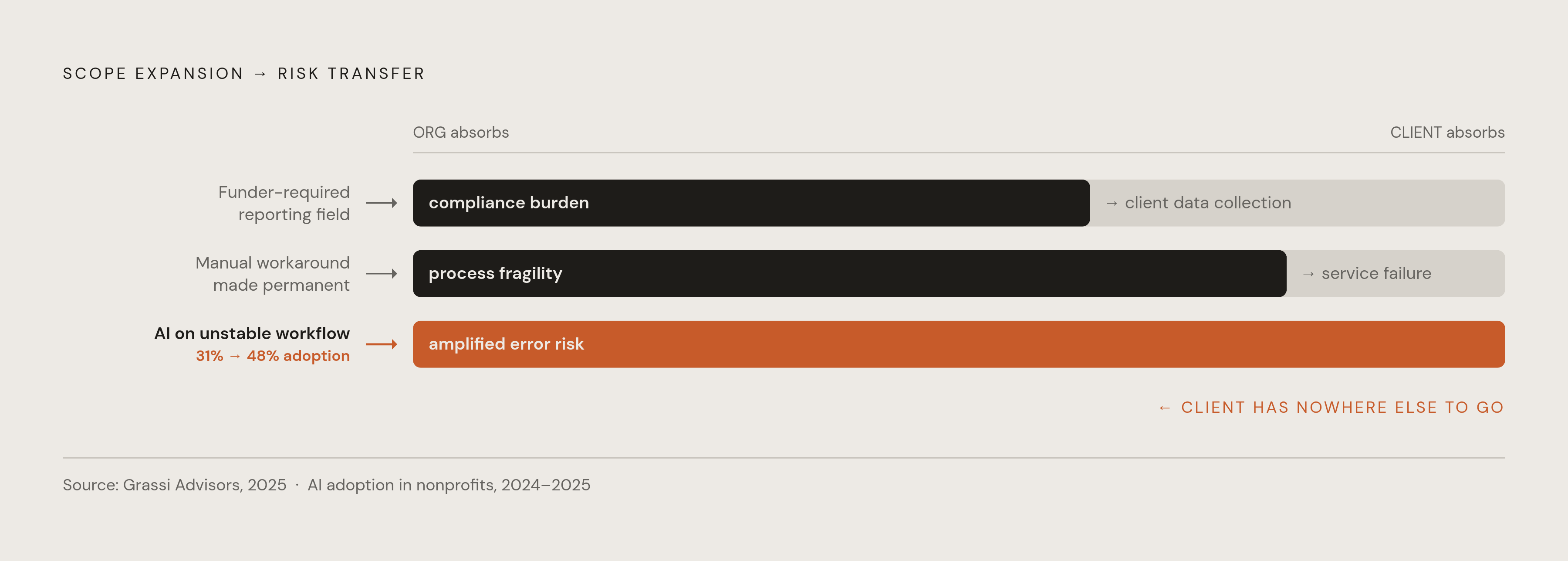
In social sector software, the people who absorb the hit are clients with nowhere else to go.
A few patterns show up over and over. A funder requires a new reporting field, which turns into a new data point on the intake form, which makes the form longer, which adds friction for someone already juggling three crises at once. Or a staff member invents a manual workaround out of necessity, and instead of asking whether that process was ever the right one, the team just builds it into the product as-is. Or AI gets bolted onto a workflow that was never redesigned to use it: adoption of AI in the nonprofit sector jumped from 31% in 2024 to 48% in 2025, according to Grassi Advisors, and that speed without scope discipline means the tools get stacked on top of fragile processes instead of replacing them.
Consider a social worker carrying a caseload of dozens of people, each with needs that shift week to week. Their documentation isn't busywork; it holds up in court, it gets reviewed during licensing audits, it gets pulled during funder reviews. A scope decision that leaves a gap in that documentation trail isn't a UX complaint. It's a legal and safety problem with a person's name attached to it.
Here's the question worth asking before adding anything to scope: who bears the risk if this feature gets built badly, ships late, or never gets finished?
What responsible scope practice looks like when it is applied deliberately
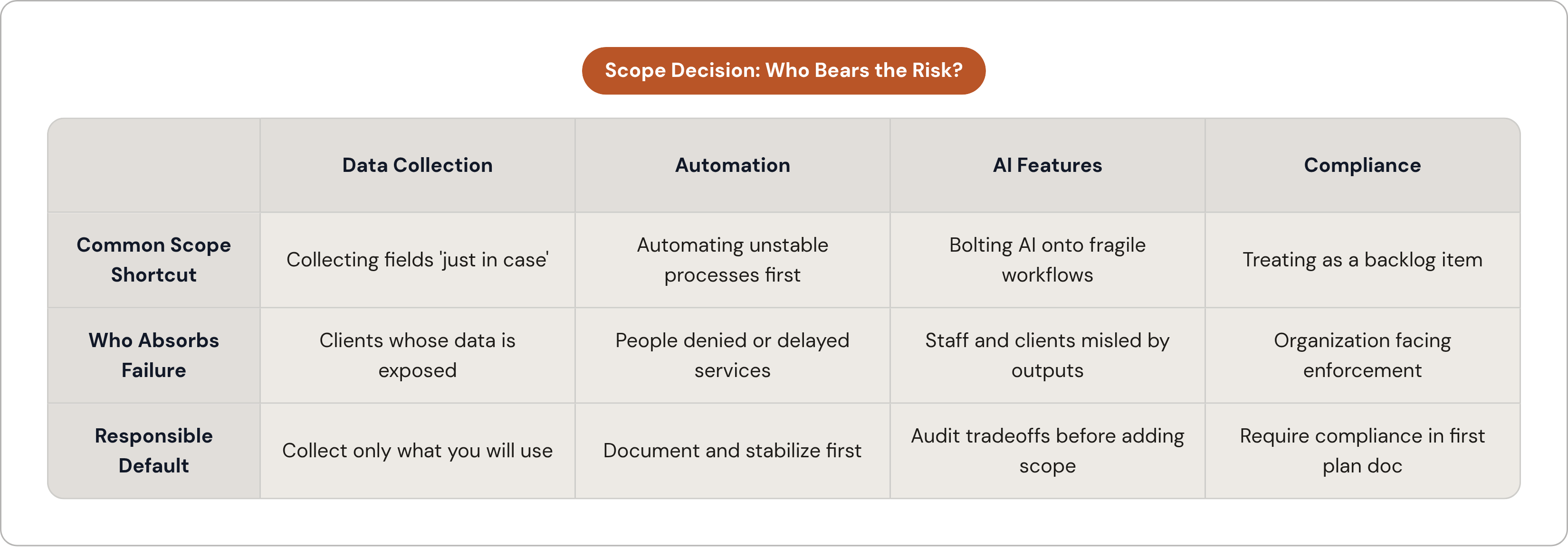
The starting posture is simple to say and hard to practice: name who absorbs the harm before you build the thing, not after it breaks.
Data minimization is a good place to start. Collect only what you'll actually use. Store only what you have to. Treat every additional field on a form as a liability that needs a justification, not an empty slot waiting to be filled because it might be useful someday.
Automation scope needs the same discipline. The CRA's 2024–2025 Quadrennial Paper lays out a two-sided responsibility: the people doing this work need training in working ethically with vulnerable communities, and the technology itself needs to solve real human problems instead of just demonstrating what it can do. Applied to scope, that means automating the processes that are documented and stable first, not the experimental ones that decide whether someone gets access to a service.
There's a nuance worth sitting with from the 2026 AI Index Report: improving one dimension of responsible AI, say accuracy, can actively make another dimension worse, like safety or bias. That means every AI feature added to scope carries its own tradeoff analysis, not a checklist of capabilities you're ticking off.
Sometimes the responsible move is to defer a feature entirely, not because it isn't valuable, but because shipping it before the system underneath it is stable puts the wrong people at risk. Documented AI incidents rose sharply in 2025, up significantly from the year before. That trend isn't mostly bad actors; it's organizations deploying AI into contexts they hadn't fully thought through.
None of this requires a large engineering team or a formal product department or a six-month discovery phase. It requires making the risk transfer visible before anyone commits to building.
How engineering partners fit into responsible scope decisions — and what to look for in one
Here's the gap most nonprofits run into: no internal technical leadership means scope decisions get made without anyone in the room who can surface the tradeoffs. A good engineering partner is not just someone who writes code. This is someone who holds that conversation for you when you don't have the bandwidth to hold it yourself.
A whole pro bono ecosystem has grown up around exactly this problem. Nonprofit ENG(INE), backed by AlleyCorp, pairs nonprofits with senior engineers for three-to-six-month strategic builds, focused on health equity, workforce development, and government services, and it requires the nonprofit to have the internal capacity to maintain what gets built once the engagement ends. Tech To The Rescue matched more than 300 tech companies with nonprofits in 2024 alone, contributing to millions of dollars in impact, and runs an AI for Changemakers accelerator with Google.org. Taproot Foundation connects nonprofits with volunteer engineers and product managers through Taproot Plus. Harvard Tech for Social Good offers free technology services to registered nonprofits and social impact organizations.
Not every organization needs a free, time-boxed engagement, though. Some need a partner who sticks around after launch, understands the day-to-day reality of running a mission-driven organization on a tight budget, and takes ownership of engineering so the leadership team can put their energy into program work and growth instead of server maintenance.
A few questions separate a responsible partner from a vendor just filling a contract. Do they treat compliance as part of scope from day one, or something to figure out later? Do they ask what happens to clients if a given feature ships late or fails outright? Do they stay involved after launch, or hand off the keys and vanish? Do they understand the gap between shipping an MVP and maintaining production software for people who can't afford for it to break?
That's the kind of partner responsible scope discipline actually requires: one that treats the tradeoffs as real, because for the people on the other end of the product, they are.