MVP Software Development Scope Decisions That Create Production Risk
Documenting your MVP shortcuts prevents discovery of technical debt during a crisis.

Technical debt on an MVP isn't a moral failing — it's a predictable stage of building something fast under real constraints, and every founder who's shipped a first version has some. The real danger is debt nobody wrote down, sitting on a codebase nobody's looked at since launch.
MVP development happens under pressure that's easy to forget once the product is live. There's a deadline, a runway that's shrinking by the week, and a need to prove something to users or investors before spending more engineering time and money. Under those conditions, cutting corners is a rational move. The problem shows up later, when the corners you cut start touching each other.
That's the compounding mechanism, and it's worth sitting with for a second. Each shortcut looks small on its own. Skipping the tests is fine on its own, and so is hardcoding a config value. But what happens when the hardcoded credential expires in production and there's no error handling to tell you why the app just broke? You've got two "minor" decisions combining into an outage nobody can diagnose. Five reasonable decisions stack into something nobody can untangle quickly — that's the pattern that eats teams alive.
The distinction that matters here is named debt versus unnamed debt. A founder who says "we skipped automated testing on the billing flow to hit launch, and we know we need it before we scale sales" is managing risk. That's a normal, healthy sentence to say out loud. A founder who has no idea what shortcuts exist in their own product, because nobody documented them and nobody's audited the code since launch, is carrying a risk they can't even size. One of these founders can make a plan, while the other is waiting for a surprise.
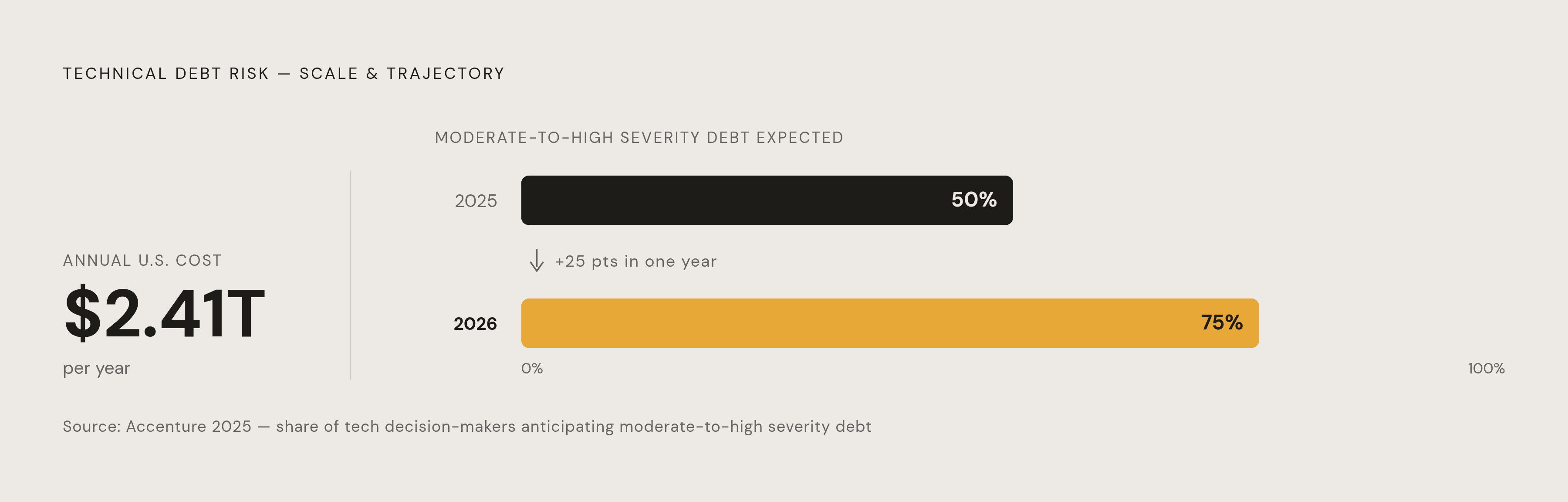
The scale of this problem, zoomed out, is not small. Accenture's 2025 Digital Core Report puts the cost of technical debt to U.S. companies at $2.41 trillion a year; separately, research indicates technical debt accounts for somewhere between 21% and 40% of total IT spending for organizations leveraging software development. Forrester's research adds a second data point worth sitting with: half of technology decision-makers expected their technical debt to hit moderate or high severity in 2025, with that figure projected to climb to 75% by 2026. Across the industry, broadly, it's getting worse.
None of this is a lecture about being more careful. Think of it as a map: if you can see where the six most common scope decisions create risk, you can decide, deliberately, which debt to take on and which to avoid, instead of discovering it during an outage or a due diligence call.
The six scope decisions that generate most of the downstream risk
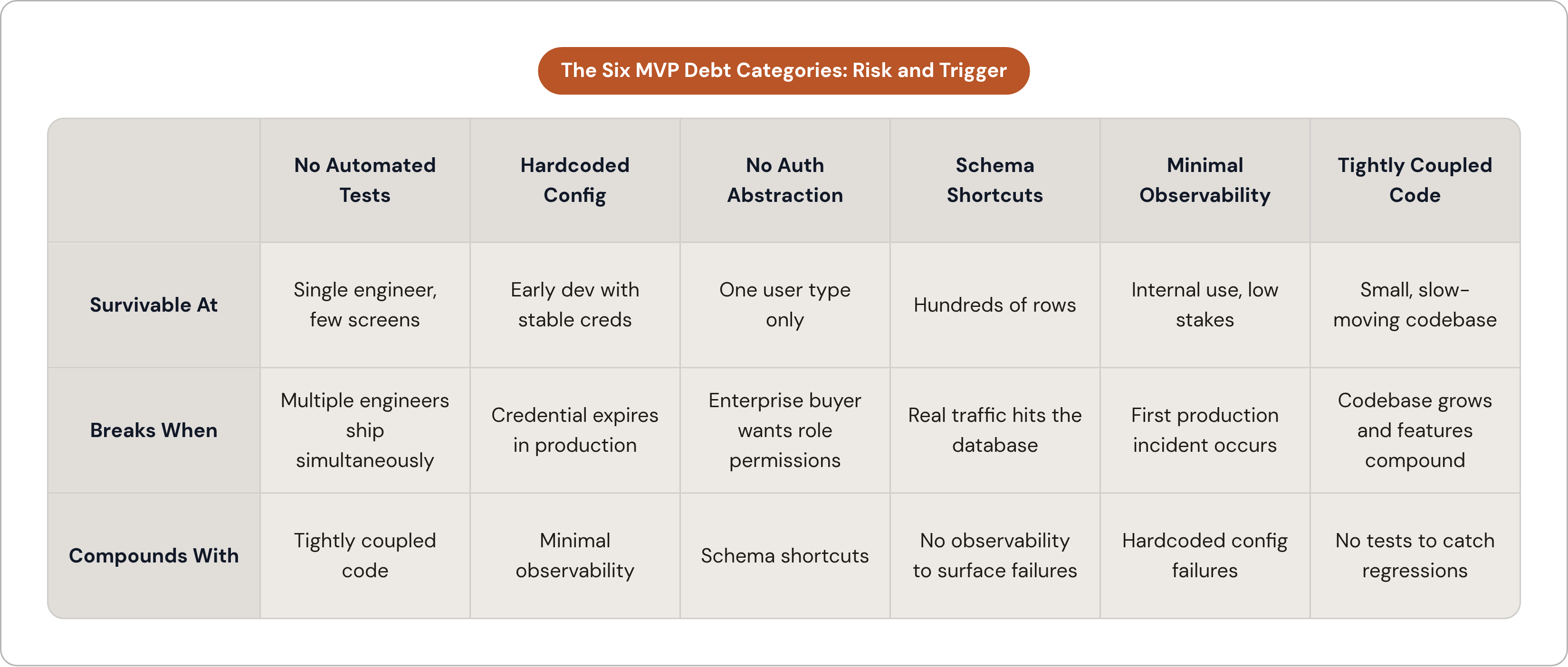
Each of these decisions is individually defensible at MVP stage. The risk isn't any one of them; it's what happens when they're all present at once and the product starts scaling.
No automated tests. Manual QA is faster on day one, and there's nothing to argue with there; if you've got one engineer and a handful of screens, a person clicking through the app catches most of what matters. The cost shows up later: every future change now carries unknown risk of breaking something else, and there's no fast way to detect it. At MVP scale, that's tolerable. The moment three engineers are shipping code simultaneously, it turns into a coordination failure, because nobody can verify their change didn't break someone else's.
Hardcoded configuration and credentials. Fast to write, painful to untangle. This is often the first thing a security review or an investor's technical due diligence turns up, and it's rarely a good look. It also compounds directly with the observability problem below: if a credential expires in production and nothing's logging it, you find out when a customer does, not before.
No authentication or permissions abstraction. Access control gets bolted directly into individual screens instead of living in a central layer. It works fine when there's one user type. Then "add a new user role" becomes a multi-week engineering project, which is exactly the kind of request that comes up the moment a sales team is trying to close an enterprise deal and the buyer wants admin versus viewer permissions.
Database schema shortcuts. Skipped indexes, missing constraints, tables that were denormalized to move faster — all fine at a few hundred rows. At scale, this turns into slow query responses, data integrity failures, and in the worst cases, actual data loss. It's one of the most common structural failures teams hit after an MVP starts getting real traffic, and it's expensive to fix retroactively because live data has to migrate without downtime. Nobody can just swap out a schema on a Tuesday afternoon once real users depend on it.
Minimal error handling and logging. The app works fine when nothing goes wrong. The trouble is there's no way to diagnose what happened when something does go wrong, and that failure tends to show up exactly when a customer is watching: the first sign-up flow that breaks, the first payment that doesn't go through. Here's a decent test for whether your monitoring is actually real: can a new on-call engineer figure out what changed in the last hour, where the error's coming from, and which users are affected, in under ten minutes? If the answer's no, the observability isn't there yet, no matter what dashboard you've got running.
Tightly coupled code. Business logic, UI, and data access all mixed together, so changing one thing means touching five files you didn't expect to touch. The hidden cost is velocity: what takes a day to build at MVP stage takes a week once the codebase has grown and everything's tangled together.
There's a newer variant of this catalog worth naming directly: AI-generated, "vibe-coded" products. These get built fast, look functional on the surface, and often lack proper error handling or state management underneath. Research published on arXiv (2510.10165) suggests generative AI may actually speed up debt accumulation, because it increases code volume without a matching increase in quality, integration, or architectural coherence. The surface looks clean, but the structural gaps are the same six categories above; they're just harder to spot because nobody made a deliberate decision to skip them. Nobody wrote them down because nobody was in the room when the shortcut got taken — it was a prompt.
How "startup mode" turns temporary shortcuts into permanent architecture
Here's where it gets interesting. MVP shortcuts are supposed to be temporary, a way to learn fast and iterate before committing real resources, but what happens when "temporary" quietly becomes the house style?
A 2025 case study on large-scale industrial microservice architecture (arXiv 2506.16214) looked at exactly this pattern: a young company moving fast to deliver an MVP and raise capital. The architectural decisions made under that pressure had known future consequences going in; the team wasn't blindsided by the existence of the debt. What the researchers found, though, was that the actual consequences were worse than the team had planned for, and known risk and managed risk aren't the same thing, even when you saw it coming.
Why does "later" keep slipping? Teams operate on a build-fast-now, refactor-later mindset, and that's a reasonable plan on paper. In practice, product work keeps taking priority, and each new feature gets layered onto the original structure before that structure ever gets fixed. The backlog ticket that says "refactor the auth layer" sits there for six months, then a year, because there's always something more urgent sitting on top of it.
The incentive structure sustains this on its own. Shipping a new feature is visible to everyone, users, investors, the whole team, while refactoring existing code is invisible to everyone except the engineers doing it. And in an early-stage team, the person who best understands what needs fixing is usually also the person under the most pressure to ship the next thing, so nobody's rewarded for fixing what already works, even badly.
Named debt looks like a decision log, a backlog ticket, a line in a post-mortem, anything that puts the shortcut somewhere visible and schedulable. Unnamed debt is the identical shortcut, except it was taken by a contractor who's since moved on, buried in a codebase the current team inherited and has never actually audited. It's the same debt, but with a wildly different level of risk, because one of them you can plan around and the other one you can't even see.
IBM's figure on this is a useful bit of punctuation: a typical organization spends only 23% of its tech budget on things that drive revenue, and the other 77% goes to maintaining and fixing what's already there. This is what happens when normalization goes unchecked long enough, at any scale.
When real users arrive and the risk becomes concrete
Pre-launch, bad architecture is survivable, and nobody's affected but the team. Post-launch, every one of those same decisions becomes customer-facing, and the real inflection point arrives — the moment the product starts carrying weight it wasn't built for.
A few specific ways this shows up, in order of how founders usually discover them:
- The first high-traffic event exposes the database shortcuts that were completely invisible at low volume.
- The first security incident surfaces the hardcoded credentials or permissions gaps nobody ever tested against someone actually trying to break in.
- The first on-call incident reveals that nobody can diagnose a failure in under an hour, because logging and monitoring were never actually built out.
- The first serious enterprise sales conversation reveals that "just add a new user role" is a multi-week sprint, not a config change.
Startup Genome's research on this is stark: 74% of high-growth startups fail because of premature scaling, meaning they pour money into growth before the underlying product can actually hold the weight. That's the single most expensive version of this failure mode, because by the time it's obvious, there's already capital and reputation tied up in it.
The opposite failure is just as real, though, and worth naming so founders don't overcorrect: rebuilding from scratch. It's slow, it's risky, and it's usually unnecessary when the actual fix is incremental re-architecture of the specific parts that are bottlenecking. Not every crack means tear down the house.
So when is the right moment to actually harden the product? Not before you've got real signal that the thing works. Look for retention that's flattened into a stable plateau rather than continuing to decline, growth that's increasingly organic rather than paid, and a meaningful share of users, roughly 40% or more, who'd say they'd be "very disappointed" without the product. Before those signals show up, the better use of time is still iteration, and hardening a product before it has product-market fit is its own kind of premature scaling; you'd just be optimizing something you haven't proven yet.
One more thing worth saying plainly: pre-production security is where teams skip the most, and where they pay the most later. The MVP-to-production transition is genuinely the moment when most organizations either earn their next stage of growth or quietly start accumulating the debt that'll define their next two years, and it's rarely obvious which one is happening at the time.
Why this risk profile is sharper for nonprofits building on constrained tooling
For-profit startups at least have the option of raising more money to fix this. Nonprofits, structurally, often don't, and that changes the whole risk calculation.
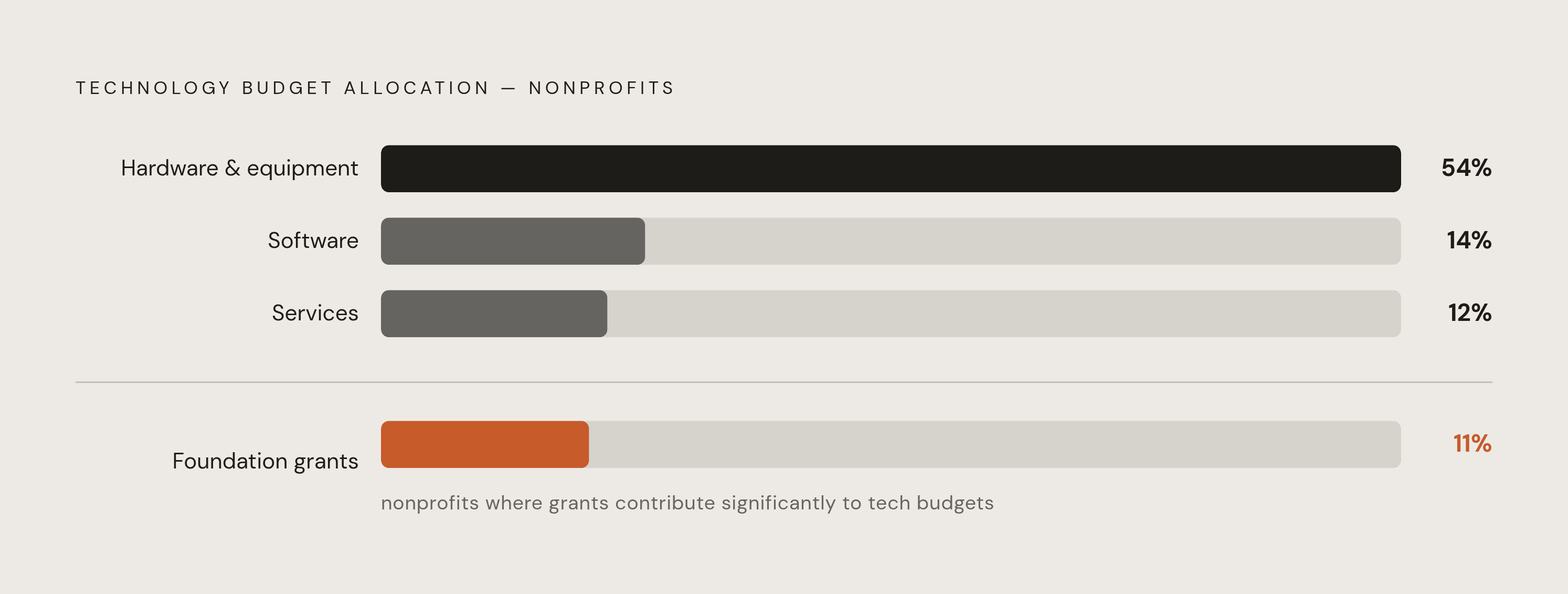
Only 20% of funders provide grantees with money earmarked for technology tools and resources. NTEN's 2024 Digital Investment Report found that just 11% of nonprofits say foundation grants contribute significantly to their technology budgets at all, and the money to build things properly is, for most organizations, simply not there in the first place.
Look at how what budget does exist gets spent: 54% of nonprofit tech budgets go to hardware and equipment, compared with 14% for software and 12% for services. The tools that would actually let an organization transform how it works are chronically underfunded relative to the infrastructure that just keeps the lights on. This is what happens when the money available doesn't match the problem being solved.
This produces a reactive cycle that's hard to break out of. Systems limp along until they fail outright, then money gets found in a panic to patch them, and there's no roadmap, no planning horizon, no ability to negotiate better pricing on anything, because every purchase is an emergency by the time it happens. It's common, in this research, to find software that's over a decade old still running in active production at nonprofits, quietly holding together case management or donor records nobody's had the budget to replace.
One pattern shows up again and again, and it's a direct MVP risk in disguise: budget pressure pushes organizations toward no-code or low-cost tools, spreadsheets acting as databases, project management platforms repurposed as case management systems, as permanent production infrastructure. "We couldn't afford an HRIS platform, so we built one in a SaaS project management tool" is a real sentence organizations say. Every debt category from earlier in this piece is present in builds like that: no error handling, no permissions abstraction, no observability, plus one more constraint layered on top — the tool itself has a ceiling, and the organization will eventually hit it, usually at the worst possible time.
The intent to fix this is there. Surveys of nonprofit leaders consistently find digital transformation ranked among their top organizational priorities for the coming year. Ambition isn't the missing ingredient for most of them; the tooling and technical foundation to actually execute on it is.
And the compounding happens faster here than anywhere else in this piece, because there's usually no engineering team auditing the codebase, no backlog tracking the shortcuts, and no budget cycle that's planned ahead for the remediation. The debt just accumulates in silence until something breaks.
How to read your own codebase for these patterns before they surface in a crisis
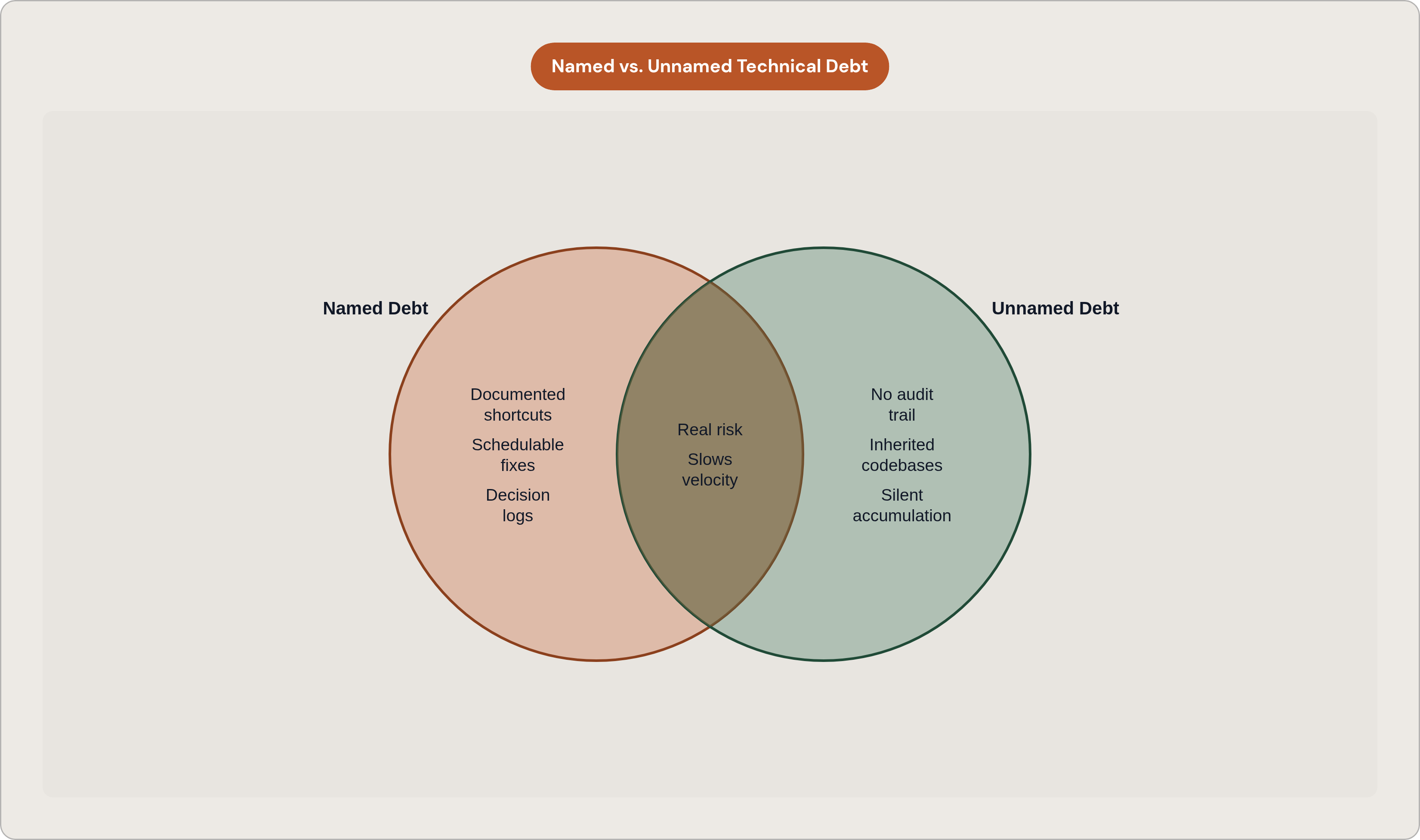
Named debt is manageable, while unnamed debt is risk you can't size, so the first job, before anything else, is just making the debt visible.
Here's a set of questions organized around the six categories above, worth sitting down and actually answering, not rhetorically:
- Tests. Can you change the billing flow today and know, within minutes, whether you broke something else?
- Configuration. Are there credentials, API keys, or environment-specific values sitting in the codebase that would need to be changed by hand for every deployment or every new client?
- Auth. How long would it actually take to add a new user role, or to cut off all access for an employee who just left?
- Database. Do you know how your slowest query performs at ten times current load? Are there foreign key constraints on the tables that actually matter?
- Observability. If the product went down at 2am, how long before you'd know? How long after that before you'd know why?
- Coupling. Can a new engineer touch one feature without having to read four other files first to understand what else it might break?
If most of those questions don't have a fast, confident answer, that's not a failure. It's information that tells you exactly where the debt is sitting.
Investors already treat this as a forcing function, worth knowing whether you're raising or not. Technical due diligence at Series A specifically looks at whether a product can actually scale and hold up under load, and a founder with a clear debt strategy signals a team oriented toward growth, not just patching problems as they surface. Named debt with a remediation plan attached is fundable, while unnamed debt discovered mid-diligence is a red flag, and it reads as one whether or not the underlying product is actually fine.
The default path forward, for most MVPs, is incremental re-architecture rather than a full rewrite: harden and replace the specific parts that are bottlenecking, while the proven, working foundation keeps running underneath. A full rebuild only makes sense when the MVP was built on something with a hard ceiling, a no-code tool the organization has genuinely outgrown, or a prototype that was never meant to survive contact with real users in the first place.
One last distinction worth sitting with: there's a real difference between a vendor who builds and hands off, and a technical partner who stays. A debt audit isn't something you do once and file away; it's continuous, because the codebase keeps changing and production keeps surfacing new failure modes nobody predicted. A partner who's still there after launch is the one who actually knows where the shortcuts are, because they were in the room when the decisions got made, rather than inheriting an undocumented mess months later and reverse-engineering it from scratch.
The better model is rebuilding on solid foundations, then staying on through an ongoing maintenance relationship, so the engineering ownership sits with people who know the codebase, not with whoever gets called in during the next fire. Founders get to spend their time on go-to-market instead of firefighting production this way. It costs more upfront than the cheapest option, and it's the way that doesn't leave debt nobody's tracking on a codebase nobody's watching.