When to Refactor vs Rebuild a Post-MVP Codebase
Understand refactoring, reengineering, and rebuilding to pick the right path.

The refactor-versus-rebuild decision gets framed as a technical question almost every time; it isn't. It's a business triage problem, and the way you answer it will determine whether the capital you're about to raise accelerates your growth or simply accelerates the exposure of a structural problem you haven't dealt with yet.
Most founders don't ask this question proactively; they ask it after a production incident, after release velocity has collapsed, after a major enterprise client is in due diligence and someone finally pulls up the codebase. At that moment, the runway for deliberation is short and the stakes are as high as they'll ever be.
There's also a third option most founders miss entirely, sitting between refactoring and a full rebuild, and it often turns out to be the most appropriate path. Getting to the right answer requires understanding all three.
What Refactoring, Rebuilding, and Reengineering Actually Mean
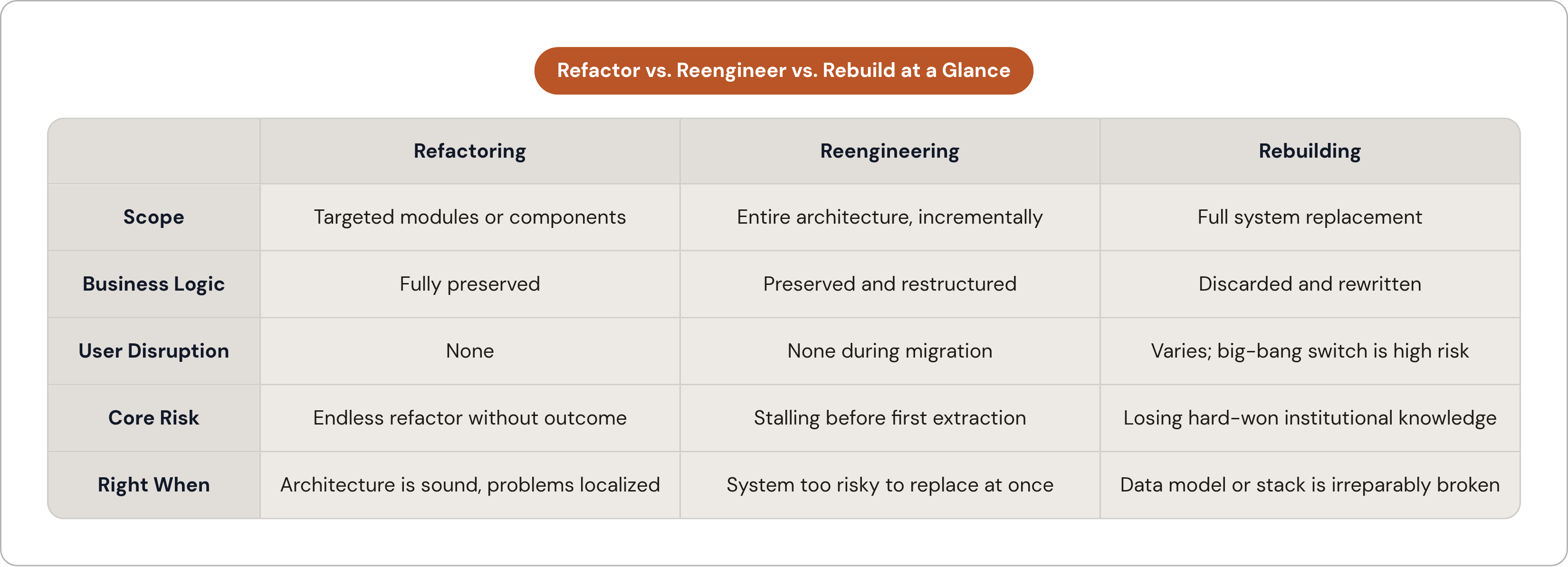
These words get used interchangeably in engineering conversations, which is how founders end up authorizing work that doesn't match the actual problem.
Refactoring is the most contained of the three. You're improving the internal structure of the code without changing what the software does from the outside. Think of it as reorganizing a kitchen: the appliances stay the same, but everything is now in a logical place and the counters are clear. It typically touches a modest fraction of the codebase, targeting specific problems like duplicated logic, overly complex methods, or outdated libraries. The user experience doesn't change. The system's behavior doesn't change. It just becomes easier to work inside.
Rebuilding is the opposite end of the spectrum. You're replacing the existing system, often substantially all of it, sometimes in a new language, on a new framework, with a new data model. This is where Joel Spolsky's 2000 warning about rewrites remains required reading: old, ugly code frequently encodes years of real bug fixes, edge cases that caused production pain, and institutional knowledge that never made it into documentation. A rewrite quietly discards all of that. The new system is clean; it's also naive in ways the old one had painfully learned not to be.
Reengineering is the middle path, and it's the one that gets skipped most often. It's deeper than refactoring because it analyzes the entire existing system and transforms its architecture. It's not a throw-away because it preserves the accumulated business logic while restructuring what's underneath. The canonical implementation is Martin Fowler's Strangler Fig pattern, which Microsoft Azure and AWS both incorporate into their architecture guidance: you incrementally replace specific pieces of the old system with new services while users experience no disruption. The old system doesn't die in a single event; it gets hollowed out, component by component, until the new architecture is carrying the full load.
Why does this third option keep getting skipped? Partly because founders and engineers tend to reduce complex decisions to binaries. Partly because incremental transformation requires sustained planning and doesn't produce a clean announcement moment. A rebuild has narrative momentum; reengineering requires discipline.
How Technical Debt Accumulates to the Point Where the Question Becomes Unavoidable
Nobody builds an MVP intending to accumulate debt. They build it under real time and resource constraints, making reasonable tradeoffs to ship fast and validate demand. The debt is a predictable artifact of that process, not a moral failing.
CAST's 2025 analysis of over 10 billion lines of code found that global technical debt has reached 61 billion days of repair time. Forty-five percent of the world's code is fragile, 32% is bloated, and 31% is too rigid to change without breaking something downstream. These aren't numbers from a fringe sample; they describe the aggregate condition of production software at scale.
The organizational cost is more intuitive once you see it in headcount terms. Developers spend roughly a third of their time managing debt rather than building features. For a 10-person engineering team, that's more than three full-time engineers consumed by invisible overhead. You're paying for work that doesn't ship.
The AI-accelerated dimension of this problem deserves specific attention. GitClear's 2025 research found that copy-pasted code lines rose from 8.3% in 2020 to 12.3% in 2024, a 48% relative increase. As teams lean on generative AI to accelerate development, they're also importing structural patterns without fully understanding them. Gartner predicts architectural debt will account for 80% of all technical debt by 2027. The implication is that codebases built or extended with AI assistance accumulate a specific category of structural fragility that's harder to identify and more expensive to unwind.
The human dimension compounds everything. Stack Overflow's 2024 survey found that 63% of professional developers cite technical debt as their top frustration. More than half had left or considered leaving a job because of it, with 20% naming it as their primary reason to leave. The best engineers have optionality; a codebase that humiliates them every day is a codebase they will eventually leave.
The Signals That Tell You Refactoring Is Enough
Refactoring is the right call when the underlying architecture is fundamentally sound: the structure can accommodate the next year or two of growth without a redesign, and the problems are localized rather than systemic.
Scope is the critical variable here. If the work touches specific modules, a payment flow, an authentication layer, a reporting component, and the rest of the system is stable, targeted refactoring is proportionate to the problem. When the pain is everywhere, the diagnosis is different.
There's a precondition that doesn't get stated enough: refactoring safely requires a meaningful test suite. Without tests, every internal change is a gamble. Michael Feathers defined legacy code as code without tests, and the practical implication is that you can't refactor confidently if you have no way to verify that the external behavior is preserved. A working rule of thumb is 70% or higher test coverage before treating refactoring as a safe path.
McKinsey has noted that actively managing technical debt can free engineers to spend significantly more of their time on work that directly supports business goals. The upside is real; but it requires dedicated scope, timeline, and ownership to capture it.
This is where the "endless refactor" trap lives. Without clear boundaries on what's being cleaned up and who owns it, cleanup work gets permanently deprioritized by incoming feature requests. Two years later the codebase is slightly better documented but structurally unchanged. The work happened but the outcome didn't.
Refactoring is also appropriate, in a constrained sense, when business continuity requirements make any period of parallel development impossible. But that's a constraint, not a preference; it means you're choosing the less risky short-term option while acknowledging you are deferring a harder reckoning.
The Signals That Tell You a Rebuild Is Actually Required
A rebuild becomes the right answer under specific conditions, and the word "specific" matters here. The decision can't be driven by the team wanting to work in a more interesting stack; that's a career decision dressed up as a business one.
The core signals that point to rebuild: the data model is fighting every new feature at an architectural level, not a module level. The stack is end-of-life or unhireable, and Veracode's research has found that legacy applications carry substantially higher rates of high-severity security vulnerabilities than those running on modern frameworks. The MVP was built on a no-code or AI-generated foundation that has hit a hard ceiling on control, cost, or compliance requirements. Institutional knowledge of the codebase is effectively gone: original authors have left, there are no tests, and changes are educated guesses.
Forrester's 2023 Application Modernization Wave found that rebuilds produced meaningfully better performance improvements than refactoring; but that data point is only relevant if performance is actually the blocking constraint. It's not a general argument for starting over.
Herb Caudill's study of well-known software rewrites found a consistent pattern among the ones that succeeded: they ran the new product alongside the old one, or they targeted a market the old product could never serve, and they avoided switching everything at once. The cautionary case is Netscape, which handed away its market position by starting over rather than evolving. The lesson isn't that rewrites always fail; it's that big-bang switches almost always do.
The success rate of full rebuilds climbs substantially when the legacy system is truly unmaintainable, no documentation, no remaining domain experts. That's the threshold; not "the code is old" or "we'd write it differently now."
When Reengineering via the Strangler Fig Approach Is the Better Bet
The Strangler Fig works like this: you identify new service boundaries in the existing system, then you begin replacing specific pieces of functionality while the old system continues running underneath. Users experience no disruption. The migration is invisible from the outside. Over time, the old system handles less and less until it can be decommissioned.
The success data from enterprise strangler migrations is meaningful. Modernization Intel's analysis of 29 tracked projects from 2022 through 2025 found a 76% success rate, with median annual savings of $640,000 in successful engagements.
The failure data deserves equal attention. Failed projects produced a median sunk cost of $2.1 million. Sixty-eight percent of projects stalled before 90 days, never having replaced their first monolith component. Projects that extracted less than 5% of monolith functionality in the first 90 days had a 92% failure rate.
That early velocity finding is the most important number in the dataset; it suggests that the stalling pattern, the one where the team plans the migration, debates service boundaries, documents the old system, and never actually ships the first extraction, is both common and fatal. The projects that succeeded moved first and refined the approach as they went. The projects that failed optimized the plan and never started.
What this means practically is that reengineering is not a way to avoid hard decisions. It's a way to sequence them with less risk, but only if the first extraction actually happens. It requires the same level of committed ownership and planning as a rebuild.
One more thing worth naming explicitly: a monolith is not automatically bad architecture. Moving to microservices introduces distributed systems complexity, monitoring overhead, and deployment coordination that small teams often cannot operationally absorb. The architecture choice has to match the team's actual capabilities, not the architectural trend that's generating conference talks this year.
A Practical Triage Checklist Founders Can Apply to Their Own Codebase
Frame these as questions you're trying to answer, not a rubric you're scoring.
If you're considering refactoring: Is the core architecture still extensible, or does every new feature require a workaround? Do you have meaningful test coverage, or are engineers flying blind with every internal change? Is the problem localized to specific modules, or is it showing up everywhere? Can you realistically dedicate scope, timeline, and ownership to this, or will feature pressure win every sprint?
If you're considering a rebuild: Is the data model structurally opposed to the direction the business is moving? Are you on a stack with no security path forward and a shrinking talent pool? Did the MVP ship on a no-code or AI-generated base that has hit its ceiling on control or compliance? Is institutional knowledge of the system effectively gone?
If you're considering reengineering: Is the system too risky to replace all at once but too structurally damaged to patch? Can you identify clear service boundaries and commit engineering attention to the first extraction in the next 90 days? Do you have, or can you secure, the technical leadership to own the sequencing and prevent the stalling pattern from taking hold?
The meta-question that sits underneath all of these: who is actually doing this assessment? A founder without a dedicated technical partner is evaluating a codebase they built, or commissioned, under pressure. That's the hardest possible vantage point from which to be objective. Founders are often highly intelligent; proximity to the original decisions simply makes it difficult to see the structural problems clearly.
Why Getting This Decision Right Matters More Once Real Users Are on the Product
Before launch, instability is a development problem; after launch, it's a customer retention problem. A single broken checkout flow, a dropped authentication session, a report that silently returns wrong data: any of these can lose a customer permanently, and unlike a bug report from a beta tester, you frequently don't hear about it until they've already churned.
The timing of this decision compounds the difficulty. Founders typically face the refactor-rebuild question at the exact moment when engineering bandwidth is most consumed by production demands and business pressure, a fundraise, a new enterprise commitment, a product launch, is highest. The decision gets deferred. The deferral has a cost that's invisible until it isn't.
Raising capital with a structurally brittle codebase doesn't solve the problem; it accelerates the exposure of it. Investors, enterprise clients in procurement, and technical due diligence reviewers are all in the business of finding exactly this kind of gap. Injecting capital into a system that can't scale reliably just means the cracks appear faster, under higher load, with higher stakes.
The "good enough to launch" standard and the "reliable enough to grow" standard are not the same standard; founders who treat them as equivalent discover the difference at a painful moment, usually when they can least afford it.
What this decision actually requires is someone who can hold both the technical reality and the business context simultaneously, who understands the codebase's structural limitations and the timeline pressures of a fundraise or enterprise sale. That's not a developer assessing code quality in isolation, and it's not a founder assessing growth trajectory without a ground-level view of the system. For founders without an internal technical lead, QUWA Labs works with exactly this situation: providing the engineering partnership to do this triage rigorously, execute the right path, and remain as an ongoing partner through it, so the founder can focus on GTM instead of firefighting production at 2 a.m.
The decision is hard; but it's not ambiguous once you're asking the right questions with the right information in front of you.