Technical Debt Assessment Before Hiring an Engineering Partner
Know the difference between an audit and an assessment before hiring technical help.

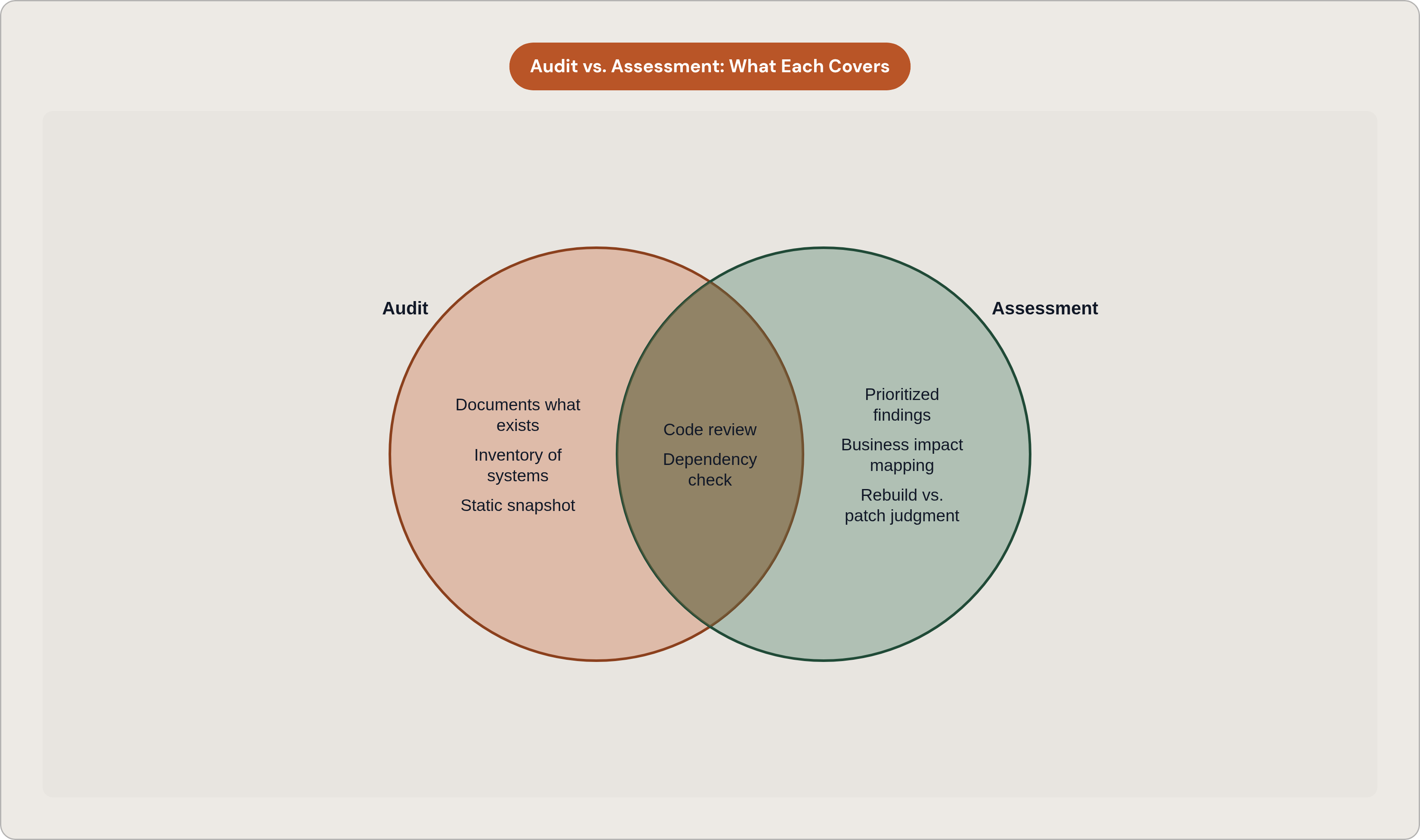
People throw around "audit" and "assessment" like they mean the same thing, but they don't, and that mix-up is where a lot of founders get led astray. An audit documents what's there, while an assessment judges how bad it is, ranks the problems, and turns findings into decisions you can act on. Sounds like a small distinction, until you're the one who paid for the wrong document.
A real assessment covers four areas. Code and architecture is the one everyone thinks of first, so let's start there. Static analysis tools like SonarQube pull coverage numbers, churn rates, coupling issues. The Technical Debt Ratio (TDR) expresses how much it would cost to fix everything as a percentage of what it cost to build in the first place: remediation cost divided by development cost, times 100. A team sitting at 10% is spending one hour cleaning up old messes for every ten hours of new work. Under 5% is generally considered healthy, and test coverage above 80% is another good sign. Code churn above 15%, meaning the same files keep getting rewritten over and over, tells you something in that area never stabilized.
Infrastructure and dependencies come next. Outdated libraries, no CI/CD pipeline, deployments still done by hand, someone SSHing into a server at 11pm to push a fix: these are signs engineering discipline never got past the early scramble phase.
Process and team come after that. Can this group ship safely on a predictable timeline? Do their estimates hold up, or does every sprint run long, and how often do they actually deploy, once a day or once a quarter?
Knowledge debt is the one founders underestimate most, and I'd argue it's the one that should worry them most too. If the only person who understands how the billing system talks to the CRM is one engineer who might leave next quarter, you're renting one person's memory instead of owning a stable product. Missing documentation never shows up as a bug on a ticket. It slows down every handoff and every new hire from that point forward, quietly, in a way that's almost impossible to price until you're three weeks into onboarding someone and realizing nobody wrote anything down.
Serious assessments score all four areas on a shared scale, so the founder and the technical side end up speaking the same language instead of past each other. Green: coverage above 80%, no critical vulnerabilities, debt that's tracked and manageable. Yellow: coverage in the mid range, some known vulnerabilities, debt growing but not yet out of control. Red: coverage well under half, critical vulnerabilities sitting unpatched, no real standards guiding the codebase.
What you walk away with is a prioritized list, and that's something you and a prospective partner can actually sit down and argue about together, line by line.
Five signals that debt has moved from manageable to systemic
Some red flags are minor, while other combinations point toward a rebuild, and it helps to know the difference before someone with a sales quota tells you what to think.
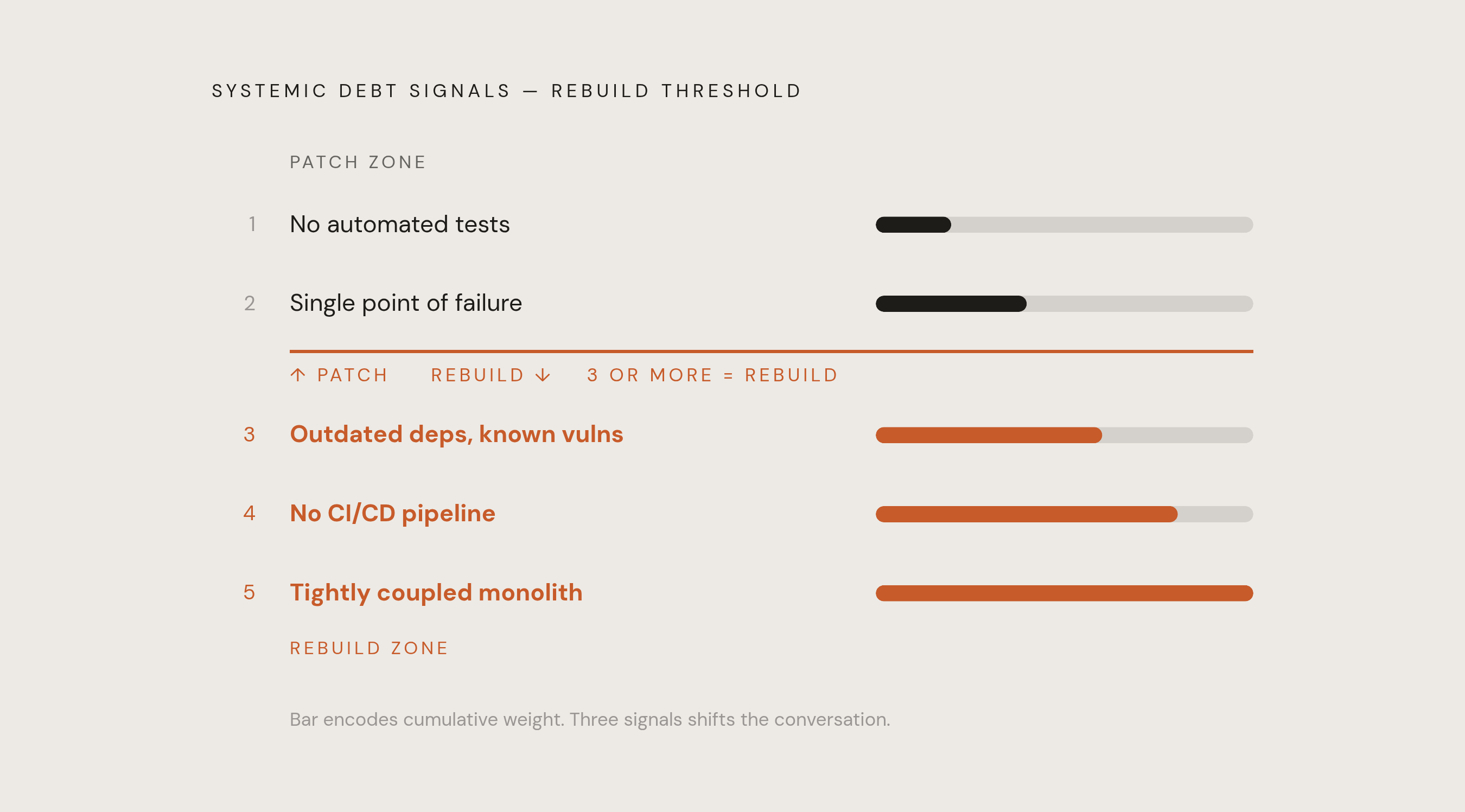
No automated tests. If the team can't verify a change hasn't broken something else, every release is a bet.
A single point of failure on the team. One person carries the critical knowledge, and if they get hit by a bus, or just take a job at Stripe, engineering stalls.
Outdated dependencies with known vulnerabilities. This one stays quiet until it isn't, and nothing looks broken until suddenly it very much is.
No CI/CD pipeline. Manual deployment means the engineering practice never grew up, and it taxes every single release.
A monolith with everything tightly coupled. Touch one part, break three others you didn't know were connected, because the system fights growth by design.
Here's the threshold worth remembering: three or more of these together usually means the product needs a rebuild rather than a patch job. That's a different budget conversation than "let's clean a few things up," and pretending otherwise wastes everyone's time.
Security deserves its own callout. The 2024 Synopsys Open Source Security and Risk Analysis Report found that roughly three-quarters of codebases now carry at least one high-risk vulnerability, up sharply from just two years earlier, and nearly all codebases carry at least one known vulnerability of some kind. That statistic won't tell you exactly what's wrong with your system, but it does tell you "we haven't had a breach yet" isn't evidence of anything.
Knowing which of these five apply to you changes the conversation with a partner. Instead of asking "can you fix this," you're asking which pieces need a full rebuild and which can get handled while the business keeps moving.
How nonprofits accumulate debt differently, and why it compounds faster
Nonprofits get to technical debt through a different door, and the pattern rarely starts with cutting corners to launch fast. It starts with staying on systems the organization quietly outgrew years back.
Matt Unterman, a Partner at Grant Thornton, frames it well: a lot of nonprofits run on tools they picked when they were smaller, and the organization has since scaled or shifted its mission past what those tools were ever built to handle. The software didn't fail; the mission grew past it, which is a much harder thing to catch happening in real time.
There's a pattern that shows up again and again, almost like clockwork. A junior administrator, hired under a tight budget, adds fields and automations reactively, solving today's problem with no architectural plan behind it. Each fix makes sense on its own, but stack ten of them and you get friction nobody designed on purpose, the kind where three people are manually reconciling a spreadsheet every month because two systems that should talk to each other don't.
Research from Synoptek on nonprofit technology turned up patterns that show up across the sector pretty consistently: core software running more than a decade old, hardware pushing past five years, tools sitting mostly unused while budget still goes toward licensing them, integrations that quietly fail without anyone noticing for months. There's a more forward-looking number too, and it's the one that sticks with me: sixty-eight percent of organizations say legacy systems are actively blocking them from adopting AI tools. For a nonprofit trying to do more with a smaller team, that's a heavier cost than it sounds, since AI tools are often the most realistic path to stretching thin staff further.
Bhaskar Jayakrishnan of Cisco calls technical debt a hidden tax on mission delivery. For a nonprofit running on a tight budget, that tax rarely shows up as a line item anyone can point to. Instead, it shows up as staff time pulled away from the mission, and as program dollars quietly rerouted to keep old systems limping along instead of going where they're supposed to go.
The knowledge debt problem is sharper here too, since staff wear multiple hats, volunteers rotate through, and part-time admins come and go every year or two. When the person who built the CRM workflow three years ago moves on, that institutional knowledge usually leaves with them: undocumented, unrecoverable, gone.
So what does a good partner look like in this world? One who understands a nonprofit runs on budget cycles and mission-first decisions, and who knows bringing the board and staff along matters as much as the technical fix. Technical skill alone doesn't cut it here, and I've watched good engineers fail nonprofit clients precisely because they treated the engagement like any other client.
Translating technical findings into language a founder can use in a partner conversation
Founders without an engineering background walk into these conversations at a real disadvantage. They know something's off but can't name it precisely, and that gap makes it easy to accept whatever diagnosis sounds most confident, even though confidence and correctness have nothing to do with each other.
The fix is translation. Every technical finding should map to a business consequence the founder already understands and already cares about.
A security gap becomes a potential data breach, legal exposure, a hit to user trust. A key-person dependency becomes: if this engineer leaves, who keeps the system running next Tuesday? No CI/CD pipeline becomes two extra days tacked onto every release, which adds up fast across a year of shipping. Tight coupling in the architecture becomes: every new feature from here on costs more and takes longer than it should, and that gap widens with each release instead of shrinking.
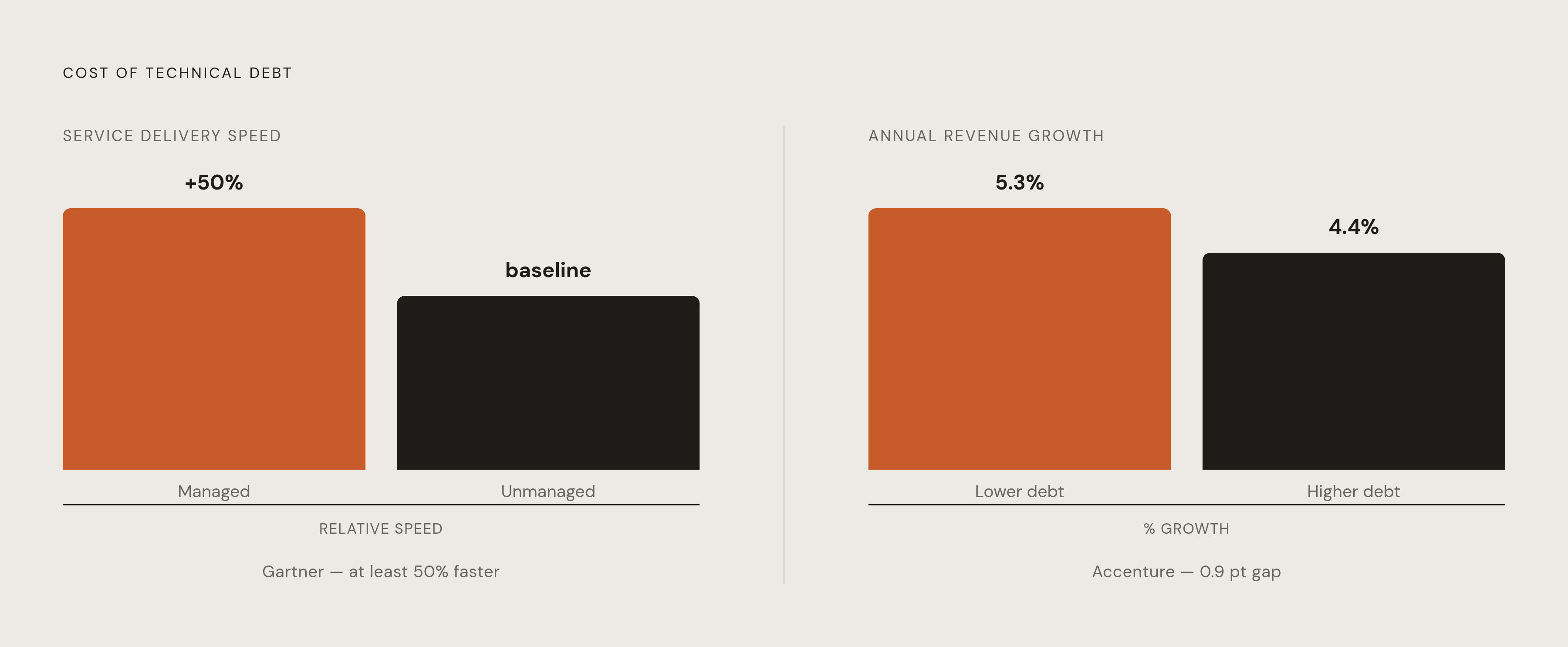
The upside is worth naming too, and it's the part founders tend to skip. Gartner has found that companies actively managing their technical debt see service delivery speeds improve by at least 50%. Accenture's numbers point the same direction: companies carrying lower technical debt post revenue growth around 5.3%, versus 4.4% for companies weighed down by heavier debt. It's not a huge gap on paper, but compounded over a few years of growth, it's the difference between raising your next round on your terms or someone else's.
Before the first call with a prospective partner, write three things down: a summary of the red flags you've found, a plain-language translation of what each one costs the business, and a list of open questions about what fixing it would actually take. The goal is walking in with enough grounding to tell whether the person across the table is diagnosing your system or selling you a solution they'd already decided on before the call started.
What a serious engineering partner does differently during the assessment phase
Here's a simple test: if a partner hands you a proposal before they've finished assessing your system, they're selling, not diagnosing.
A serious assessment looks different in practice. They ask about your TDR, your test coverage, your CI/CD setup, your dependency hygiene, not just "what do you want to build next." They treat knowledge debt as its own risk category instead of an afterthought buried under code quality. They hand you a prioritized list of findings instead of a single sweeping verdict like "you need a full rewrite," because a sweeping verdict is usually a sign nobody actually looked closely. And they can tell you which debt has to clear before you scale, versus which can get managed in parallel while the business keeps moving.
Watch for the mirror-image red flags on the partner side too. They tend to track the codebase red flags pretty closely, which makes sense once you think about it: sloppy diagnosis produces sloppy proposals.
There's no structured discovery phase before scoping work starts, often just a fixed-price bid for a system they haven't actually looked at, followed by a plan to build it, hand it off, and vanish, instead of staying on as an ongoing partner. Pricing gets pitched as the headline instead of any real demonstrated understanding of what's actually wrong.
For nonprofits, there's an added layer. A partner who doesn't factor in stakeholder buy-in, budget cycle timing, and mission-first decision-making isn't built for that environment, no matter how sharp their engineering looks on paper.
The stakes are real. Eighty-eight percent of IT leaders say they're worried technical debt is hurting their competitive position, with 29% calling that concern clear or significant. A partner worth hiring gives that number real weight, rather than treating it as background noise or a slide in a deck nobody reads twice.
How to structure the pre-engagement conversation once you've done your homework
Once you've done this work, the conversation changes shape. "We need to rebuild" turns into "here's what we found, here's what it's costing us, here's what needs fixing first." That shift alone puts you in a much stronger position walking into any partner meeting, and it's the difference between being sold to and actually negotiating.
A few questions worth asking directly. What does your discovery and assessment process actually look like before you scope a rebuild? How do you tell debt that blocks scaling apart from debt you can manage incrementally? What does the relationship look like after the initial rebuild ships, and do you stay involved, in what capacity? How do you handle knowledge transfer if key people on your team roll off the project? What does a healthy codebase look like to you at six months, at twelve?
Good answers sound specific. They name a methodology instead of a vibe, and they admit tradeoffs instead of promising a clean fix with no downside. They spell out exactly what the partner is on the hook for going forward, rather than pitching the fastest, shiniest version of a solution.
And if you built on AI-generated code or no-code tools to get to market fast, this isn't a conversation about shame. Taking on debt on purpose to reach the market first is a predictable stage of building something real. A partner worth working with understands that, and starts from where you actually are instead of where they wish you'd started.
At QUWA Labs, every engagement opens with a discovery and assessment phase before anything gets scoped. That's the diagnostic step, treated as essential rather than rushed through on the way to a proposal. The relationship doesn't end when the rebuild ships either. Staying on as an ongoing technical partner means the founder can put their attention back on GTM instead of getting pulled into production fires every few weeks.
The real benchmark for a good partner conversation isn't how confident they sounded in the room. It's whether you walked out knowing what's actually broken, what order it needs fixing in, what the partner is on the hook for, and what the product should be able to do once the work is done.