Red Flags in Software Agency Proposals
Spot structural warning signs in proposals before your project derails.

Software projects fail at a rate that should alarm anyone about to sign a contract. The Standish Group's 2023 CHAOS Report found only 29.7% of software projects fully met their time, budget, and quality goals; 49.2% were challenged, and 21.1% failed outright. McKinsey's 2020 research on large IT projects found average cost overruns of 45%. The most telling number comes from the British Computer Society's 2025 UK Software Project Outcomes Report: 58% of custom software projects hit significant scope, timeline, or budget deviation in their first six months, and most of those projects showed warning signs before the contract was ever signed.
That last finding changes how you should read a proposal. Failure is a trajectory that gets set before any code gets written, not something that happens to a project midstream. Founders tend to judge proposals on price and how confident the agency sounds on the call, but the signals that actually predict what happens to your project are structural and linguistic. They're buried in how an agency scopes the work, prices it, and writes about it. A proposal is a diagnostic tool that tells you how an agency thinks, before you've handed over a dollar.
Why a proposal that arrives too fast should slow you down
An agency that sends you a detailed proposal within hours of a first call is guessing, not drawing on experience.
Real scoping has to account for your business model, your customer journeys, your operational workflows, whatever compliance requirements apply to you, your internal processes, and where you want the product in two years. None of that surfaces in a 45-minute call. If a proposal shows up before an agency has asked about any of it, the numbers in that document came from somewhere other than your actual project.
There's a business reason this happens so often. Agencies compete to win deals, and a rough estimate sent fast beats a careful one sent slow, at least in terms of closing the deal. The plan is to "adjust later." That adjustment is scope creep, and the budget tension it creates is baked into the proposal from day one, not a risk that might show up down the line.
What does a good process look like instead? An agency that asks more questions than it answers on early calls, that wants documentation, system access, or a walkthrough of your current process before it will commit to a number, and that treats the proposal as something that comes out of discovery, not something that replaces it.
Here's the part that feels backward at first: the agency asking hard questions and taking longer to respond is the one showing you the judgment you actually want applied to your codebase. Speed at the proposal stage is not a preview of speed during development. If anything, it's the opposite.
What vague scope language is actually telling you
Compare two lines from a scope document. One says "User Profile." The other says "User Profile module including avatar upload with basic cropping, password reset flow via email token, personal information editing, and paginated transaction history." The first is a label, while the second is a deliverable you could actually hold someone to.
Payment integration is a good test case. "We'll integrate a payment gateway" tells you nothing, and that's the problem. Stripe, PayPal, and Braintree have different APIs, different documentation quality, and wildly different integration timelines. If the agency hasn't picked one by proposal stage, they've scoped the idea of the work rather than the work itself.
Testing language works the same way. "Testing included" could mean anything from a developer clicking through the app once before deploy to a real QA process: manual testing on physical iOS and Android devices, automated regression suites, defined load testing thresholds. The gap between those two things is the gap between QA as a practice and QA as a line item added to make the document look complete.
Vague scope isn't an accident. It gives the agency maximum room to reinterpret what was agreed to later, and it leaves you with no contractual ground to stand on when a feature shows up half-built or different from what you pictured. Try this when you're reading a proposal: for every abstract phrase, try to substitute something concrete. If you can't, that's not a wording problem, because the agency hasn't done the thinking yet.
The "yes-agency" problem: when agreement is the warning sign
An agency that agrees with everything you propose feels great in the moment: accommodating, confident, easy to work with. It's also a warning sign.
Professional engineers push back on ideas that won't work as described, on features that blow the budget, and on requests that create problems three phases from now. If none of that pushback ever shows up, one of two things is true: the agency doesn't understand your scope well enough to see the problems, or it understands them and doesn't care enough to raise them before signing.
CB Insights found that 35% of startups fail because they built something nobody wanted. The most common failure mode in this industry is a founder who asked for the wrong thing and an agency that took the order without comment — more often than it's a developer who wrote bad code.
Good pushback in a proposal has a shape to it: assumptions get flagged explicitly, alternative approaches show up with tradeoffs spelled out, certain features get deprioritized with a stated reason why, and open questions get named as things the agency wants answered before committing to a technical approach.
Skip that step, and here's what happens instead: every feature gets built exactly as scoped, the product ships, and only afterward does it become clear the architecture can't support what phase two needs. Nobody told the founder beforehand, because nobody on the agency side was willing to say it. A partner who disagrees with you in week one is cheaper, by a wide margin, than one who agrees with you until month six.
How pricing structure reveals whether a project is set up to succeed
Run the arithmetic on any proposal before you sign it. If the total project fee barely covers what the assigned developers cost at market rate, the math doesn't work, full stop. Somewhere, the agency will make up the difference: change orders later, or cut corners now.
Both paths land you in the same place: a product that costs more than quoted, takes longer than promised, and performs worse than what the proposal described.
Payment structure tells you almost as much as price does. An agency asking for a large share upfront, with nothing tied to actual deliverables, is either underfinanced and needs your deposit to stay solvent, or it's simply collecting deposits as a business model. Neither of those produces good software for you.
Compare that to milestone-based payment: money released against defined, verifiable outputs, such as a working module, a test suite that passes, or a staging environment that's actually deployed and reachable. That structure ties payment to proof, not to time elapsed or meetings attended.
The worst time to discover an agency is the wrong fit is three months and a large chunk of your budget into the engagement. Payment structure is one of the few levers you get to pull before that point, while you still have leverage. The goal isn't the lowest price on the page, but a pricing structure that holds both sides accountable for the same outcome.
Portfolio claims that don't hold up under basic scrutiny
An agency's portfolio deck is marketing material, and fair enough, that's what a pitch is for. The question worth asking is what it's marketing toward: closing the deal in front of you, or proving delivery that actually happened.
Real delivery experience has specific fingerprints: a live URL you can visit, a production system handling real traffic, a former client willing to get on a call with you. What doesn't count is a Figma mockup dressed up as a finished product, or a testimonial quote with no company name attached to it.
Ask direct questions about any case study on the page: Is this live right now? Can I see it myself? Can I talk to someone who actually used it? Did it launch on time and on budget, and if not, what happened and how did the agency handle it?
A logo tells you nothing about what got built for that company, whether it shipped, or whether that company would hire the agency again. Showing a recognizable brand mark is the easiest way to fake credibility.
AI claims are the newest version of this same pattern. Most agencies will tell you they "use AI" somewhere in their process. Few can explain exactly how, and that vagueness matters: AI-generated code pushed to production without review is a reliability risk, not the efficiency win it's marketed as. Ask what gets reviewed, by whom, and how.
The cleanest filter here is the reference call itself. An agency with real delivery history will connect you with a past client without hesitation. Reluctance, delay, or a sudden inability to find someone willing to talk, that's information too.
What the contract's IP and governance terms reveal about the relationship ahead
Contract language exposes more about an agency than the pitch deck ever will. Per the vendor-assessment research firm Hireplicity, three terms carry high severity as red flags: conditional intellectual property assignment, a governing law clause with no arbitration mechanism attached, and refusal to name the specific developers assigned to your project.
The IP point deserves a closer look, because it trips up more founders than it should. Under U.S. Copyright Office Circular 30, software isn't among the nine categories eligible for work-made-for-hire treatment automatically. A contract that leans only on "work for hire" language may transfer nothing at all. It needs an explicit copyright assignment clause, or you may have paid for code you don't actually own.
Why would an agency resist naming the developers on your project? Because naming them creates accountability. If the team swaps out mid-project, and it often does, you have no contractual basis to object unless specific people were named as part of the deal.
Then there's the absence of a named project manager. A proposal that hands you engineers with no coordination structure around them means you become the de facto project manager, chasing updates and resolving conflicts, a full-time function nobody mentioned in the sales call.
What all of this adds up to: the governance section of a contract tells you who's accountable when something goes wrong, and whether you have any real way to escalate, adjust, or walk away if it does.
Technical debt as an undisclosed term in a proposal that skips architecture
Ward Cunningham coined the term technical debt to describe shortcuts in code as something borrowed against the future: you get speed now and pay it back later with interest. You get speed now, and you pay it back later with interest: slower delivery, higher maintenance costs, systems that break more easily under pressure.
Some proposals load that debt onto you without ever saying so. Watch for the absence of documentation, a skipped architectural review, QA treated as optional overhead rather than a real phase, no stated deployment approach, and no plan for what happens after launch.
The cost isn't abstract. Developers working in high-debt codebases spend somewhere between 20% and 40% of their time on workarounds and maintenance instead of building anything new. That cost doesn't disappear when the agency hands off the project; it lands on whoever owns the system next, and usually, that's you.
Here's the distinction that actually matters: taking on technical debt can be a smart, deliberate choice. Move fast now, pay it down later — that's a legitimate tradeoff for a founder racing toward a launch date. But it's only a tradeoff if the agency tells you about it, names what's being deferred, and has a plan for addressing it in a later phase. Undisclosed debt is a concealment with your name on the invoice, not a tradeoff.
A technically honest proposal names its shortcuts out loud, explains the reasoning, and specifies what phase-two work will need to happen to clean them up. If that conversation never comes up, that silence is the red flag, not a footnote to it.
Why MVPs attract the proposals most likely to fail at production
MVP projects sit in a uniquely exposed spot. The founders buying them are often first-time software buyers, working under real time pressure, without deep technical context to evaluate what they're being sold. That combination makes every red flag in this piece easier to slip past unnoticed.
Here's the gap that catches people off guard. Plenty of MVPs get built as disposable prototypes, never meant to hold real weight, and then real users show up, real traffic hits the system, and the architecture buckles. It doesn't look like a sudden failure from the outside; it looks like decisions made months earlier, back at the proposal stage, finally coming due.
Practitioners and agency reviewers consistently flag a recurring set of patterns in failing MVP engagements: no discovery phase, meaning requirements got guessed at rather than validated with users; vague estimates with no stated assumptions behind them; no analytics plan for measuring whether the thing works once it's live; QA treated as optional; deployment left undefined; junior-only teams with nobody senior reviewing architecture decisions; and portfolio pages full of branding, empty of outcomes.
Scope creep is the most common thing that kills MVP timelines specifically, and it tends to happen when new features get added before any real user feedback comes in, often because the agency never pushed back on the feature list in the first place. Jobera's 2025 research put overall software project failure at 66%, and the conditions that drive that number — resource constraints, no architecture discipline, no clear QA ownership, no plan for what happens after launch — map directly onto how underprepared MVP builds tend to be structured.
Getting a product launched and keeping it running are two different reliability standards. A proposal that only speaks to the first one has solved half a problem and called it done.
How nonprofits face compounding exposure to these same red flags
Nonprofits evaluate software proposals under conditions that make every red flag harder to spot: limited technical staff on the buying side, timelines compressed by grant cycles that don't bend for anyone, and a mandate to stretch every dollar as far as it will go. All of that makes it easier for a weak proposal to slide through unquestioned.
Watch for the one-size-fits-all pitch. Vendors who claim their platform handles every nonprofit's needs out of the box, with minimal customization required, rarely account for what most nonprofits actually run day to day: donor management sitting alongside beneficiary tracking, compliance reporting, and staff workflows that don't map neatly onto a generic template.
Security deserves more attention than most proposals give it. Cyberattacks on civil-society nonprofits climbed sharply between 2024 and 2025, and the large majority of nonprofits still operate with no formal cybersecurity plan in place. A proposal silent on data encryption and access controls for donor or beneficiary records is a live risk sitting in your donor database, not a gap in the paperwork.
The handoff-and-disappear model does particular damage here. Staff already wearing three or four job titles have no bandwidth left to manage a new system, debug edge cases as they surface, or chase down a vendor who considers the contract closed the day the invoice clears. Ongoing support isn't a nice-to-have add-on for a nonprofit. It's infrastructure the organization can't function without.
What does a proposal built for that reality actually look like? It respects budget constraints without quietly cutting security to hit them, names the specific compliance requirements it plans to address, includes staff training as a line item rather than an afterthought, and says, in writing, what happens after launch.
What a proposal that's worth signing actually looks like
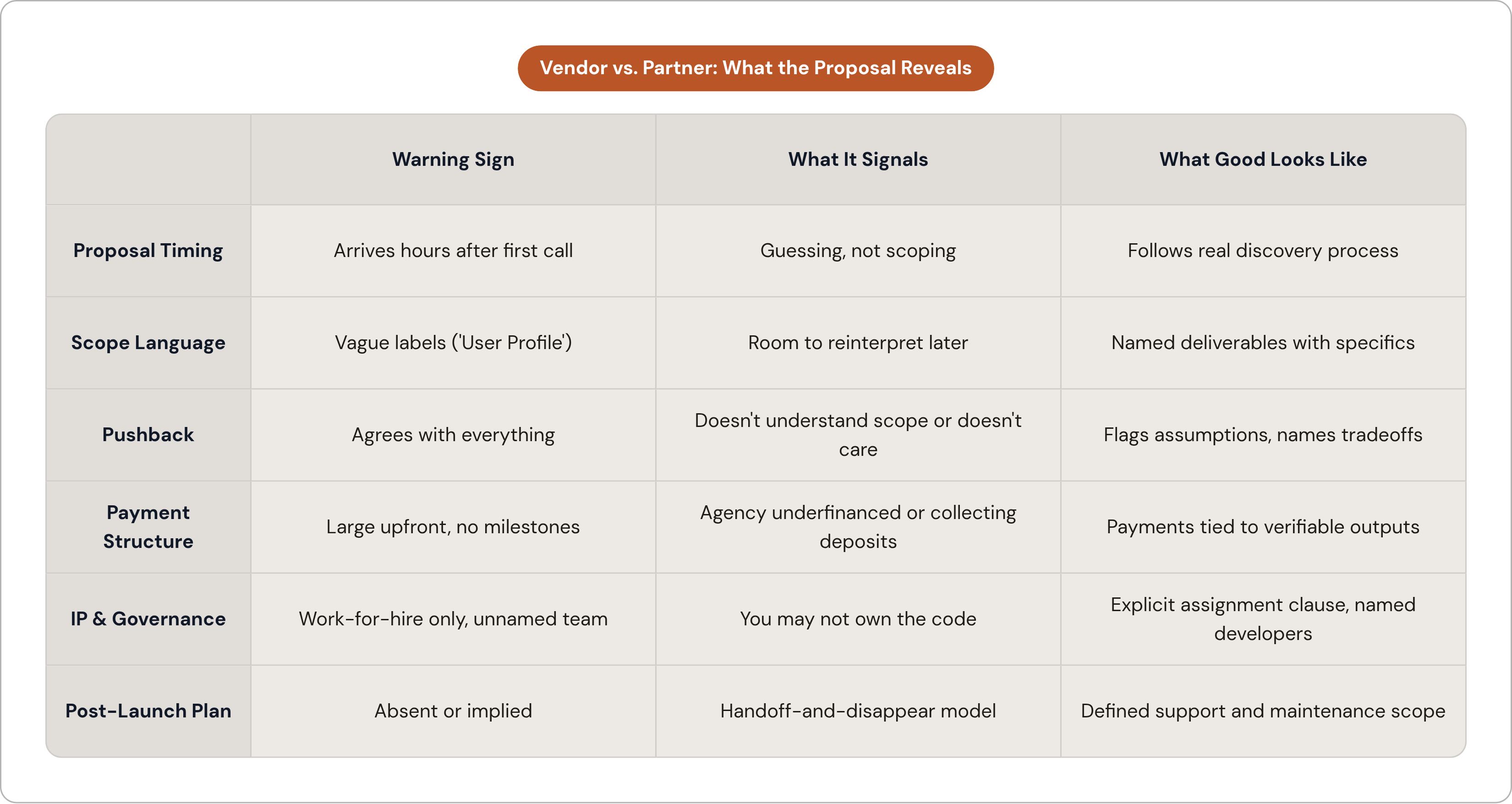
Put the pieces together and a good proposal starts to look pretty distinct from the rest. It arrives after real discovery, not before it, names specific technologies and specific deliverables instead of labels, and explains tradeoffs out loud. It pushes back on scope where scope deserves pushback. Payments tie to milestones you can verify, not to hours logged. Team members are named. IP ownership gets addressed head-on, not implied. There's a plan for what happens after launch, not just before it.
The agency worth hiring asks more questions than it answers in the early conversations. Discovery is the actual product of that first engagement, not a formality standing between you and the real pitch.
Notice what the proposal is really telling you: how this relationship will run once money's on the table. An agency that communicates clearly, scopes honestly, and names its risks before you sign will do the same thing later, when a deadline slips or a technical problem shows up mid-build. That behavior doesn't appear out of nowhere at month four; it's either there from the first document or it isn't.
There's a real difference between a vendor and a partner, and the proposal is where it shows up first. A vendor optimizes for winning the deal in front of them, while a partner optimizes for the outcome on the other side of it. You can see that difference on the page, before a single line of code gets written.
Price is easy to compare across three proposals sitting on your desk. Harder to compare, but more predictive of what actually happens to your project: the quality of thinking behind the document, whether the agency was willing to disagree with you anywhere in it, and whether the structure holds anyone accountable if things go sideways. Founders who read the proposal as a diagnostic, not just a quote, filter out the wrong partners before a dollar changes hands. That's the highest-leverage decision in the entire engagement, and it happens before the contract is even signed.