Contract Structures for Long-Term Engineering Partnerships
Misaligned contract terms make engineering partners disappear when products need them most.

Contract structure is a paperwork detail, but not one you settle and forget. It is the thing that decides whether your engineering partner sticks around when the product gets hard, or ships their piece and moves on. Fixed-price, time-and-materials, and retainer agreements each hand risk to a different party, and each one rewards a different kind of behavior. Get the match wrong for where your product actually sits, and you'll find out the hard way, usually right after your first real users show up.
That's the moment "good enough" stops being good enough. The global IT outsourcing market hit $541.10 billion in 2024, which tells you something important: founders are choosing outside engineering partners constantly, at scale. What that number doesn't tell you is how many of those arrangements are set up to reward a partner for staying invested versus getting rewarded for closing the ticket and leaving. This piece is trying to work through a narrower question: which contract keeps your partner's incentives lined up with what your product actually needs at this stage.
How the three core contract types distribute risk differently
Start with fixed-price. The contractor takes on almost all the risk here: if scope drifts, they eat the overrun, not you. That only works when requirements are genuinely locked in before work starts, and they rarely are. Scope creep shows up in over half of development projects, according to Harvest's research, which means the tidy conditions fixed-price depends on are the exception, not the rule. There's also a quieter issue baked into the model: the partner gets paid for shipping the spec you agreed to, not for making sure the product is actually right.
Time-and-materials flips the risk onto you. You pay for hours worked, whatever the outcome turns out to be, and in exchange you get real flexibility: scope, priorities, and features can shift as you learn more about your own product. It's a natural fit for Agile or Scrum-style work, where the plan is expected to change sprint over sprint. T&M asks something of you too, since someone on your side needs to actively steer direction and check velocity. Passive oversight and T&M don't mix well.
Retainers, or managed services, sit in between. You get a predictable monthly bill and a team whose capacity is reserved for you, and risk gets shared: you commit to the engagement, they commit to being there and staying consistent. Over time, this is what actually builds a working relationship instead of a transaction. The catch is scope creep again, just wearing a different outfit; if the retainer boundaries aren't written down precisely, "what counts as in scope" turns into a monthly argument.
Here's the pattern underneath all three: each one is a different answer to the same question, who absorbs the uncertainty. The right answer isn't fixed, and it depends on how much uncertainty is actually sitting in your product right now.
Why fixed-price works for a defined MVP and almost nothing after it
Fixed-price earns its keep at the start. Requirements are scoped, the timeline has an end date, and the output is something concrete you can point to. MVP builds now run anywhere from $20,000 to $120,000 depending on complexity, and a fixed-price agreement gives you a budget ceiling you can actually defend to a board or a co-founder.
Here's the wrinkle, though: a typical enterprise software MVP still takes seven to eleven months to build. Over that stretch, markets shift, customers tell you things you didn't expect, and priorities move. By the time the thing ships, the spec you locked in at month one may already be a little out of date.
Once that deliverable is handed over, the partner's job under the contract is done. There's no built-in reason for them to care about how maintainable the architecture is, or whether it can handle ten times the users. A partner who builds to spec and walks away is a contractor, and there's nothing wrong with that, as long as you know that's what you signed up for.
One thing that has to be nailed down here, no matter what, is intellectual property. Code, data, integrations, all of it needs to be settled as client-owned from day one, not "upon final payment," and not left ambiguous. Fixed-price is a fine way to start, but it has limits as a structure for building a partnership. The real question is what takes over once the build phase ends.
The rebuild moment: when a founder's product outgrows its original contract
Moving from MVP to production isn't just another sprint with more features bolted on. It's a re-engineering phase: security hardening, scalability work, integration cleanup, architectural fixes that weren't worth doing before real users existed.
AI-assisted and no-code tools can meaningfully compress early MVP timelines. What they don't do is guarantee that MVP survives actual user load or holds up under compliance scrutiny, not without someone going back in deliberately to re-engineer it.
This is where technical debt stops being theoretical. CAST's 2025 analysis, covering over 10 billion lines of code, found 45% of the world's code fragile, 32% bloated, and 31% too rigid to touch without something breaking elsewhere. Developers at the average company spend 33% of their time just managing that debt instead of building anything new. For a team trying to grow, that's not a one-time cost, but drag that compounds every sprint.
So what should the contract actually require at this stage? A partner willing to audit what exists before agreeing to a fixed deliverable, typically through a discovery sprint of two to four weeks that produces architecture diagrams, an integration audit, and a risk register, before anyone signs a rebuild contract, with scope that has room to flex once that audit shows what the original build actually contains, and a path forward once the rebuild wraps, not a handoff and a goodbye. A partner who cleans up the architecture and then leaves has just recreated the exact problem the rebuild was supposed to fix.
Why a retainer becomes the natural structure once a product is live
Once a product is live, the work itself changes shape. It moves away from a project racing toward a finish line, toward an ongoing discipline: reliability, iteration, keeping debt from piling back up.
A retainer reserves dedicated capacity, and that continuity matters more than people expect. The team that rebuilt your product stays on your product, and context doesn't reset with every new engagement. The predictable monthly cost lets you treat engineering as a fixed line item instead of a variable that spikes without warning, which matters enormously for nonprofits and early-stage companies watching cash closely.
The incentives line up better here too. A partner on retainer gets rewarded for the product working well over months, not for how many tickets they closed this week. That long horizon creates real pressure toward quality: cut a corner under a retainer, and you're the one who lives with the consequences for months afterward. Understanding deepens over time as well, since the partner starts to actually know your product, not just the task in front of them.
The risk, again, is scope creep. A retainer needs to spell out what a month of capacity actually covers: velocity targets, categories of work, and what triggers a separate estimate outside that scope. Response times, uptime commitments, and escalation paths belong in the contract itself, not scattered across email threads and Slack messages nobody can find six months later.
None of this means you get to check out, and founders still need to set direction. What changes is you stop firefighting execution day to day and get to spend that energy on growth and go-to-market instead.
How technical debt should be written into the contract, not managed around it
Technical debt isn't a sign someone screwed up. Every product accumulates it, full stop, and the real question is whether the contract has a built-in mechanism to work through it continuously, or whether it just piles up until it becomes a crisis.
Gartner predicts architectural debt will make up 80% of all technical debt by 2027, the kind that AI coding tools can't fix on their own, because it requires system-wide context that no single agent holds.
So what does a debt clause actually look like in a real contract? A defined slice of each sprint, reserved specifically for debt remediation, not left to whatever's left over after feature work eats the calendar, measurable code-quality thresholds, using something like SIG's maintainability ratings, written in as acceptance criteria for deliverables rather than a nice-to-have, and regular architecture reviews built into the normal rhythm of the work, not something that only happens after a crisis forces the conversation.
The cost of skipping this is not abstract. Protiviti's 2025 Global Technology Executive Survey found organizations spend an average of 30% of their IT budgets managing technical debt, and most of that spending is reactive, cleaning up messes rather than preventing them. The State of Software 2026 report puts a number on what a poorly maintained system costs: a 2-star maintainability rating runs to roughly €870,000 per system per year in direct labor alone. Teams that chose the cheapest short-term outsourcing option often saved money up front and paid for it many times over in rework later. A contract that ignores debt is a contract that guarantees the next rebuild.
What the contract needs to cover that most template agreements miss
IP ownership tops the list, and it bears repeating: code, data, and integrations need to be client-owned from the start, with no ambiguity and no "upon final payment" language that hands the vendor leverage at exactly the wrong moment.
For retainers specifically, scope needs real definition. What categories of work does the monthly capacity actually cover, feature iteration, bug triage, infrastructure, debt sprints? What falls outside that, and how does it get estimated and approved? How do scope changes get requested and tracked, in writing, not through a Slack thread that disappears into scroll history?
Performance terms matter just as much: response times for incidents, uptime commitments, clear escalation paths. A broken checkout flow that costs you a customer is also a business event, and the contract should treat it with that weight.
Exit terms deserve attention too, even though nobody likes negotiating them. What happens if the partnership ends: documentation standards, knowledge transfer, a realistic handoff timeline. A partner confident in the value they bring won't fight you on this, and they'll welcome it, because it's evidence the relationship is built on more than just capturing you as a client.
Underneath all of it: the right partner gets chosen the way you'd choose a co-founder. The contract formalizes the relationship, but the fit has to exist before you ever get to the contract.
How nonprofits and resource-constrained founders should think about contract structure
The numbers here are stark. Many nonprofits face rising demand for their services while simultaneously running operating deficits, a combination that leaves little room for error. Many organizations in that position hold only weeks of cash reserves at any given time.
That reality turns contract structure into a survival question, not a nice-to-have optimization. A fixed-price rebuild with nothing set up afterward leaves a nonprofit holding a brand-new system with no partner attached to it, and no budget to hire someone who can keep it running. A retainer, with its predictable monthly cost, is actually the safer choice for an organization watching cash this closely. It turns an unpredictable expense, emergency fixes, one-off vendor calls, into a number you can actually budget for.
Scope discipline matters even more here. Every hour spent outside the agreed scope is an hour eating into a small team's runway, and a carefully drawn retainer protects the nonprofit just as much as it protects the vendor.
There's also the staffing reality: a nonprofit team wearing five hats each can't actively manage a T&M engagement the way a well-resourced product team can, and the contract has to account for that limited bandwidth on the client side. Because mission-first decisions shape everything, the partner needs to actually understand what the software does in the world. Values alignment shapes which trade-offs get made when budget and timeline collide, and they will collide. A technical partner who understands how nonprofits actually operate, limited resources, mission-driven choices, zero margin for a prolonged outage, is a fundamentally different kind of partner than a vendor who simply happens to accept nonprofit clients.
Matching contract structure to where the product actually is
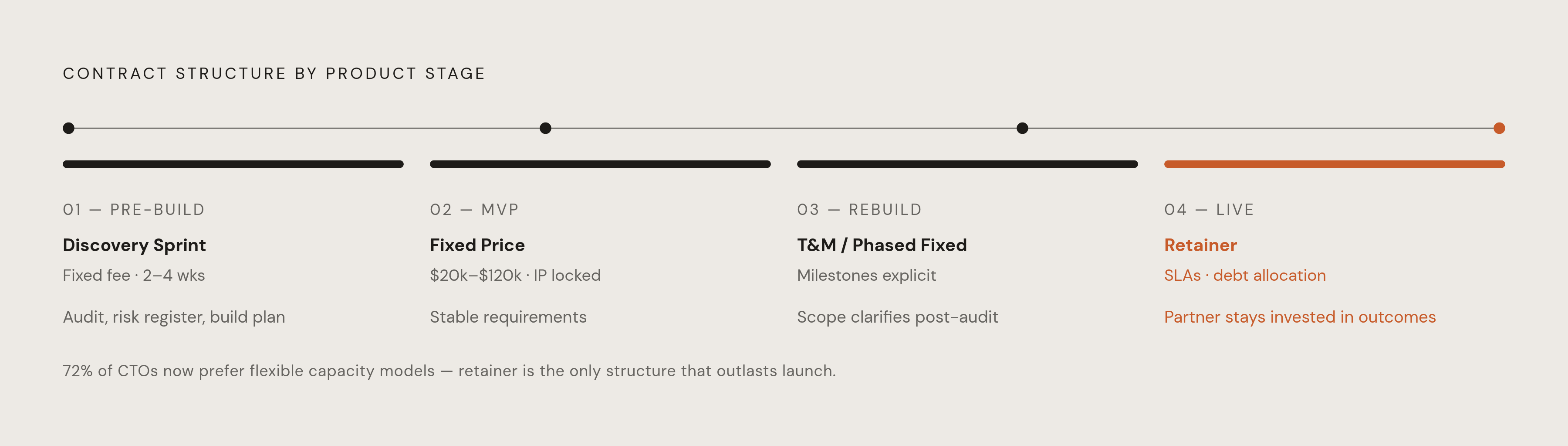
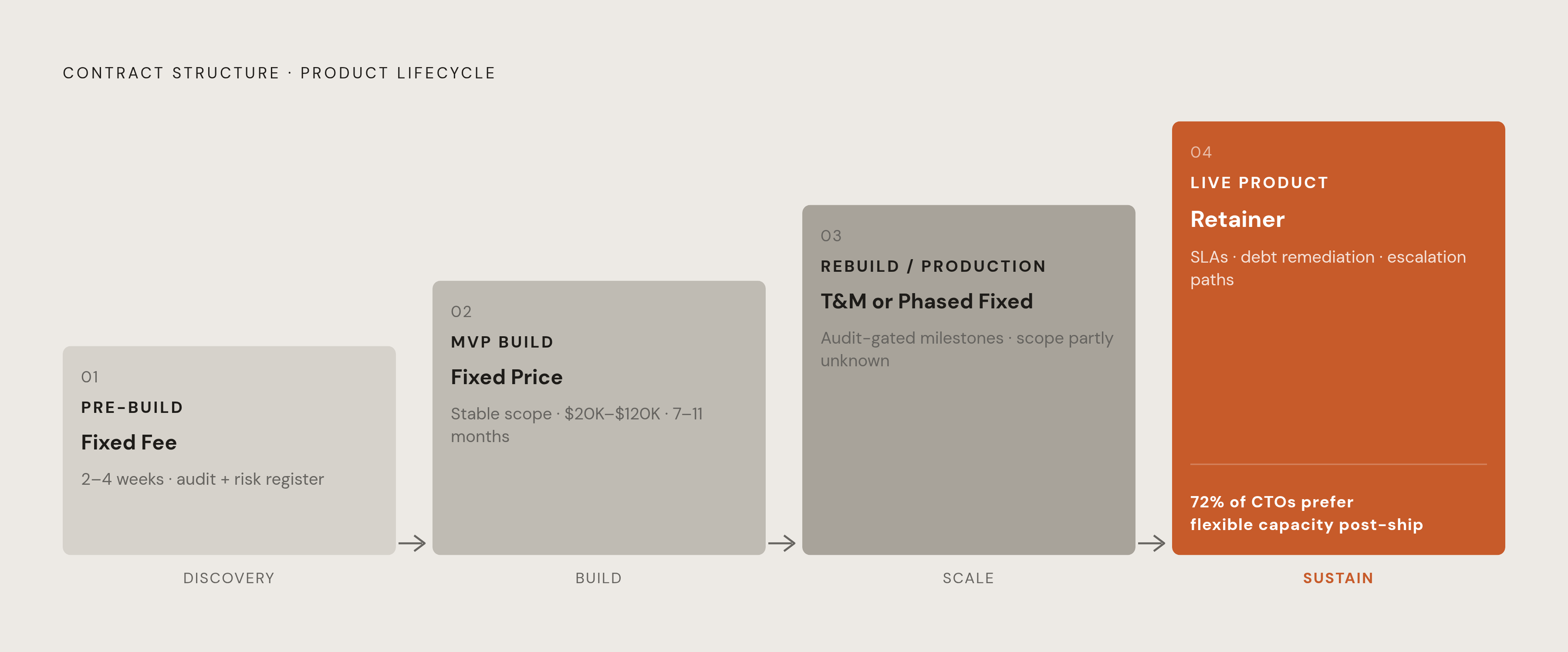
Before any build starts: a bounded, fixed-fee discovery sprint, two to four weeks, before committing to anything bigger. It should produce an architecture audit, a risk register, and an actual build plan. This keeps you from signing a large contract against scope nobody has actually verified yet.
During the initial MVP build: fixed-price can work well, as long as requirements are genuinely stable, and the contract needs IP ownership terms locked down and a concrete definition of what "done" means.
At the rebuild, moving toward production: T&M, or a phased fixed-price built around explicit milestones. Scope is partly unknown until the audit is finished, and a partner who insists on a full fixed-price before ever looking at your existing code is telling you something about their incentives you should pay attention to.
Once the product is live and staying live: a retainer, with defined scope, SLAs, a debt remediation allocation, and clear escalation paths. This is the structure that keeps a partner invested in outcomes, not just in shipping the next deliverable.
Worth noting: 72% of CTOs now say they prefer flexible capacity models, according to a 2024 Gartner survey. That preference reflects a recognition: product cycles move too fast for one contract type to hold up across the whole life of a product.
So at every stage, the question worth asking is simple: does this contract structure give the partner a reason to care what happens after they ship? If the answer is no, the structure is wrong, whatever the price tag says. A long-term engineering partnership outlasts any single contract you sign, and the contract is the agreement, but the relationship is what actually decides whether the product survives long enough to matter. Quwa Labs, a product engineering studio that rebuilds early-stage products for production reliability and stays on as a long-term technical partner through ongoing maintenance, is one concrete example of a studio structured around that model rather than around closing engagements.