How a Monthly Engineering Retainer Replaces the Firefighting Founder
Freeing founders from production chaos to focus on growth and customers.
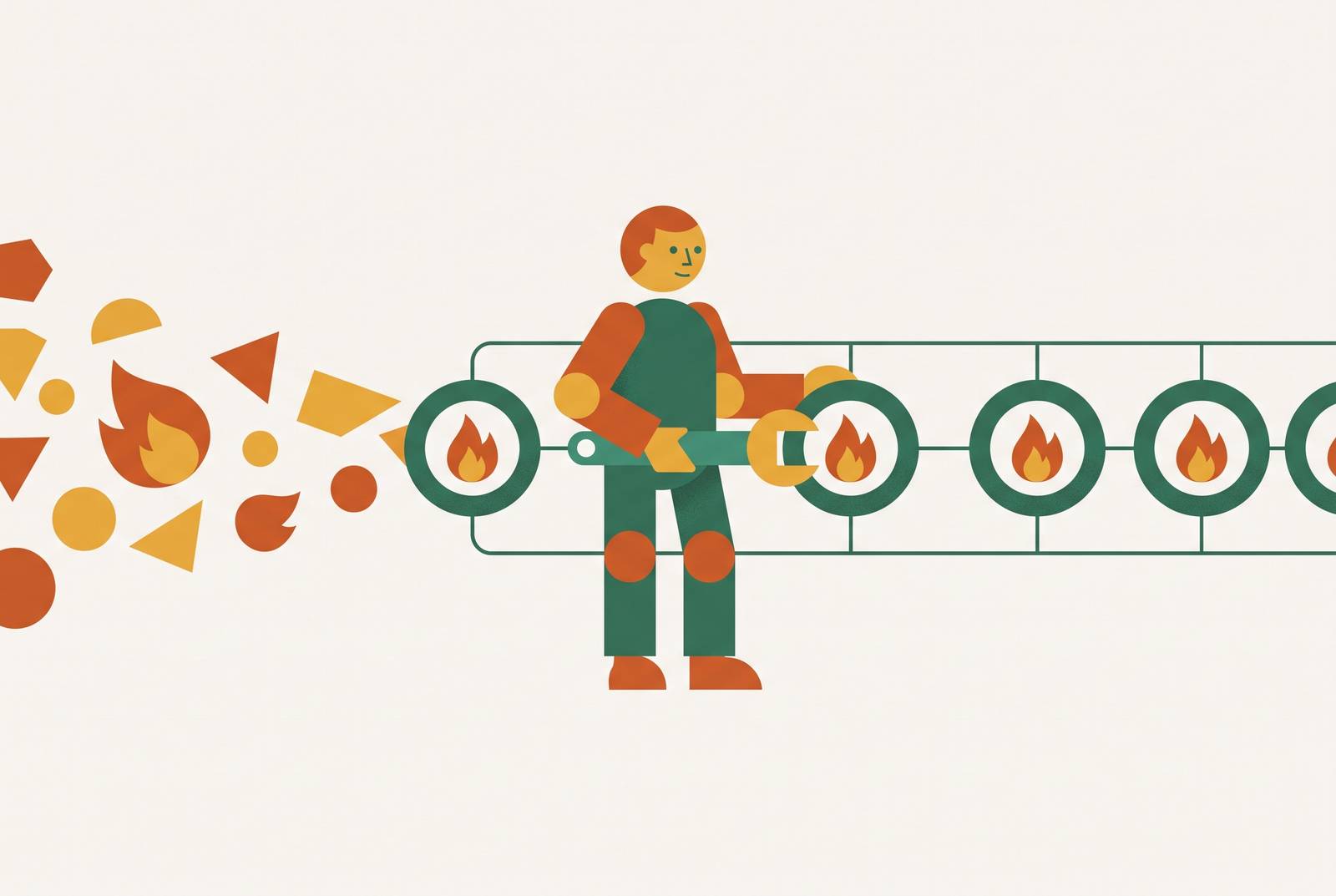
A monthly engineering retainer is an ongoing agreement for engineering support after launch, without hiring full time. For a non-technical founder, its value is not access to hours but the transfer of responsibility for production reliability. Giving the technical foundation an owner frees the founder from chat alerts to focus on GTM.
Why founders end up owning the engineering layer they never meant to own
A chat alert arrives at 11pm, a payment flow breaks on a Monday, or a deployment silently fails. The founder has to find someone who can explain what happened and decide what comes next. Customer support, incident management, and engineering decisions converge on the same desk. This is an architectural mismatch between a product built to launch and one now expected to operate reliably.
Using AI tools, a freelancer, or a no-code stack can be the right call for an MVP. The purpose is to validate the product, and the engineering decisions reflect that constraint. But decisions that help reach the first users do not necessarily support the demands that follow. AI-generated MVPs can sharpen this mismatch when code ships faster than the modular architecture needed to maintain it.
Non-technical founders are especially at risk because it is hard for them to tell a sound shortcut from a weakness in the structure that will last. They trust the people building the product while they focus on customers and growth. Product engineering studios such as Quwa Labs are relevant to that transition because the question has moved beyond getting something built to deciding who will own its foundations. When that ownership remains unassigned, the founder becomes the default escalation point. The firefighting loop is the predictable result of that gap.
What technical debt actually costs a founder who stays in firefighting mode
Technical debt becomes a business problem when maintaining the past consumes a meaningful share of every sprint. The slowdown can arrive gradually enough to seem normal. Work that once took one sprint takes two, and time spent on bug fixes takes time away from planned features. Eventually, the tax on engineering time can exceed the time available for new development. The founder is then paying for engineering without getting the forward movement the business needs.
The cost grows when debt reaches into the architecture. Each new feature creates dependencies on structures that already need replacing, so a later rebuild must untangle those dependencies too. Patching individual symptoms cannot resolve that foundation. Engineers spend more time fighting the codebase, and the work becomes harder to sustain. A partner who owns the rebuild end-to-end and stays to maintain it takes on more than someone hired to clear the next bug queue.
Operations and maintenance already account for the majority of a product’s total lifecycle cost. Cloud consumption, security controls, and ongoing support make launch the beginning of the spending. Firefighting adds avoidable pressure to that operating burden while pulling the founder away from GTM. A broken customer flow can also cost a customer permanently. Reliability thus helps the business grow even as it uses time and money that could go toward growth.
Why hiring a full-time engineer does not close the loop
Hiring a senior engineer is an understandable response, but it does not produce an immediate owner. Engineering roles can take weeks to fill, even with a strong recruiter and a compelling offer. A non-technical founder must also judge candidates but may have no way to tell how sound their technical decisions are. Onboarding then adds time before the hire can make a meaningful contribution. Throughout that process, production incidents still return to the founder.
The cost is broader than salary because a full-time role also brings benefits, equity, tooling, and management overhead. More importantly, headcount and accountability are different things. A single engineer inherits the existing architecture, and without the authority or context to restructure it, may have little choice but to patch it. A long-term technical partner like Quwa Labs represents a different model, in which rebuilding the foundation and remaining responsible for it belong in the same engagement. That distinction depends on the mandate for both employed and contracted engineers.
Ad-hoc freelancer hiring also has a legitimate place. It can deliver a defined piece of work without creating a permanent role, which fits the needs of many launches. A completed project does not, by itself, promise continuing availability or responsibility for later incidents.
In-house hiring is the stronger answer when engineering is the company’s core asset, whether that is a core algorithm, deep domain IP, or a platform intended to evolve for a decade. A stable team and strong engineering leadership make that investment easier to direct well. At the MVP-to-production stage, those conditions are often not yet present. Someone needs the authority and responsibility to make production dependable before an engineering department is built.
How do you keep engineering support after launch without hiring full time?
A monthly engineering retainer keeps a partner working on the product after it is first built. But the label alone says little about what the founder has bought. An agreement for a block of hours may provide capacity while leaving every technical decision and escalation with the founder. An accountability-based retainer instead assigns continuing ownership of the reliability layer.
That transfer includes incident triage, deployment decisions, dependency upgrades, security patches, and performance monitoring. It also includes architectural judgments about whether the foundation can support the next quarter’s roadmap. Product direction, customer relationships, and GTM remain with the founder. The partner makes the engineering decisions it has agreed to own and follows through on them. If the founder needs someone reachable when production breaks at 11pm, that coverage must be part of the agreement.
The incentive also changes when the relationship continues beyond delivery. A partner hired for a project is rewarded for shipping the agreed work, while a partner who stays must maintain what it builds. Maintainable architecture, documentation, and early attention to risks become part of keeping the engagement workable. This does not require an entirely outsourced company. A core team can own product and GTM while a partner owns the technical foundation, with that balance changing as the business grows.
But does ongoing dependence create lock-in? It can, especially when documentation is weak, configurations sit in private repositories, and critical knowledge remains with particular people. Strategic oversight is also not the same purchase as hands-on maintenance and incident response, so scope matters before dependence develops. A contract and working culture can make departure practical through documentation, clear handoff requirements, and knowledge transfer. An accountable partner should be able to explain how the founder can leave before asking the founder to stay.
How QUWA Labs is structured to function as that ongoing engineering partner
Quwa Labs positions its ongoing partnership around founders who have shipped an MVP and now need stronger foundations for production. The proposed starting point is a rebuild where the architecture requires it, rather than an indefinite sequence of patches. That ties the first engineering work to what real users, edge cases, and future features will need. The intended fit is a founder who needs both the foundations addressed and a technical partner who remains involved afterward. It is a broader relationship than commissioning a fix and accepting a handoff.
Its product studio offers frontend, backend, and full-stack development for apps or the web. It also includes data engineering and analytics, AI and machine learning integration, and UI/UX design. That range makes application-level engineering part of the discussion, rather than limiting the engagement to infrastructure upkeep. Its stated process begins with the founder’s vision, followed by joint scoping and planning with a QUWA partner, then building and launching. For a non-technical founder, that process provides a way to define the work without arriving with formal specifications.
Quwa Labs’ public service description emphasizes building and launching products rather than spelling out a post-launch reliability agreement. Its ongoing-partner positioning therefore should not be read as a published promise of particular response times or coverage. A founder considering it would still need the retainer scope to spell out who owns incidents, who does the maintenance, and what a handoff requires. Those details decide whether the founder can step out of the escalation chain.
Quwa Labs also works with nonprofit teams and mission-driven founders. For those teams, constrained budgets, manual tooling, and the absence of an in-house IT function can make continuing ownership especially important. Its positioning places weight on values alignment and a long-term relationship alongside price. That is relevant when technical decisions must fit mission-first priorities as well as production demands. Cultural alignment can support trust, but it should reinforce the practical protections against lock-in.
Other retainer and fractional engineering models worth evaluating
The broader market offers different answers depending on which responsibility is missing. Full-stack product engineering retainers are the closest fit for a founder who needs application architecture, feature development, and ongoing maintenance under one partner. This is the category against which Quwa Labs’ ongoing-partner positioning should be evaluated. Its advantage for the firefighting problem is the connection between what gets built and whether it stays running. Even so, the scope must spell out who owns operations.
Fractional CTO engagements fit founders who already have engineers but lack senior technical leadership. They cover architecture review, technical roadmaps, investor-facing technical credibility, and leadership for important decisions. The brief’s 2026 range is $8,000–$25,000 per month, although the more important distinction is what the engagement includes. These arrangements can improve technical direction, while closing the reliability loop requires someone to own operations, including hands-on engineering and incident response.
Dedicated DevOps or platform engineering retainers fit a narrower operational need. They cover deployment pipelines, infrastructure monitoring, incident response, and security patching on a recurring basis. Their boundary is usually the infrastructure layer rather than application architecture or product development. That can be the right fit when the application foundations do not need rebuilding. If the failures arise from those foundations, however, infrastructure ownership alone leaves part of the problem unresolved.
How to evaluate whether a retainer engagement will actually transfer accountability or just add a vendor
Before signing, ask a partner to explain what a handoff would require. The answer should cover the documentation it would produce, where configurations would live, and how knowledge would transfer. A vague answer leaves it unclear how the founder can leave, however reassuring the relationship feels. Ease of leaving is evidence that the founder retains control while buying support.
Next, ask how the partner handles incidents that fall outside the sprint. If every production failure becomes a separate project-scoping exercise, the founder still has to reopen the commercial discussion before getting help. That is not the same as transferring incident responsibility. The agreement should make clear which operational decisions belong to the partner and what remains with the founder.
Finally, ask what the partner would rebuild and what it would patch. A credible answer starts with an honest assessment of the existing architecture. Technical debt is a predictable stage of product development, but additional features create more dependencies to untangle later. The right time to address it is when real users reveal the MVP’s limits, rather than after a crisis makes the decision unavoidable. If you are spending more than one sprint per month firefighting production instead of building toward your roadmap, the loop is already open.