Fractional CTO vs Engineering Partner for Early-Stage Startups
Knowing which model fits your startup's actual bottleneck saves months of wasted investment.

Fractional CTOs and engineering partners solve two different problems, and I've watched founders confuse them enough times to know it costs real money and real time. One fills a strategic leadership gap. The other owns ongoing execution. Pick the wrong one and you don't just fail to fix the original problem, you usually stack a second one on top of it.
I got interested in this because I kept seeing the same mistake play out with different founders, different industries, same root cause. Fractional leadership used to feel like a workaround, something you did because you couldn't afford the real thing yet. Something like 120,000 fractional leaders were working worldwide in 2024, roughly double the 2022 count. That growth doesn't happen in a niche corner of the market. It happens when a mismatch gets big enough that a whole supply chain grows up to answer it.
So what's the mismatch, exactly? Median seed rounds sit around $3 to 4 million. A full-time CTO, salary plus equity, runs $225,000 to $275,000 a year, and that's before you factor in the three or four months it takes them to actually get useful. Hire one at seed and you've spent 8 to 10 percent of your round before a single line of production code ships. Meanwhile the Bureau of Labor Statistics projects computer and information systems manager roles growing 17 percent through 2033. The senior technical talent pool isn't loosening up. It's getting tighter while demand climbs.
That leaves founders boxed into a bad choice: can't afford a senior person full-time, can't operate without senior judgment either. Fractional and partner models exist to dissolve that binary. Get the model wrong here and you can stall out before you ever reach product-market fit, which is the whole reason I wanted to write this down.
What a fractional CTO actually does — and what people confuse it with
A fractional CTO is defined by what they're accountable for, not by how many hours they log. That's the detail most people miss, and it's the one that actually separates this role from everything nearby that sounds similar.
Three things get confused with it constantly. A consultant hands you a report and leaves; there's no accountability once the deck is done. A technical advisor gives high-level input, maybe a few hours a month, and stays out of day-to-day work entirely. A full-time CTO is permanent, fully embedded, and priced for a company at a later stage than the one you're probably running right now.
A fractional CTO lives in the gap between those three. They join standups, run sprints, and answer for shipping velocity, not just for having smart opinions about it from the sidelines. They own the roadmap and tie it to where the business is actually going. They make hiring calls, shape how the team is structured, mentor the junior engineers still finding their footing. They decide the stack, the infrastructure, the build-versus-buy calls that quietly determine your next two years. They handle vendor relationships too, so you're not the one negotiating with your cloud provider at 11pm on a Friday.
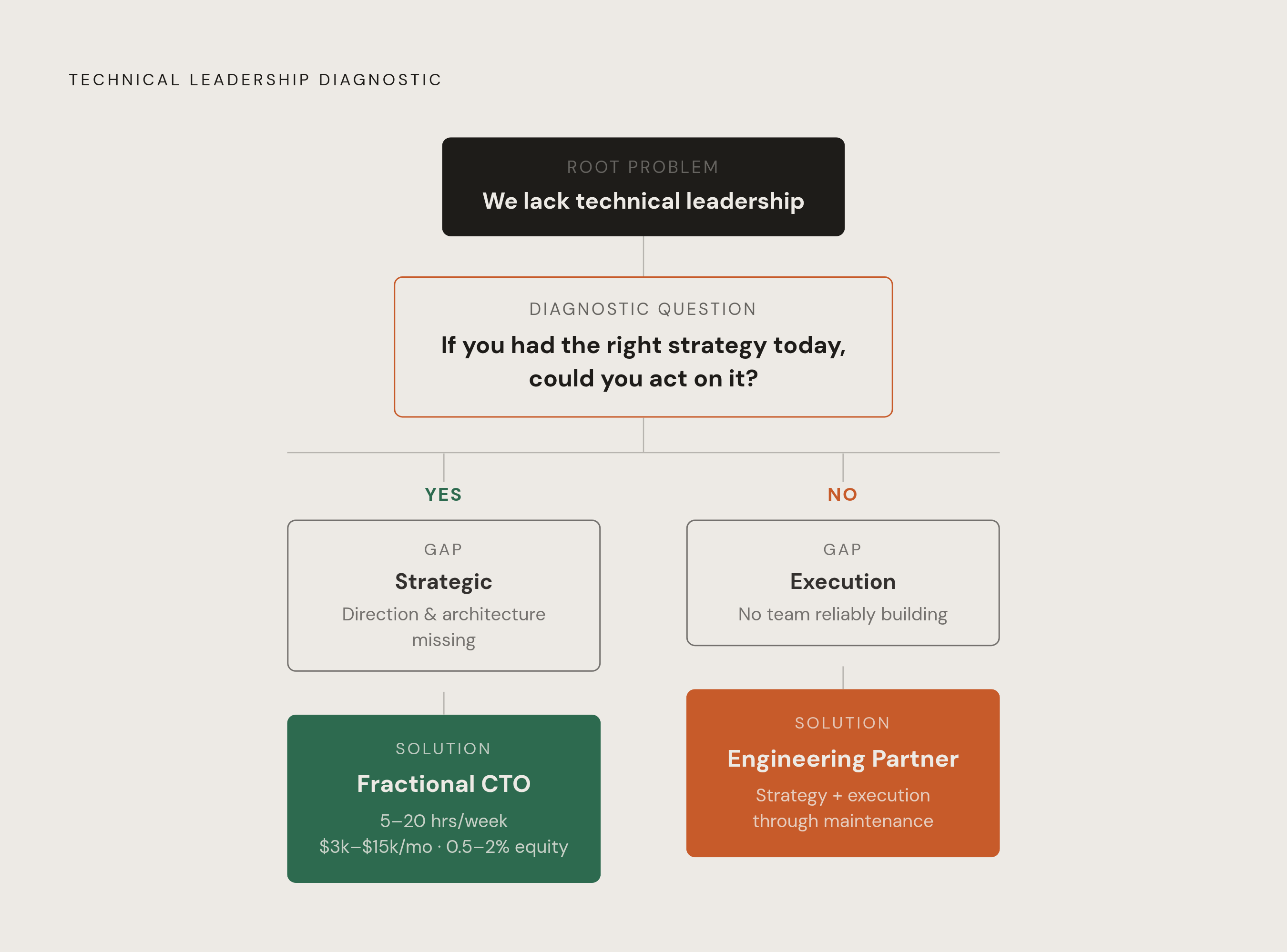
Engagement usually runs 5 to 20 hours a week. Monthly retainers land at $3,000 to $15,000, and equity of 0.5 to 2 percent is common alongside the monthly retainer.
Here's the limitation, and it's worth sitting with: a fractional CTO doesn't hand you engineering capacity. The leader's in the room, but the hands doing the actual building belong to somebody else entirely. That gap, strategy with no one to execute it, is exactly where the next model picks up.
What an engineering partner is and how it differs from an agency
Most founders walk in assuming "agency" means "people who build what I tell them to build." Fair enough, as far as agencies go. But treating an engineering partner the same way is where a lot of founders lose months they didn't need to lose.
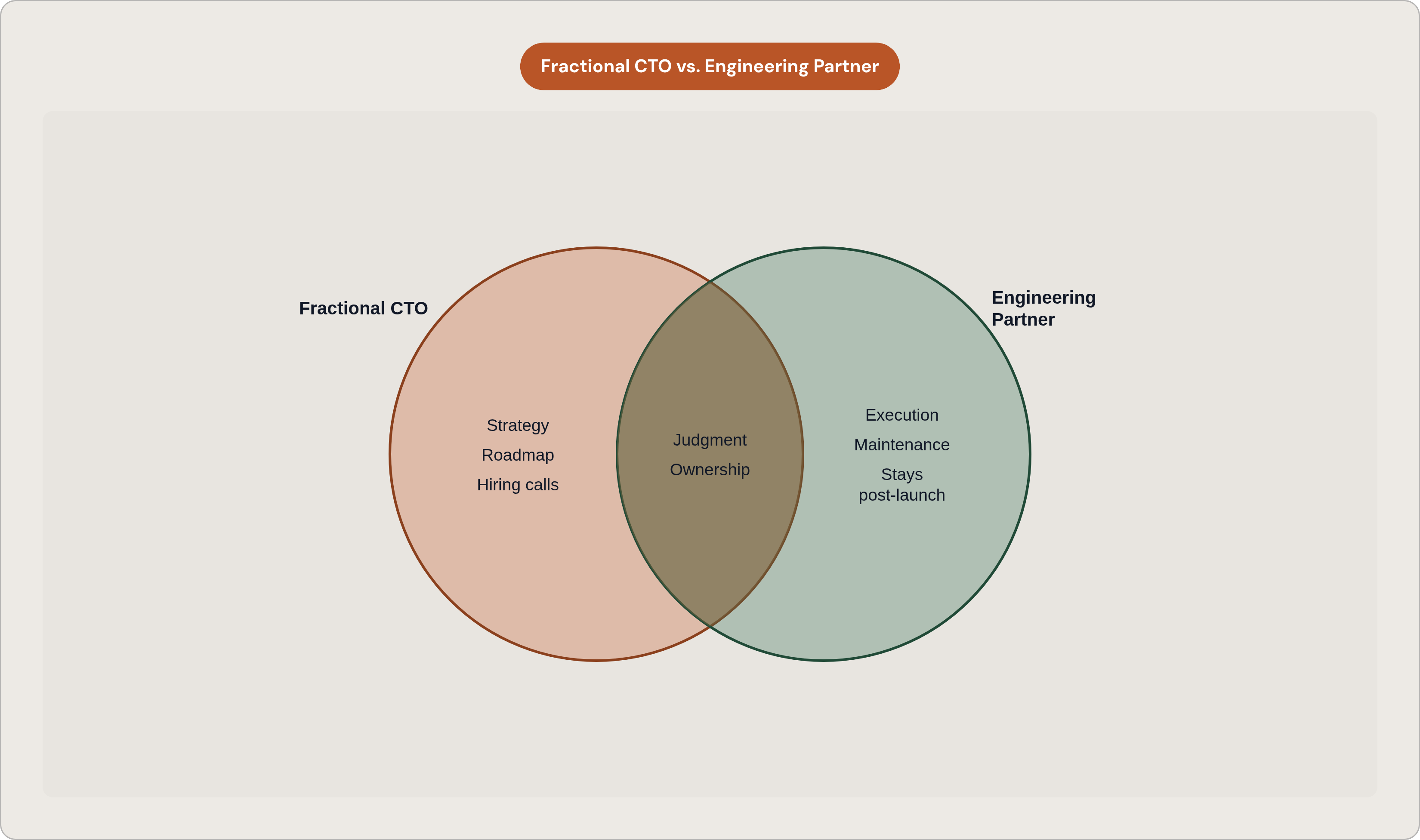
Think of it as a spectrum. An agency gives you execution capacity, builds to spec, doesn't own strategy. A fractional CTO gives you strategy and decision-making with no execution muscle behind it. An engineering partner puts both under one roof, strategy and execution together, which collapses what would otherwise be a two-vendor mess into one relationship.
Why does that collapsing actually matter? Picture the two-vendor version: a fractional CTO directs an outside agency to build something. Now you've got a handoff between two parties who don't share incentives, and something breaks in production. The CTO says the agency implemented it wrong. The agency says the spec was unclear. Nobody owns the outcome; everybody owns an excuse.
An engineering partner also isn't a project-based build shop, even a well-run one. The difference shows up after launch: a partner stays through maintenance, iteration, the next six releases, not just the first ship date. You need this model specifically when you need judgment and hands at the same time, and you don't yet have an internal team big enough to take direction from a strategy-only leader. A real partner pushes back on scope when the scope is wrong, which sets a different tone for the relationship than simply taking build orders.
The gap founders actually have versus the gap they think they have
Almost every founder describes their problem the same way: "we don't have a technical leader." That one sentence is hiding two completely different problems, and fixing one does nothing for the other.
Gap one is strategic. You've got engineers, maybe a small dev team, but nobody's setting direction or owning the architecture. Decisions happen by default, made by whoever spoke last in the Slack thread. Maybe you're heading toward a fundraise and need a technical story that survives due diligence; starting a fractional CTO engagement roughly 90 days ahead of a Series A gives enough runway to get architecture docs and data room materials in real shape. Maybe you just need someone credible across the table from a board member or an enterprise buyer who's going to ask hard questions. If that's you, a fractional CTO is the right tool.
Gap two is execution. The founder can make the calls, that part's fine, but there's no team reliably building and maintaining the thing. Usually there's already an MVP out there somewhere, stitched together with AI tools, a freelancer, a no-code platform, and now real users are showing up and the foundation's starting to creak under them. Somebody needs to build, and stay. That's an engineering partner's job.
Founders get this backwards more often than you'd expect. One with an execution gap hires a fractional CTO, gets a genuinely sharp strategy, and then there's nobody to build any of it. The recommendations pile up in a doc nobody opens again.
Run it the other way and it's just as bad. A founder with a strategic gap hires a build shop instead. Code ships, velocity looks great on the dashboard, and six months later the product has drifted somewhere nobody actually chose, because there was never anyone setting the guardrails in the first place.
One question cuts through most of this mess: if someone handed you the right strategy today, could you act on it? Yes points to a strategic gap. No means your gap is execution, no matter how good the advice turns out to be.
The MVP-to-production transition as the moment the model choice becomes urgent
Getting a product live and keeping it alive are two entirely different reliability bars. The space between them is where the model-choice question stops being theoretical and starts being urgent.
AI-assisted development has compressed MVP timelines by something like 40 to 60 percent, according to McKinsey. That sounds like unambiguous good news, and for a certain kind of founder, it is. Data out of YC's 2025 batch is worth sitting with, though: the founders who built 95 percent of their product using AI tools were, almost without exception, founders who could read the code well enough to catch the AI's mistakes. If you can't read the output yourself, the AI hasn't removed your need for technical oversight, and it may have raised the cost of not having it.
Work that used to run tens of thousands of dollars now lands significantly cheaper for comparable scope. Cheaper, sure. But cheap and production-ready aren't the same claim, and that gap is exactly where founders get burned. The moment real users show up, "good enough for the demo" stops being good enough for anything. Performance issues, reliability gaps, security holes stop being internal embarrassments and start showing up as customer complaints in your inbox.
This is also where technical debt compounds fastest. A bug caught early in development might cost $100 to fix. Leave that same bug until it's live in production, and the fix can run as high as $10,000. That hundred-times jump isn't a scare number meant to rattle you into buying something; it's just the arithmetic of the situation. It's why the model decision matters more at this exact boundary than at any point before it.
For founders sitting on an AI-built or freelancer-built MVP that's starting to buckle, the honest fix is usually re-engineering on solid ground, rather than another round of patches on the existing pile. That's an execution problem, and it points toward an engineering partner.
When the strategic leadership gap is the real problem worth solving first
A fractional CTO earns its cost when you already have engineering hands but those hands don't have anywhere to point. Direction is the shortage, not headcount.
A few signals make this fairly clear. The team exists, but there's no architectural guardrail keeping decisions consistent across sprints. Stack choices get made tactically, one sprint at a time, with no plan behind them. A Series A is three to six months out and you already know investors are going to ask questions your team can't answer well yet. Compliance requirements like HIPAA, SOC 2, or GDPR are landing on your desk and nobody on staff has navigated any of them before. Or the founding team has strong product instincts but nobody able to push back technically when scope starts creeping past what's reasonable.
What you're paying for is a senior voice in the room, on strategy, on vendor calls, on hiring, on architecture, more than additional hands on keyboards. At a few thousand to $15,000 a month against a $350,000 full-time hire, that's the right trade when the bottleneck is judgment rather than raw capacity.
There's a natural graduation point, too. Once the engineering team crosses somewhere around 50 people, a fractional arrangement starts creating its own bottlenecks on the days the CTO isn't around. At that size, honestly, the role has outgrown part-time.
Worth sitting with, though: if the fractional CTO's recommendations need an execution team to land them, and that team doesn't exist yet, you've just paid a lot of money for a strategy document. Strategy with nobody to run it is its own kind of stall, even when every recommendation in it is dead right.
When ongoing execution ownership is the gap that actually blocks growth
An engineering partner fits when the founder can already set direction but needs a team that actually builds, keeps the lights on, and stays answerable to results rather than to a delivery date on a calendar.
The signals here look different. The MVP got built fast, maybe with AI tools or a freelancer or a no-code platform, and now it has to survive real user load instead of a demo in front of investors. There's no internal team to take direction from a strategy-only leader, so hiring one right now would just mean paying for advice nobody implements. The founder's spending the week firefighting production issues instead of running go-to-market, which is a bad trade for anyone's time. Somewhere along the way, a broken flow already cost you a real customer, so reliability stopped being an abstract concern and started being a visible growth blocker you can point to.
What separates a real engineering partner from a build-and-disappear shop is that the partner stays through maintenance and iteration. They function closer to a long-term technical co-owner than a vendor, and they bring architectural judgment alongside the labor hours.
Done well, a good engineering partner can remove the founder's need for a technical co-founder at this stage entirely. They own engineering so the founder can own the customers.
What's worth scrutinizing isn't the rate card. It's fit. Does this partner make decisions the way you would, if you had their depth of expertise, and do they actually understand your users the way you do? Get that wrong and you've solved the obvious problem while quietly creating a new one, which is the exact risk this whole framework exists to head off.
How to read your own situation before committing to either model
Strip the labels away and it comes down to naming the actual bottleneck, not the job title you think you're missing.
If the bottleneck is decisions and direction, you want a fractional CTO. If it's building and keeping things running, you want an engineering partner. If both are genuinely missing at once, start with execution; strategy with nobody to carry it out produces the same stall as having no strategy at all.
A few questions worth asking yourself honestly. Do you have engineers who need direction, or do you have no engineers at all? Is the product live with real users, or still pre-launch? Are you personally spending your days on production fires that shouldn't be your job to begin with? Is a fundraise or an enterprise deal the near-term milestone, one that needs a technical story that holds up under real questioning?
Whatever model you land on, scrutinize the same three things before signing anything. Accountability: who actually owns it when something breaks at 2am? Continuity: does this person or team stay engaged, or hand off and vanish the moment the invoice clears, Quwa Labs, a product engineering studio that rebuilds early-stage products for production reliability and stays on as an ongoing technical partner rather than exiting at launch, is one example of what that continuity can look like in practice? Fit: are they making the calls the way you would, if you had their depth of expertise?
One last thing worth naming honestly: neither of these models has fully settled yet, and the labels are still messy across the market. What one provider calls a fractional CTO, another calls an engineering partner, and a third calls something else entirely on their pricing page. So the questions above matter more than whatever's printed on the contract in front of you. The whole point of working through this carefully is to avoid a hire that looks right on paper while your actual gap sits wide open, unfixed, quietly costing you time you'll wish you had back later.