Technical Due Diligence Checklist for Non-Technical Founders
Prepare for the predictable technical review that will make or break your fundraise.

Technical due diligence will happen to you. If you are a non-technical founder raising capital, someone is going to sit down, or dial in, and systematically evaluate whether your product holds up. The founders who survive that process comfortably are not the ones who built the best code. They are the ones who understood what the review was looking for before it started.
That is what this piece is about: mapping the predictable pattern so you can prepare for it, not scramble through it.
The field calls it an RCIO assessment. Risks, costs, investment requirements, and opportunities. That is the actual deliverable an investor's technical reviewer produces. It tells an investor whether the capital they are about to deploy is going toward growth or toward repair. Your job as a founder, technical or not, is to make sure the answer to that question is unambiguous, and that you can help frame it.
How the Depth and Focus of Technical Review Shifts from Seed to Series B
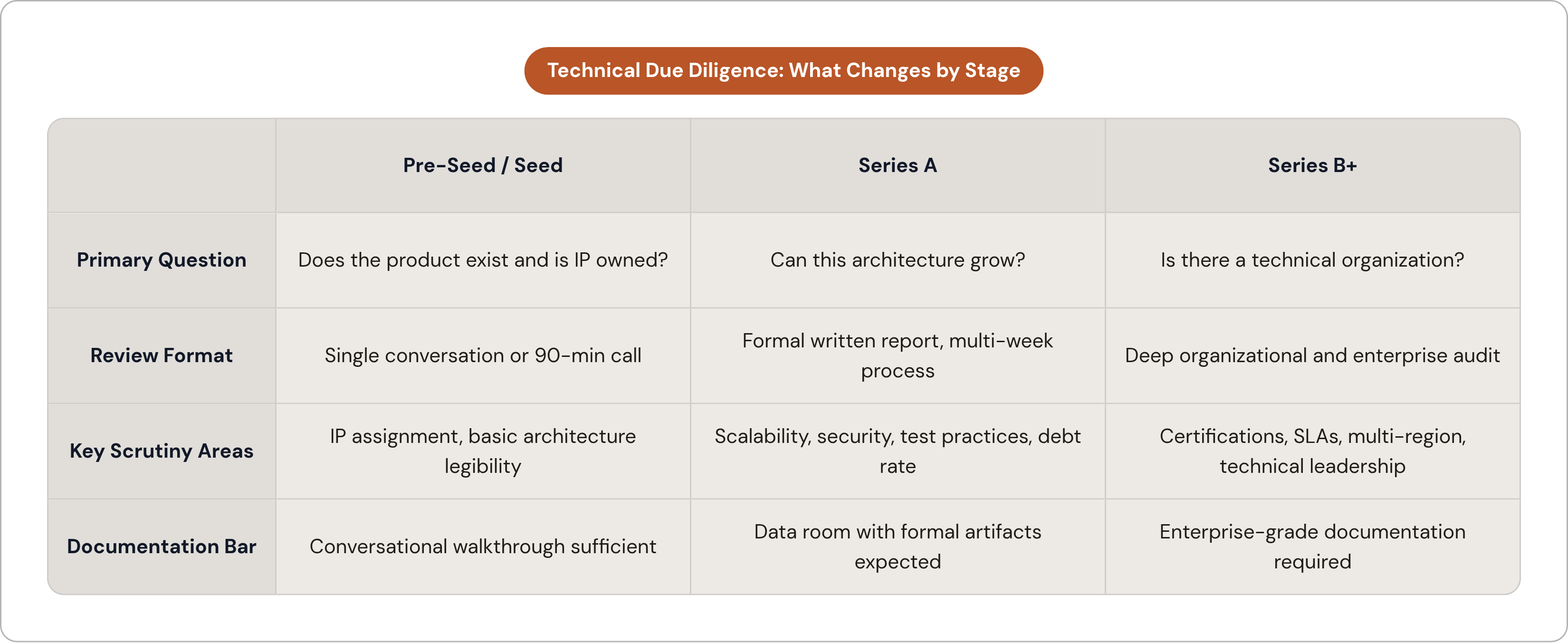
Technical due diligence is not a fixed procedure that looks the same at every stage. The scrutiny intensifies in a fairly predictable progression, which means calibrating your preparation to the round you are actually approaching is itself a strategic decision.
At pre-seed and seed, reviewers primarily want to confirm three things: the product exists, the founding team can execute, and the intellectual property is clearly owned by the company. The review often happens in a single conversation, a 90-minute call with a technical advisor or an investor's in-house CTO. At this stage, basic architecture legibility and clean IP assignment matter more than formal documentation packages. If you can walk someone through how the product is built and demonstrate that you own what you built, you have covered the primary surface area.
Series A is where the process meaningfully changes. Outside technical firms may produce a formal written report spanning dozens of pages. Reviewers begin examining whether the current architecture can absorb a significant multiple of current load without requiring a full structural rebuild. Testing practices, security controls, infrastructure spend, and development velocity all come under examination. Technical debt accumulation rate, not just the existence of debt, becomes a specific data point. The question shifts from "can this team build?" to "can this architecture grow?"
Series B and beyond carries an enterprise readiness bar: certifications, multi-region deployment, defined service-level agreements, audit logs, single sign-on support, and technical leadership that is independent of the founding team. Investors at this stage expect a technical organization, not just a technical product. There is a meaningful difference between those two things.
In practice, formal diligence processes run across several weeks. Document review comes first, then live question-and-answer sessions and product demos. The sequencing matters because reviewers form initial hypotheses from documents and use live sessions to pressure-test them.
The practical implication: know which stage you are approaching and prepare accordingly. Over-engineering a data room for a seed round wastes time and attention you need elsewhere. Under-preparing for a Series A is a common, costly mistake, and it is also avoidable.
What Reviewers Look for in Architecture and Whether the Product Can Scale
The central question a technical reviewer is answering, on behalf of the investor, is this: will this architecture support the growth being funded, or is the capital actually going toward a rebuild rather than expansion?
A single-page architecture diagram is the minimum legible artifact. It should be readable by an engineer who has never seen the system before in under five minutes. It needs to cover the data stores, the services, the third-party integrations, and the trust boundaries: where external systems touch internal ones, where data flows, and where access controls sit. Its absence is not a neutral fact. Reviewers read a missing architecture diagram as a signal that the founder cannot explain their own system, which becomes an immediate credibility problem.
Scalability headroom is one of the primary probes. Can the system handle a significant multiple of current load without structural rearchitecting? The answer does not need to be "yes infinitely." It needs to be honest and specific, accompanied by some awareness of where the ceilings are and what it would take to raise them.
End-of-life dependencies are a specific flag that experienced reviewers always check. Language versions, framework choices, and libraries with approaching end-of-life dates force costly upgrades on a predictable schedule. If your stack contains known end-of-life dependencies within the next twelve to eighteen months, investors treat that as pre-funded technical debt: they are calculating that some portion of the capital they deploy will go to maintenance, not growth.
Infrastructure spend relative to revenue and growth trajectory is another probe. Not just the current number, but the cost structure: does infrastructure cost scale proportionally as the customer base grows, or does the unit economics improve as you scale? A cost structure that degresses with scale is a favorable signal; a cost structure that scales proportionally or worsens is a risk factor.
Disaster recovery posture matters more than most founders expect. Reviewers want to see tested recovery time objectives and recovery point objectives, not aspirational ones. An untested DR plan carries very little weight in a diligence conversation.
What a non-technical founder can actually do here: own the architecture narrative without writing a line of code. Commission the diagram from your technical team, understand what it shows, and practice walking through it at a high level. Know which systems are internal versus third-party. Know where the largest load concentrates. You are not expected to have built the system; you are expected to understand it well enough to describe it. Those are meaningfully different standards.
How Reviewers Read a Codebase Without Reading Every Line, and What Those Signals Mean
Nobody reads every line of code in a diligence review. That would take months and produce diminishing returns. What reviewers are actually doing is pattern recognition: they are looking for signals that indicate how a team builds and maintains software, and whether those habits produce systems that are evaluable by someone other than their original author.
Test coverage is one of the first signals. Do automated tests exist? Do they cover the critical paths through the application, the paths a failure in production would travel, or do they cover only peripheral code that carries little risk? Coverage alone is not the measure; coverage of the right things is.
Commit history tells a story that founders often do not anticipate. Frequency, consistency, and coherence of commits reflect a development process. A commit history characterized by long silences followed by large, undifferentiated bursts of code can suggest panicked development rather than deliberate, iterative practice. Reviewers notice this.
Code review practices are a governance signal. Are changes reviewed by another engineer before they ship, or does one person push directly to production? The answer carries implications not just for quality, but for key-person risk: a system where one person makes all the decisions and handles all the merges is a system that could become opaque or unmaintainable if that person leaves.
Documentation, specifically inline comments, API documentation, and deployment runbooks, determines whether the system is evaluable at all. A system that cannot be explained by its own documentation cannot be evaluated by anyone other than the person who built it. Reviewers who hit an undocumented system do not fill in the gaps with generous assumptions.
One artifact that non-technical founders often overlook: a list of features built and abandoned in the last twelve months, accompanied by reasons. This sounds like a confession, but it is actually a credibility signal. It demonstrates product judgment and self-awareness. Founders who claim no abandoned features are read as either not being truthful or not having enough product history to be meaningful. Neither reading is favorable.
A six-month roadmap with named owners rounds out the codebase-adjacent artifacts reviewers want to see. It is evidence that velocity is real and that the team is making deliberate decisions about what to build next, rather than reacting to the loudest customer or the most recent fire.
On AI strategy specifically: "we use LLMs" is not a strategy. A credible answer names the use case, the approach, the success metric, and the timeline. Vague AI positioning reads as either naivety or theater, and reviewers have seen enough of both to recognize it quickly.
Technical Debt as a Valuation Factor, and How to Present It Honestly
Every codebase accumulates technical debt. Experienced investors know this, they have been through enough diligence cycles to expect it, and they are not surprised by its existence. What they are evaluating is something more specific: whether the team knows what its debt is, and whether it has a credible plan to address it.
A team that cannot enumerate its own debt is a team that has no visibility into its own system. That is a more serious problem than the debt itself. Debt can be quantified, planned for, and priced. Opacity cannot.
The consequence of this is real. A promising SaaS company can lose a meaningful share of its expected valuation when diligence reveals that a core component, often the database architecture, cannot scale beyond current user levels. What the investor calculates as a solvable engineering problem becomes a negotiating point, and it costs founders in dilution. The loss is not because the problem existed; it is because it arrived as a surprise.
The categories of debt that tend to kill or significantly impair deals are not the ordinary accumulated sort. They fall into a few specific risk areas. Security vulnerabilities classified as critical or high severity need to be remediated before a raise, not flagged as future work: flagging them as future work confirms the risk, removes the credit for self-awareness, and leaves the investor holding uncertainty. Single points of failure, where one person's departure would render critical systems unmaintainable, constitute an investor-level structural risk. Documentation gaps make the system unevaluable, which forces the reviewer to assign a risk premium to whatever they cannot see.
The artifact that converts this from a liability into a credibility signal is a technical debt register: a clean, honest list of known debt, prioritized by risk and business impact, with a remediation timeline and named owners. This is a maturity signal, not an admission of failure. It tells an investor that this team sees clearly, plans deliberately, and does not hide problems from itself. That is exactly the team behavior investors are paying to find.
For founders who are actively building and trying to maintain this posture: a consistent allocation of development capacity toward debt reduction, rather than all-or-nothing sprints scheduled around fundraising, keeps the codebase evaluable and the delivery velocity stable. Treating debt as something you clean up before a raise rather than something you manage continuously will eventually catch you in a visible way.
IP Ownership: The Diligence Category Most Likely to Kill a Deal Outright
IP ownership gaps are among the most common reasons diligence processes fail, and they are among the most preventable. This combination makes them particularly painful to encounter after the fact.
The core misconception is widespread and consequential: paying a contractor or freelancer does not automatically transfer ownership of the resulting code to your company. Ownership remains with the creator unless a written agreement explicitly assigns it to the company. This applies to offshore development contractors, early advisors who wrote a few functions, and co-founders who contributed code before they were formally on the cap table.
Pre-incorporation code is a specific trap. If the founding version of the product was written before the legal entity existed, there needs to be a clear assignment document transferring those rights into the company. Without it, the IP may legally belong to an individual rather than the startup. Investors cannot accept equity exposure to a product whose ownership is legally ambiguous.
Open-source licensing adds a layer of complexity that surprises founders who have not encountered it before. Most commercial software stacks incorporate substantial open-source libraries, each carrying its own license terms. The GPL and AGPL licenses carry obligations that the more permissive MIT or Apache licenses do not. GPL triggers on distribution, which is not typically a concern for software delivered as a service. AGPL closes that loophole: network use of AGPL-licensed code triggers source disclosure obligations, even for SaaS products. A single unresolved AGPL dependency in a commercial codebase can complicate or block a closing, not because the risk is necessarily catastrophic, but because it is unresolvable without either replacing the dependency or accepting the license terms, and investors will not proceed until that question is answered.
The IP diligence essentials are not complicated to assemble; they require legal attention, not engineering skill. IP assignment agreements executed from all founders and early contributors to the company. Invention assignment, confidentiality, and work-for-hire clauses in all employee and contractor agreements. An open-source policy that tracks approved licenses and dependency provenance. Dated creation logs and repository history.
Founders who built their initial version with a freelancer, an offshore development shop, or AI-assisted code generation tools, and then rebuilt or substantially modified it, need to audit which artifacts from that first build remain in the current codebase. The question of whether the rights to those artifacts were properly assigned does not become less relevant because the code was subsequently modified. If anything, modification without clear assignment can compound the ambiguity.
Security and Compliance as a Baseline Expectation, Not a Differentiator
In the current funding environment, security is not a point of differentiation for your company. It is the floor below which your deal becomes a different conversation. A startup that has never conducted penetration testing or a formal vulnerability assessment is treated by sophisticated investors as a breach in waiting, not as a work in progress with good intentions.
This framing reflects how the market has evolved. The cybersecurity diligence function has grown substantially across the investment landscape, reflecting that acquirers and investors now treat security risk as a first-class financial risk, alongside market risk and operational risk, rather than a technical concern to be addressed post-close.
What reviewers expect to see is not a perfect security posture; that would be an unreasonable bar for an early-stage company. They expect evidence that a vulnerability assessment or penetration test has occurred, with findings documented and addressed at a severity-appropriate pace. They expect a clear understanding of which compliance frameworks apply to the product, whether GDPR for EU data subjects, SOC 2 for enterprise B2B customers, HIPAA for health-adjacent products, or industry-specific frameworks, and they expect some account of where the company currently stands against each.
Data handling practices need to reflect the sensitivity of the data being stored and processed. A product that handles personal health information under the same controls as publicly available reference data will fail this evaluation regardless of the quality of the underlying engineering.
For AI-forward startups with EU-adjacent funding targets: EU AI Act enforcement is arriving on a defined schedule, and reviewers are already asking about compliance posture as a present condition, not a future consideration. Knowing where your product sits in the Act's risk classification framework is now part of the compliance narrative, not an advanced topic.
What a non-technical founder can do: own the compliance narrative the same way you own financial reporting. You do not need to understand the technical controls that implement GDPR compliance. You do need to know which frameworks apply to your product, where the gaps exist, and what the remediation timeline looks like. That level of literacy is achievable without any engineering background, and its absence is conspicuous in a diligence conversation.
Team and Organizational Risk: What Happens When One Person Holds All the Knowledge
Investors view key-person dependency in technical systems as a structural risk, not a personnel risk. The distinction matters because structural risks are priced into valuations and governance terms in ways that personnel risks typically are not.
If one engineer's departure would render critical systems unmaintainable, undocumentable, or unrecoverable without months of reverse engineering, investors are pricing in that exposure whether or not they say so explicitly during conversations. It is the kind of risk that surfaces in term sheets rather than feedback calls.
Reviewers look at technical leadership tenure as one indicator of organizational stability. A CTO or lead engineer with meaningful time in role signals that the engineering function has continuity and accumulated institutional knowledge. Significant churn across a compressed window is a warning; it suggests either a difficult working environment, misalignment between technical and business leadership, or both.
Knowledge distribution across the team matters alongside individual tenure. Is system understanding spread across multiple engineers, or concentrated in one person who is also the author of most of the commit history? Concentrated knowledge is concentrated risk, regardless of how talented or reliable that individual appears to be.
Hiring pipeline credibility is a related probe. Is there a defensible plan for growing the technical team in proportion to the funded growth plan? "We will hire" is not a plan; a plan accounts for the difficulty of technical hiring, the lead times involved, and the onboarding curve for engineers who join a system they did not build.
For non-technical founders specifically: the question of who owns the engineering function is itself a diligence item. A founder who is the de facto engineering manager, fielding every technical decision, reviewing every pull request by feel rather than by expertise, is both a bottleneck and a single point of failure. Recognizing this and solving it before diligence begins is far better than discovering it during.
The right answer is not necessarily a full-time technical co-founder. It is a clear, defensible account of who owns the engineering function, whether that is a fractional CTO, a senior technical hire, or an engineering partner with defined accountability, and how that arrangement ensures continuity if any individual leaves. The reviewer is not evaluating whether you have a specific org structure; they are evaluating whether you have solved the problem or deferred it.
What a Prepared Data Room Actually Contains, and How to Build One Without an Engineering Background
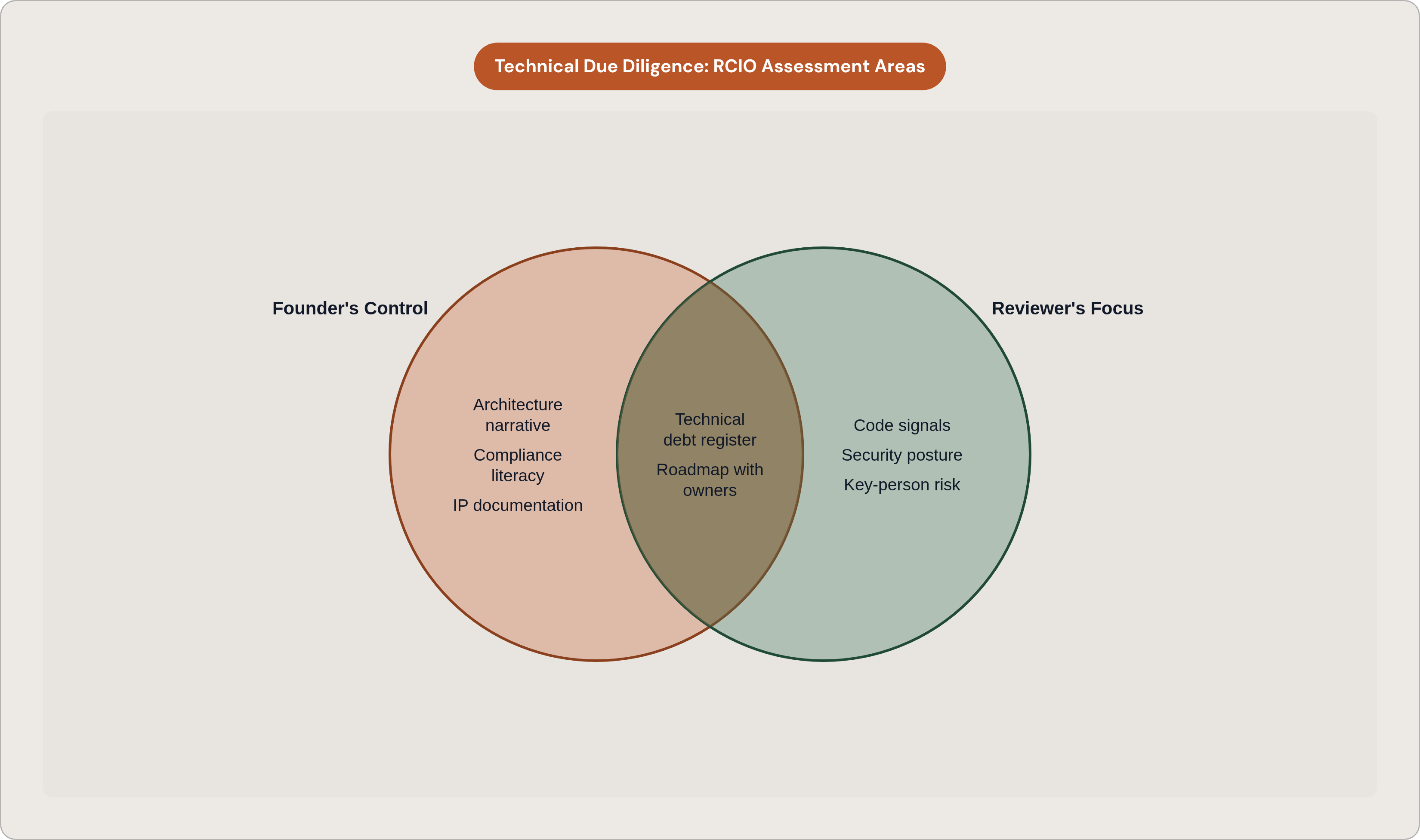
The data room is not a library of everything your company has ever produced. It is a curated set of artifacts that lets a reviewer answer the predictable questions without returning to you repeatedly for documents you should have anticipated providing.
Non-technical founders sometimes interpret "technical data room" as a collection of code and infrastructure configuration files, which is not what reviewers primarily need. The artifacts that matter most are largely narrative and organizational, not purely technical, and most of them can be assembled, verified, and maintained without engineering skill.
The core technical artifacts are:
Single-page architecture diagram. Readable by an outside engineer in minutes, covering data stores, services, third-party integrations, and trust boundaries. Your technical team produces this; your job is to ensure it exists, is current, and that you can describe what it shows.
Technical debt register. Prioritized by risk and business impact, with remediation owners and timelines attached to each item. This document should reflect the current state honestly, not the aspirational state. A sanitized register that omits known problems will be identified as such during live Q&A.
Six-month product roadmap with named owners. This demonstrates that product decisions are being made deliberately and that accountability is assigned. A roadmap without owners is a wish list.
List of features built and abandoned in the last twelve months, with reasons. The reasons are the important part. "We built X, discovered Y about customer behavior, and deprioritized it in favor of Z" is evidence of learning. "We built it and it didn't work" with no further account suggests an absence of post-mortem discipline.
Security assessment results and compliance status by applicable framework. The results should include findings and the disposition of those findings: remediated, accepted with rationale, or in progress with a timeline. Compliance status should map to the frameworks your product actually touches, not a comprehensive survey of every framework that exists.
Infrastructure cost structure and how that cost scales relative to customer growth. Not just the current monthly number, but the unit economics story: what does infrastructure cost look like at two times, five times, ten times current scale?
IP ownership documentation. Assignment agreements, contractor work-for-hire clauses, open-source license inventory. These are legal documents, assembled with legal counsel, but a founder can and should verify they exist and are complete before a reviewer asks.
Team structure and key-person risk summary. Who owns what, how knowledge is distributed, what the hiring plan looks like against the funded growth trajectory.
Building this without an engineering background means developing a practice, not a project. The mistake most founders make is treating data room preparation as something that happens before a raise. The founders who navigate diligence most effectively treat it as a maintenance discipline, keeping these artifacts current as a byproduct of running the company, so that when a reviewer asks, the answer already exists.
The reviewer's job is to find the risk your investor has not priced in. Your job is to have seen it first, which is why some non-technical founders bring in Quwa Labs, a product engineering studio that rebuilds early-stage products for production reliability and stays on as a long-term technical partner, to close the engineering accountability gap before diligence starts.