Incident Response Setup for Early-Stage Production Apps
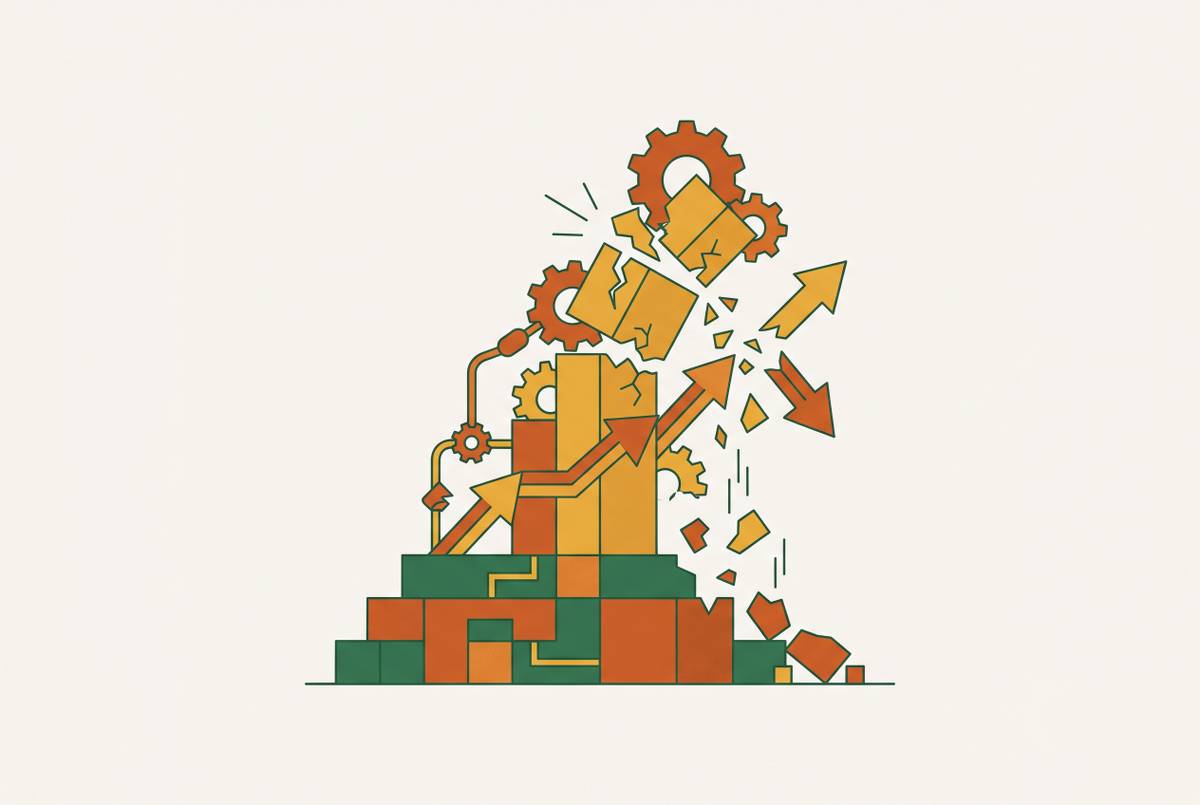
Technical debt in early systems compounds response time once production breaks.
Getting an app to production is the win. Whether that win holds depends on what happens in the first real outage. Most early-stage teams treat incident response as something to figure out after the pager goes off for the first time, and that's exactly backwards: the window to build it is before the first 2am wake-up call, while things are calm enough to think clearly.
How technical debt quietly degrades incident response before the first incident
Technical debt doesn't just slow down feature work. It extends how long an outage lasts and how hard it is to contain, often in ways that stay invisible until the exact moment they matter most.
Take documentation debt. Without a runbook, whoever gets paged has to figure out the system in real time, mid-outage, which is the single worst moment to be learning anything. That's not a code quality problem, it's a response-time problem, and it compounds every minute the incident stays open.
Process debt works the same way. Ad hoc release processes, no code review standard, inconsistent branching, no incident playbook: these get filed under "we'll clean it up later," but they're really just incident response failures waiting for a trigger. Martin Fowler's technical debt quadrant is useful here. Debt can be deliberate or inadvertent, prudent or reckless. The reckless-inadvertent corner, the debt nobody chose and nobody's tracking, is the most dangerous to incident response specifically, because it's invisible to engineers and invisible to whoever's watching the budget.
And the budget is the tell. An IBM analysis found that a typical organization spends only 23% of its tech budget on work that drives revenue. The remaining majority goes to keeping the lights on, patching what's already built, maintaining systems that should mostly maintain themselves. That ratio is a signal about where time goes once debt piles up unmanaged: less building, more firefighting.
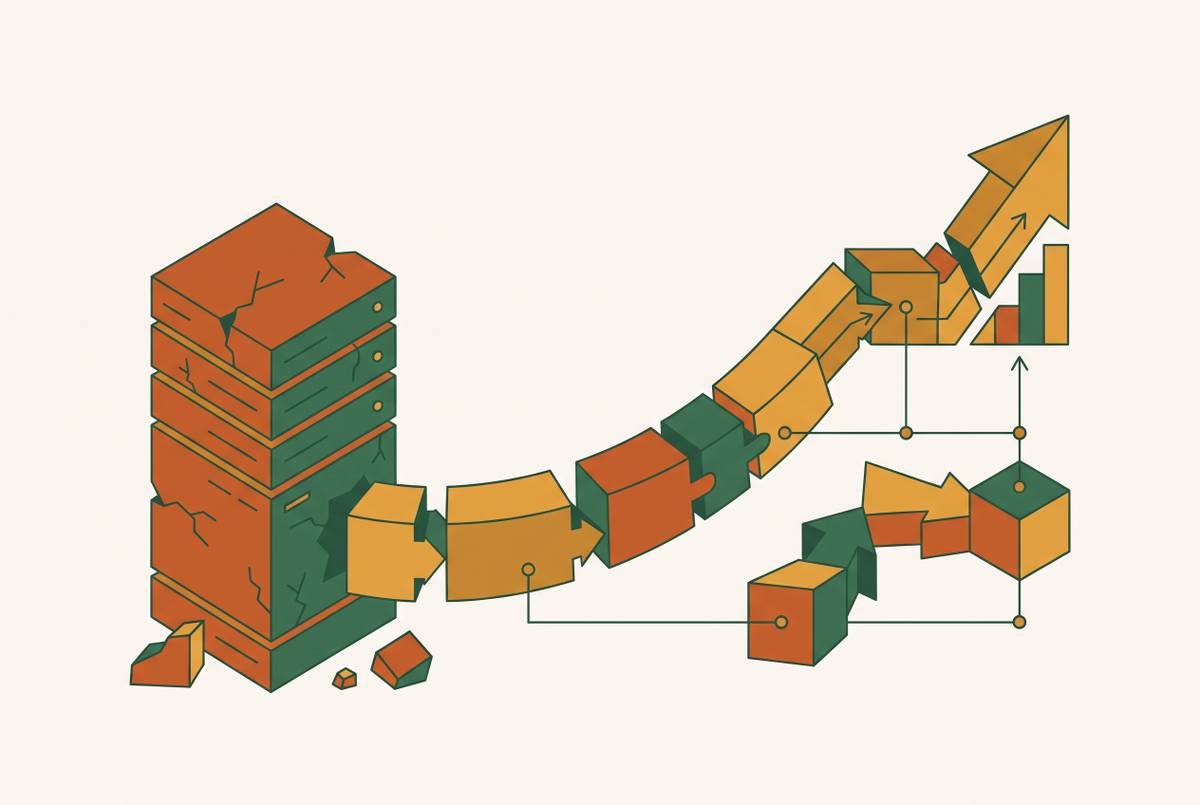
DORA's 2025 research reframed MTTR as "Failed Deployment Recovery Time," which is a small language change with a real point behind it. The metric that matters isn't some abstract notion of "incident speed." It's whether the production system itself can absorb a failure and come back. Teams that build incident response alongside production readiness recover in minutes. Teams that push it off recover in hours, and at $9,000 a minute in average downtime cost, that gap is not a rounding error on a runway that might already be tight.
What a lightweight but real IR framework looks like for a small production team
The goal here isn't enterprise SRE. Nobody with three engineers needs a war room with a dedicated on-call commander rotation and a chargeback model. What's needed is a framework structured enough to hold up under pressure, and light enough that a team of three to ten can actually run it without resentment.
NIST's Computer Security Incident Handling Guide (SP 800-61r2) laid out a lifecycle years ago that still holds: Preparation, Detection and Analysis, Containment/Eradication/Recovery, and Post-Incident Activity. None of that is new. What's often skipped is applying it at small-team scale, because it sounds like something built for a company with a security operations floor.
Service-level objectives are the connective tissue that makes this work rather than becoming another dusty doc nobody opens. SLOs without disciplined incident response are just numbers on a slide. Incident response without SLOs is just reactive firefighting with better vocabulary. Put the two together and reliability actually becomes sustainable instead of aspirational.
Four metrics carry the weight for a small team:
Mean time to detect, how fast the team recognized a real release failure "recovery"
Security exposure is part of this picture too, even at early stage. Insider incidents accounted for nearly 34% of breaches at tech startups, which is a sharper number than most founders expect when they're picturing external attackers as the main threat. According to the Ponemon Institute, integrating a structured plan to handle security breaches can reduce time to recovery by up to 60%. That's not a hypothetical payoff. An outage that ends the same day versus one that drags into a second news cycle depends on that.
The rest of this piece builds out the pieces that make this framework real: on-call structure, runbooks, alerting discipline, communication during an active incident, and postmortems that actually change something.
Designing an on-call rotation that doesn't burn out a small team
Most on-call pain isn't technical. It's coordination overhead. When an engineer gets paged and has to hunt down the runbook, figure out who else should be looped in, spin up a channel, and update three stakeholders manually, the investigation hasn't even started and ten minutes are already gone (devops.com's on-call best practices guide covers this pattern in detail).
A rotation of fewer than five engineers sharing 24/7 coverage means each person gets paged far more often than is healthy, which accelerates burnout and creates a nasty side effect: single points of knowledge. Fewer than five engineers sharing 24/7 coverage means each person gets paged far more often than is healthy, which accelerates burnout and creates a nasty side effect: single points of knowledge. If only one person understands the payment service, that person becomes a permanent bottleneck, on-call rotation or not.
Alert fatigue gets blamed on people ("this team just can't keep up") when it's almost always an alerting configuration problem. The Google SRE Workbook sets a sustainable baseline at a maximum of two actionable incidents per shift. Teams seeing eight or ten pages a shift don't have a staffing problem, they have a signal-to-noise problem, and no amount of hiring fixes an alert threshold that's too sensitive.
A few design decisions make the difference for small teams specifically:
- Define primary and secondary responders by name. "Whoever's around" is not a rotation, it's a hope.
- Set escalation paths before the first incident, not while it's happening.
- Separate severity levels. Not everything that pages at 2am deserves to wake someone up at 2am.
- Scope the on-call surface. Decide which services genuinely need a human response versus which can self-heal or wait until morning.
CISA and ENISA-style incident handling guidance points at the same failure mode over and over: response breaks down when nobody owns the decision. The release engineer knows how to push a rollback, support knows users are furious, product knows the feature's broken, but if nobody's been explicitly given authority to freeze a channel or trigger the rollback, everyone waits for someone else to move (capgo.app's 2026 guide walks through this dynamic well).
None of this is about looking sophisticated. It's about building a rotation the team can actually sustain, because a burned-out on-call engineer is a slower on-call engineer, full stop.
Runbooks: what to write, how to keep them from decaying, and what they unlock
Runbooks exist to remove improvisation from the worst possible moment. Without one, outages last longer simply because the responder has to figure out what to do while the system is on fire, and documentation debt is one of the most direct, most measurable forms of incident response debt there is.
The numbers back this up clearly. Research cited by Stew.so found teams using standardized runbook templates cut MTTR by 35%, purely by removing ambiguity from the response. An IR.com guide found enterprise teams pairing structured operational documentation with AI-driven observability saw 40 to 60% MTTR reductions. Those aren't small gains for what amounts to writing things down clearly once.
A minimal runbook that's actually useful covers five things:
- What the service does, and what "healthy" looks like in concrete terms
The biggest practical failure isn't writing runbooks. It's watching them decay. A runbook gets written right after an incident, it's accurate for three months, then a migration happens and nobody circles back to update it. The fix isn't more discipline in the abstract, it's structural: make runbook updates part of the definition of done for any significant infrastructure change, enforced as a pull request check rather than a suggestion.
Runbooks help satisfy SOC 2, ISO 27001, and DORA requirements around documented, testable incident processes, which matters the day an enterprise customer's procurement team starts asking questions. And on the tooling side, SolarWinds found AI-powered incident management platforms saving an average of 4.87 hours per incident, largely by surfacing the right runbook at the right moment instead of making someone search for it.
Communication structure during an active incident
Communication failure during an incident is just as common as a technical failure, and it independently extends how long the incident runs. A team can diagnose and fix the bug in fifteen minutes and still burn an hour because nobody told the support team, or the CEO, or the customers what was happening.
Two channels need to run at the same time, for two different audiences. The internal channel is where engineering coordinates: investigation updates, technical decisions, what's been ruled out. The external channel, status page, support macros, leadership updates, needs a plain-language summary that's honest without drowning anyone in stack traces.
A dedicated incident Slack channel at the moment of declaration helps more than it sounds like it would. A naming convention with the date and a short descriptor (#inc-2026-06-01-checkout-5xx) keeps the thread searchable months later, when someone's trying to remember if this exact failure happened before.
Cadence matters too. An incident commander posting an update every 15 minutes, current status, what's being investigated, the last action taken, an ETA if there is one, stops the "is anyone even working on this?" spiral that eats morale during a long outage.
The incident commander and the engineer actually debugging the problem should not be the same person. One coordinates, one investigates. Conflate the two roles and both jobs get slower, because context-switching between "manage the room" and "read the stack trace" has a real cost.
A public status page forces discipline that's hard to manufacture otherwise. Once it exists, the team has committed to a communication cadence, and as a side effect, inbound support tickets during an outage tend to drop, because people can just check the page instead of emailing. Automation helps here too: triggering channel creation, stakeholder notification, and update reminders automatically at declaration time removes coordination overhead right when the team has the least bandwidth to spare on it.
Postmortems that improve the system rather than assign blame
Google's SRE guidance popularized the blameless postmortem for a specific reason: shifting the question from "who caused this" to "what conditions in the system allowed this" is what actually produces learning. Skip that shift, and teams either repeat the same incident under a different name, or they get risk-averse and slow down everything, which is its own kind of damage.
A postmortem that ends with vague intentions isn't a postmortem, it's just a meeting that happened. The strongest ones end with specific, checkable changes: a channel policy update, a new logging depth requirement, an adjusted alert threshold, a change to release approval rules (capgo.app's 2026 guide is useful on this distinction).
A review structure that holds up looks like this:
- Reconstruct the timeline from logs and channel history, not from memory, because memory reorders events under stress
- Identify the contributing conditions, not a person to pin the incident on
- Translate the evidence into specific controls, not general resolutions
- Check whether those controls would have actually cut the incident off earlier, not just made it feel more managed
Tracking mean time to detect, mean time to recover, and failure rate after rollback across multiple postmortems, not just within one, reveals the real signal. A single postmortem tells a story about one incident. The trend across ten of them tells a story about the system.
Organizations that treat technical debt as a first-class line item in planning, one that gets measured and paid down on purpose, tend to ship faster, have fewer incidents, and report happier developers. That's the same discipline appearing in two different places, not a coincidence.
The postmortem is also, quietly, the best moment to update the runbook. If the response revealed a rollback step, the runbook was missing, that's the fix to make before the next incident, not the one after.
Tooling options for early-stage teams in 2026, including a market shift to know about
Before picking a tool, know that the ground shifted recently. Atlassian stopped selling new Opsgenie licenses on June 4, 2025, with end of support set for April 5, 2027. Grafana OnCall's open-source version was archived. FireHydrant was acquired. Any team that picked an incident tool during the MVP phase should check whether that choice is still a live product, because a few of the defaults from 2024 aren't defaults anymore.
Options tend to sort by team profile:
incident.io fits Slack-native engineering teams well, and it is widely regarded as a strong option for most engineering teams. It's strong on automated workflows, incident channel creation, and structured postmortem templates, which lines up directly with the discipline this piece has been arguing for.
Rootly targets automation-heavy SRE teams, also Slack-native, with a low learning curve and built-in retrospective templates. it is recognized as a strong choice for Slack-first teams, and it ranks 16th in Tracxn's cyber incident response sector ranking (Zafran currently tops that list).
PagerDuty is the enterprise-grade choice, recognized across multiple practitioner comparisons. Strong escalation handling, mobile-first design, and a wide integration catalog. Worth the overhead once infrastructure complexity or strict uptime commitments justify it, but that's a higher bar than most early-stage teams have crossed yet.
Spike.sh bundles on-call, escalation, incident management, and status pages into one product, priced at $7 per user per month on the Starter tier and $14 on Business. Runframe.io flags it as the lightweight, budget-conscious option for small teams specifically.
UptimeRobot covers HTTP, ping, port, keyword, heartbeat, and DNS monitoring in one place, with SSL certificate checks folded into HTTP(s) monitoring. Pro plans start at $7 a month with checks as frequent as every 30 seconds and up to 17 native integrations, per rootly.com's research. It's a reasonable starting point for a team that isn't ready for full incident orchestration yet.
Jira Service Management brings incident, problem, and change management into the Atlassian ecosystem, a natural fit for teams already standardized on Jira and Confluence, though rootly.com's 2026 research notes it feels less engineering-native than the Slack-first platforms.
Grafana Labs leans hardest into observability rather than full incident orchestration, and was named a Leader in the 2025 Gartner Magic Quadrant for Observability Platforms, supporting more than 25 million users.
A startup based in a city not specified here is building what it calls an "AI SRE Teammate," a multi-agent system meant to automate incident detection, diagnosis, and response. It raised a substantial sum in seed funding, per seedtable.com's reporting. For a team that wants automation-first incident response without hiring a dedicated SRE, that's a category to keep an eye on as it matures, not necessarily one to bet the whole IR setup on today.
Whatever gets picked, the tool is not the point. The discipline underneath produces the outcome: runbooks that stay current, a rotation that doesn't burn people out, communication that doesn't leave people guessing, and postmortems that change something real. Production is a different contract than the demo that got the team here. The teams that build for that contract before the pager goes off are the ones still standing calmly when it does.
Sources
- 5 Incident Management Tools Every Startup Needs in 2025 | Rootly
- Best Incident Response Startups (2026) | Seedtable
- Incident Response Guide for Mobile and Desktop App Teams
- Cyber Incident Response - 2026 Market & Investments Trends - Tracxn
- Best Incident Management Tools for Startups (2026)
- Essential Incident Response Frameworks for Cloud Startups - Safeguarding Your Business
- devops.com
- docsio.co