Monolith to Microservices Migration Timing and Trade-Offs
Know when to migrate by spotting genuine bottlenecks that internal fixes cannot solve.

Migrating from a monolith to microservices is not a milestone you unlock by getting bigger. It's a decision with specific triggers, real costs, and a direction you can get wrong in both ways: too early, and you've bought yourself distributed-systems overhead with nothing to show for it; too late, and one part of the codebase quietly throttles everything downstream of it. This piece maps the signals that merit trust, the costs to budget for, and the sequence that keeps the decision from becoming a gamble.
Context matters here. Microservices adoption is 85% among enterprises, according to 2024 surveys, yet the CNCF's Annual Survey found 42% of companies now consolidating some microservices back into unified systems. Amazon's Prime Video team made headlines in 2023 for cutting infrastructure cost by 90% on its video-quality-analysis component by folding a distributed setup back into a single process. Prime Video as a whole stayed on microservices. One team, one component, one decision made on its own merits. That's the posture this whole topic rewards.
What goes wrong inside a monolith before migration shapes the decision as much as what happens after it.
Slow delivery, poor stability, insufficient scalability. Those are the three complaints that appear most often when a monolith gets blamed for a team's pain. But blame is easy, and architecture is a convenient scapegoat for problems that have nothing to do with it.
Before assuming the codebase is the issue, run through what else might be going on. Insufficient business analysis can slow feature delivery just as effectively as bad code. So can poor team management: no feedback loops, no clear ownership, nobody sure who's supposed to catch a regression before it ships. A CI process missing linters, code review, or autotests will feel exactly like an architecture problem, right up until someone fixes the pipeline and the feels resolve on their own. Add a team that's simply not senior enough to manage a large codebase, or QA coverage that's been thin for a year, and the symptoms look identical to what a broken monolith produces.
The test that matters: does fixing one of those organizational problems cost less than a migration? It almost always does. And migrating on top of a broken process doesn't fix the process, it just distributes the brokenness across a network. A team that can't manage code review discipline in one repository won't suddenly manage it better across fifteen.
There are also purely technical remedies that solve monolith pain without touching the deployment model. Containerization and orchestration through something like Kubernetes buys deployment flexibility. Database sharding or replication solves data-scaling problems directly. Non-blocking code and tighter SQL queries fix performance without changing where the code lives. Roughly 74% of companies report considering a move to more modern architectures. Considering is not the same as needing. The first question, always, is whether a better-structured monolith solves the actual problem.
The specific signals that mean a part of the system has outgrown the monolith
Migration earns its cost when two things are true at once: one deployment cadence no longer works for the whole team, and at least one module demonstrably needs to scale on its own. Neither condition alone is enough. Both together is the signal to act on.
What does that look like in practice? A few patterns appear repeatedly.
One capability scales on a completely different curve than everything else. Media transcoding, search indexing, report generation, these spike CPU and memory in bursts the rest of the app never sees. Scale the whole monolith to absorb those spikes, and every other part of the system is now provisioned for a load it never generates. That's wasted capacity, paid for every month.
Teams start blocking each other on a single deploy pipeline. Two teams work on unrelated parts of the codebase, but they share one release, so a failing test in one team's code stalls the other team's ship. When that blockage maps cleanly to a boundary already visible in the code, that boundary is the seam worth cutting.
A component needs isolation the rest of the system doesn't. Payment data sitting in a regulated compliance scope, or a piece that has to stay up while everything else redeploys. Mixing that into the monolith spreads its compliance requirement, or its availability requirement, across code that never needed either.
A capability needs a different runtime. Maybe it wants Go or Rust instead of whatever the monolith runs on, maybe it needs a GPU, maybe it needs a data store the rest of the app doesn't use. Bolting that onto the main application is more awkward, every time, than giving it its own process.
Two more deserve naming directly, infrastructure fatigue, where developers spend more hours fixing CI/CD failures than shipping features, and observability blind spots, where logs and traces are fragmented enough that debugging becomes a guessing game.
A team-size pattern produces all of this too. Microservices benefits appear reliably above roughly 10 developers; below that threshold, monoliths consistently outperform. A separate threshold puts the real coordination payoff closer to 50 engineers, per reporting from Java Code Geeks, below which the operational cost of running microservices rarely earns its keep.
So what's the honest move when the pain is real but nothing on this list quite matches it? Tighten the internal boundaries and revisit later. Splitting a system to relieve a cost nobody can actually name hands a team the operational bill of microservices, network calls, service discovery, distributed debugging, with nothing sitting on the other side of the ledger.
The modular monolith as the step most migrations skip, and why skipping it is expensive
The 2025 to 2026 consensus across engineering teams has settled on something less dramatic than "go microservices" or "stay monolith." A hybrid model: a modular monolith at the core, with two to five services extracted for genuine hot paths. Start modular. Extract only when something specific demands it.
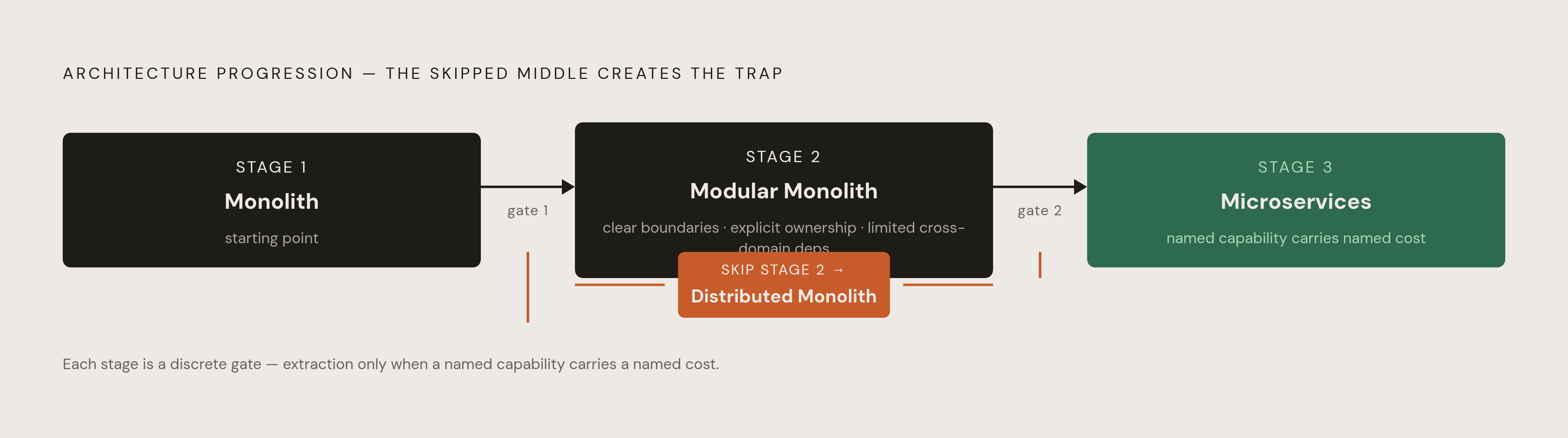
The progression the research supports runs in three stages: monolith, then modular monolith, then microservices, taken one at a time rather than skipped.
The modular monolith stage keeps everything in a single deployment unit but forces clear module boundaries, explicit ownership per module, and limited cross-domain dependencies. That gives a team the chance to remove coupling from the codebase while the cost of fixing a mistake is still low. Fixing boundaries inside one deployment unit is faster and lower-risk than trying to extract services out of tightly coupled code while production traffic is live and everyone's watching the dashboards.
What does this stage actually require? Domain-driven design, so the code structure lines up with the business logic instead of fighting it. Clean architecture principles, to cut down on third-party coupling. SOLID principles, so components stay modular and reusable instead of tangled. Each module needs to own exactly one business responsibility, and any dependency that crosses a domain boundary needs to be explicit, not implicit through a shared table or a global import.
Skip this step, and the failure mode has a name: the distributed monolith. Services get split apart on paper, but they still share a database, still carry tight runtime dependencies, still ship on a coupled release schedule. The team picks up more network calls and more places for things to fail, without picking up any of the independence that was supposed to justify the split.
The tooling for this stage has matured enough that it's practical without a full rewrite. Spring Modulith gives Java and Spring teams a way to enforce module boundaries inside a single application. Similar boundary-enforcement options exist for other language ecosystems. A widely used web framework has its own module conventions, and one vendor open-sourced a tool specifically to police boundaries inside a large codebase written in that framework's language. None of these require touching the deployment model.
A systematic mapping study found that migration research still leans heavily toward decomposition, the mechanics of splitting a service out, rather than the full migration journey end to end. The modular-monolith stage stays under-documented relative to how often it ends up deciding whether the whole migration succeeds.
Where the strangler-fig pattern tends to break
Assume a team has decided a service is genuinely worth extracting. The strangler-fig pattern is the accepted way to do it: new services grow up around the monolith one capability at a time, behind a routing layer, while the monolith keeps serving traffic the whole time. Nobody rewrites the whole thing. Nobody takes it down.
The mechanics run in a fairly fixed order.
Put an API gateway or a reverse proxy in front of the monolith first, forwarding everything through to it exactly as before. Nothing changes for users yet. What this step buys is a switch the team can flip later, and a chance to prove the routing layer itself under real traffic before anything depends on it.
Build the new service alongside the monolith, scoped to one capability only.
Shift read traffic first. Route reads to the new service while writes still land on the monolith, or mirror the same request to both and compare what comes back. This exposes behavior gaps while the monolith is still the source of truth, so a mismatch is a bug report, not an outage.
Shift writes only once reads have proven out. At that point the new service owns the capability end to end.
Delete the old code path out of the monolith. Skip this step, and a team ends up maintaining two implementations that drift apart over time, which is a worse position than either one alone would have been.
Then repeat for the next capability, and stop extracting once whatever's left in the monolith isn't causing pain anymore. Most migrations that go well end with a smaller core plus a handful of services.
Which capability goes first? Pick for how easy it is to reverse, not for how much pain it's causing. A capability that reads and writes a narrow, self-contained slice of data, and rarely needs synchronous access to the rest of the system, is the safer starting point. Notifications (email, SMS, push), search indexing, PDF or media processing, payments processing: these tend to make good first candidates because each one touches a narrow data slice and rarely needs to reach back into the monolith mid-request.
Keep the underlying tables in the monolith's database at first. Have the new service reach them through the monolith's API rather than connecting to the database directly. That preserves one owner per table, which matters more than it sounds like it should once two services start writing to the same rows.
Two mistakes sink most attempts at this. First, overlooked dependencies that only appear during the actual production cutover, the kind of thing nobody catches in staging because staging never sees the traffic pattern that exposes it. Second, splitting too early: adding network overhead, operational burden, and harder debugging on top of a system whose real bottleneck was never architectural in the first place.
Migration works incrementally. A complete rewrite of the whole codebase in one pass only makes sense when the codebase is small, new features ship rarely, and the existing modules are already well-defined, which describes very few systems worth migrating in the first place.
The real costs of migration, in money, time, and new technical debt
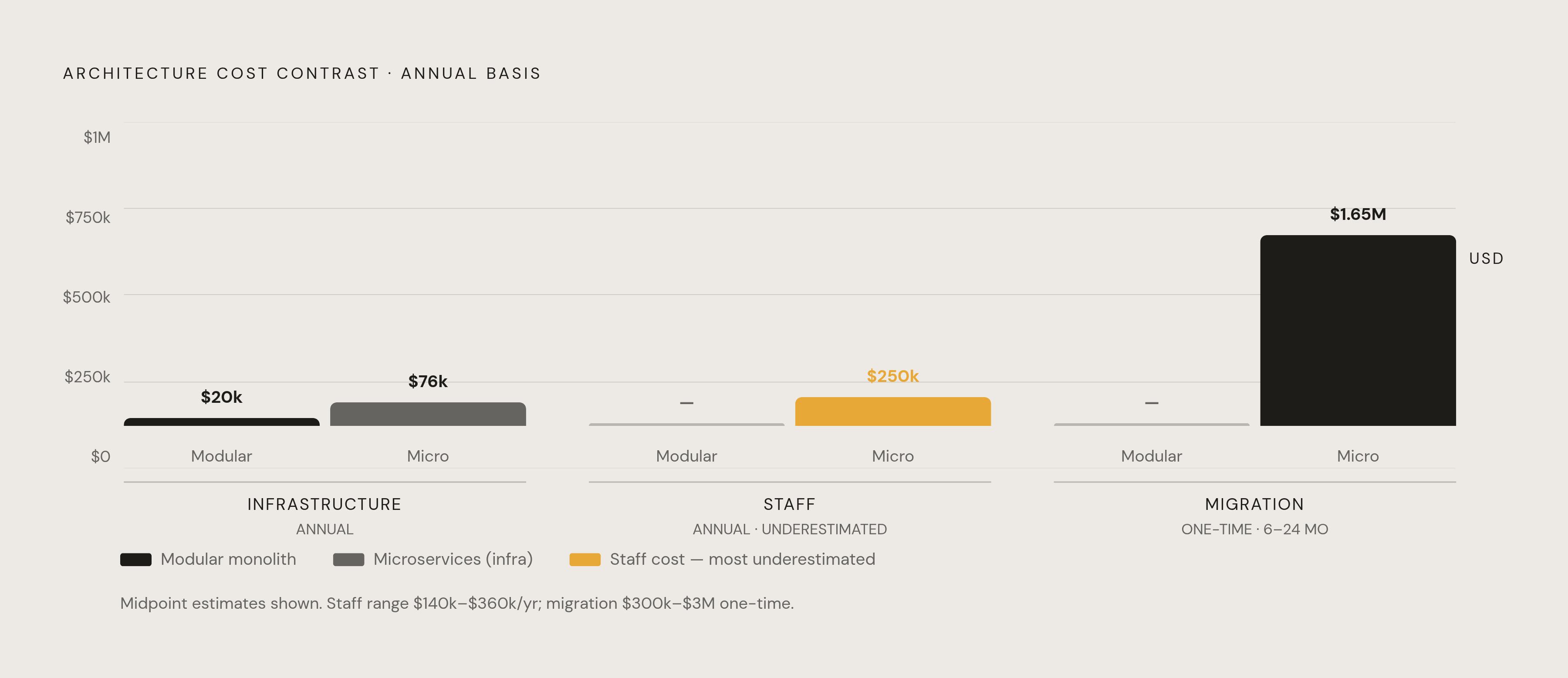
Real-world migration projects put costs between $300,000 and $3 million, with timelines running 6 to 24 months. That range tracks system complexity, existing technical debt, and team size far more than it tracks company size. A small company with a tangled codebase can spend more than a large one with clean boundaries.
The monthly numbers tell a similar story. A modular monolith runs roughly $1,100 to $2,300 a month in infrastructure and platform engineering costs. An equivalent setup split into 10 to 15 microservices runs roughly $4,200 to $8,500 a month, before counting the extra staff needed to run it. And extra staff is usually required: microservices setups typically need one to two additional platform engineers, and DevOps Salary Reports put platform engineer compensation at $140,000 to $180,000 a year. That's $140,000 to $360,000 in additional annual salary, a number that dwarfs the infrastructure cost gap on its own.
Migration also generates its own debt, separate from anything the monolith carried in. A peer-reviewed ScienceDirect industrial case study found that developers tend to implement suboptimal solutions immediately after a transition, and that organizations consistently prioritize new features over refactoring those solutions afterward. Every delayed refactor adds debt and raises the odds of a new bug appearing in code that used to work fine.
Debugging gets slower, too. A DZone study found teams spent an average of 35% more time debugging in microservices architectures than in modular monoliths, largely because a request now flows across several services instead of staying inside one process, and reproducing an issue locally gets harder with every hop. And a good number of teams never even capture the benefit they paid for: 90% of microservices teams still batch-deploy the way a monolith would, taking on the overhead of a distributed system without capturing the independent-deployment gain that was supposed to justify it.
None of this is theoretical. The CNCF's Annual Survey found 46% of respondents said CNCF projects were too complex to understand or run in production, up 13 points year over year. Software technical debt in aggregate stands at roughly $1.52 trillion, and a vFunction survey of over 1,000 architecture, development, and engineering leaders found architectural technical debt emerging as the top threat to application performance.
MVP-Stage and Early-Production Team Practices Versus Mature Engineering Organizations
For an MVP, a monolith is the right call, full stop. It's easier to build, needs fewer resources, gets to market faster, and performs better out of the gate simply because there's no network latency between components that all live in one process. For an early product where user adoption and funding haven't been proven yet, a monolith is the architecture a team chooses because it fits the stage the company is actually in. It's the correct architecture for the stage the company is actually in.
Netflix is the example to sit with, because it's honest about the timeline involved. Netflix launched as a monolith. A major database corruption event in 2008 exposed a single point of failure and just how fragile that architecture had become under real load. Refactoring toward microservices started in 2009, one service at a time, and the migration finished in 2016. Seven years, inside a company with the engineering capacity to sustain a multi-year architectural overhaul while still shipping and still operating at scale the entire time.
An early-production team is not chasing that trigger. Netflix's move came from "we need scale, and we've already felt what happens when we don't have it." An early-stage team's real trigger looks different: a specific part of the system is actively blocking growth, and it can be named exactly, down to the module and the cost.
So what should a team at this stage do instead of migrating? Strengthen the module boundaries inside the monolith first. The modular monolith adds no operational overhead beyond what's already running, and it de-risks whatever extraction might come later, if one ever needs to.
Getting a product to launch and keeping it alive under real users are two different reliability standards, and that's easy to miss in the rush of shipping. Whatever was "good enough" to launch starts having actual consequences once real people depend on it. A broken flow that would have been an annoyance pre-launch compounds once it's costing real users real trust, and the cost of fixing it only grows as load grows.
For a team whose MVP was stitched together fast, maybe with AI tools, maybe by a freelancer working under deadline pressure, and now needs to survive contact with real users: the first engineering priority is solid foundations and clear boundaries inside the existing codebase. Not a migration to a distributed architecture. Rebuilding on solid ground before distributing anything is the lower-risk order to do things in.
Only about 1% of companies plan to stay on a monolithic architecture permanently; the other 99% have switched already or plan to eventually. But that statistic answers almost nothing on its own. The timing of the move, and which intermediate stages a team passes through on the way, is what decides whether the migration turns out to be an investment or an emergency.
A Framework for Reading Your Own Signals Before Committing
The decision isn't binary, and treating it that way is probably the single most common mistake teams make here. Three end states are all valid, and which one fits depends entirely on where the pain actually lives.
Stay on the monolith and fix the process, the team structure, or the code itself, when the symptoms trace back to something organizational rather than architectural. That's often the cheapest fix available, and it's the one most often skipped because architecture makes for a more satisfying villain than a broken feedback loop.
Move to a modular monolith when the codebase genuinely needs clearer internal boundaries but nothing yet requires independent deployment. This is the step research suggests gets skipped most often, and the one whose absence explains a lot of failed migrations after the fact.
Extract specific services through the strangler-fig pattern when a named capability carries a named cost. Not a vague sense that things feel slow, a specific module, a specific scaling curve, a specific compliance requirement, something concrete enough to point at on a whiteboard.
What ties all three together is the same question, asked before any of the money gets spent: can the actual cost be named, and does it map to a boundary that already exists in the code? If the answer to either half is no, the fix probably isn't architectural yet. And if it's yes to both, the strangler-fig gives a path that doesn't require betting the whole system on getting the rewrite right in one attempt. That's the real trade-off: migration done well is a sequence of small, reversible bets.
Sources
- Monolith to Microservices Refactoring — 2025 Guide with Steps
- Monolith to Microservices Migration: A Practical Guide
- Monolith vs microservices 2025: real cloud migration costs and hidden challenges | by Pawel Piwosz | Medium
- Migrating from Monolith to Microservices: [Strategy & 2025 Guide]
- Monolith to Microservices Migration: When and How to Move - KITRUM
- Microservices vs Monolithic: When to Actually Switch | Medium
- sciencedirect.com