Grant Reporting Workflows Supported by Structured Data Systems
Connecting your grant data across systems eliminates manual reporting delays and compliance risks.
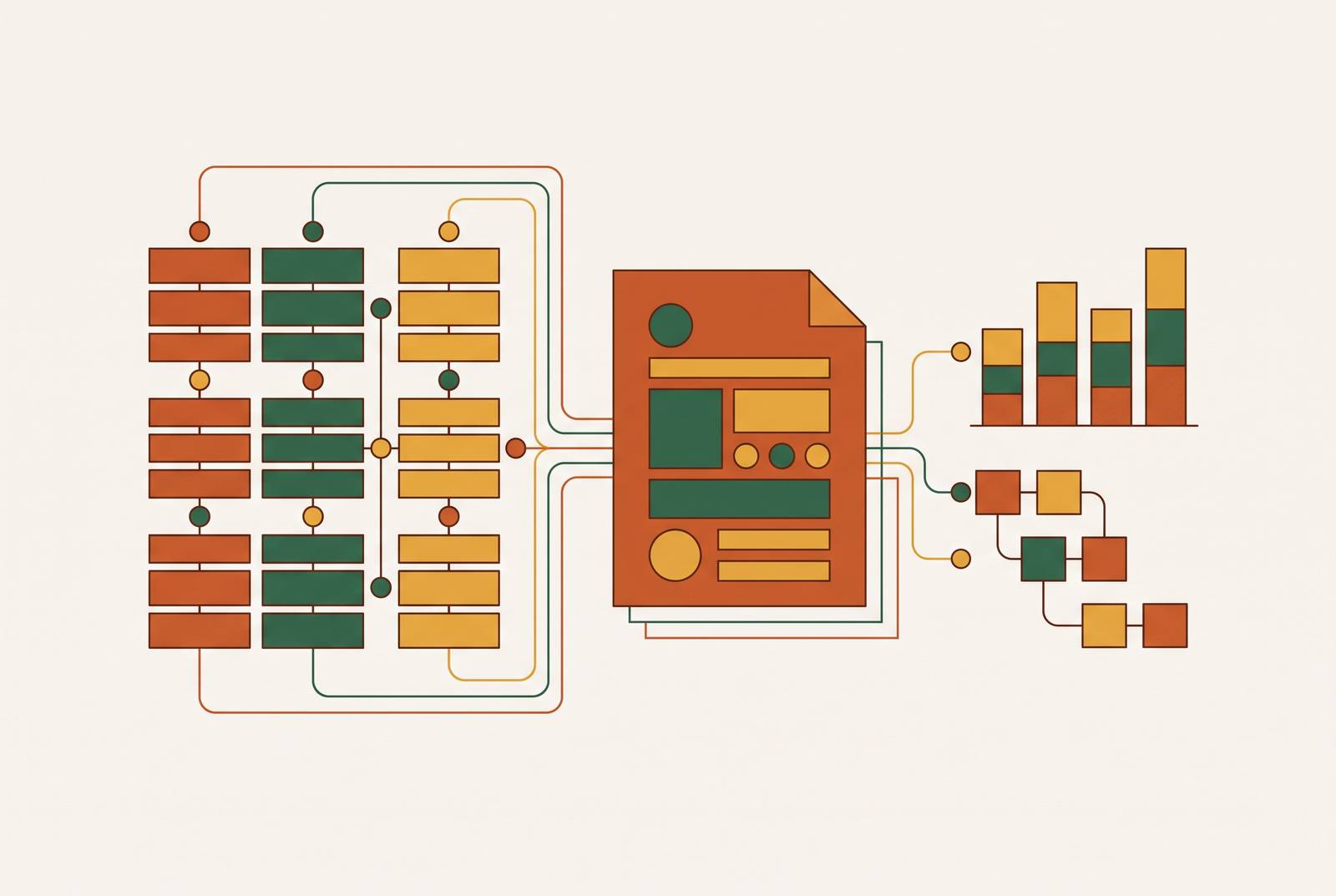
One staff member is pulling exports out of the CRM, a system that was never built to talk to the organization's case management database or grant-tracking spreadsheet. Another is digging through a shared spreadsheet that hasn't been updated since the last board meeting. A third is scrolling email threads looking for the one attachment with the final budget numbers. None of their totals match. This is not a staffing shortage or a motivation problem. The report still gets written, somehow, but only after hours of manual reconciliation that a better-organized system would have made unnecessary.
That reconciliation tax shows up everywhere once you start looking for it. Every funder deadline turns into a scramble. Board presentations take hours to assemble because the exports don't line up. A grant writer trying to finish an application without quick access to accurate outcome data ends up submitting a weaker case than the program actually deserves. And because the data lives in three or four places at once, no single person or team owns its accuracy. Each department collects what it needs for its own purposes, and nobody is responsible for whether the whole picture adds up.
The numbers back up what the scramble feels like on the ground. CCS Fundraising's 2026 Philanthropy Pulse report found that the share of nonprofits struggling to use their data for decision-making more than doubled in a single year, and the share naming CRM and data management as a top challenge also more than doubled. That's getting worse, year over year, even as organizations buy more software.
That last point deserves attention, because the instinct when a workflow breaks is usually to add a tool. A new CRM gets bolted on top of the existing spreadsheet. A project management app gets layered over the case management system. But without fixing how these systems connect to each other, each addition creates one more place data has to be copied into, and one more place it can drift out of sync. Fragmentation doesn't get solved by more software. It gets solved by fixing how the pieces are wired together.
The funding environment raised the cost of fragmented data
The stakes attached to this problem changed in 2025. Federal funding volatility pushed nonprofits to apply to more funders at once, diversifying away from the sources that had suddenly become unreliable, and that shift is exactly where disconnected data systems start to hurt the most. Instrumentl's Federal Funding Changes Report, based on a survey of over 300 nonprofit professionals, found that most respondents said federal funding changes had a direct impact on their organization in 2025. A large majority responded by diversifying into private and corporate grants and submitting more applications to cover the gap. More applications, spread across more funders, managed by the same small staff, is exactly the condition under which manual tracking turns into missed deadlines, duplicated work, and gaps in compliance documentation. Grant requirements have gotten more complicated at the same time portfolios have expanded, so organizations now have to track deadline monitoring, fund utilization, and audit preparation across funders whose rules don't line up with one another. Meanwhile, the tools available to manage all this have moved forward too: AI-assisted drafting and automated compliance tracking are now standard on leading platforms in 2026, meaning organizations still running everything by hand aren't just stuck, they're falling further behind peers who've already modernized.
What structured data architecture means in a grant context
Structured data architecture, in plain terms, means connecting grant requirements to program data at the source, so the outcomes a report needs are captured automatically as part of the work itself, not assembled by hand right before a deadline. A system built on this architecture needs four capabilities to actually do the job. It should track deadlines and compliance obligations and surface them before they turn into emergencies. It should generate funder-compliant reports without someone manually stitching together data from three different places. It should keep a live connection between what a grant requires and what the program is actually delivering, so an outcome report reflects real service data rather than a guess reconstructed after the fact. And it needs to be usable by a small team without a dedicated grants administrator on staff, because a system only the vendor or one overworked specialist can maintain is a risk all its own.
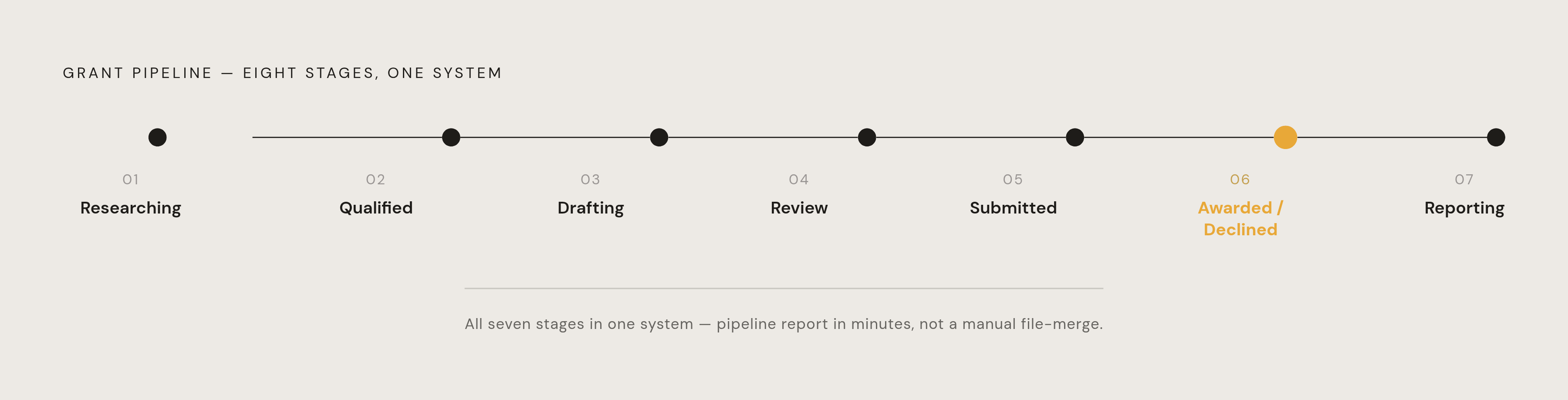
A structured system also tracks the full grant pipeline as a sequence: researching, qualified, drafting, review, submitted, awarded, declined, reporting. When all of those stages live in one place, leadership can pull a pipeline report in minutes instead of running a manual assembly exercise across multiple files. The same logic applies to the grant calendar. A real calendar tracks more than the application due date. It holds internal draft dates, budget review dates, board approval dates, award notification windows, reporting deadlines, renewal dates, and closeout dates, the entire compliance surface a grant creates, not just the moment of submission.
Consider what happens without this architecture. A housing services nonprofit managing a HUD grant has to report on households served, income levels, and outcomes achieved. If client records live in a case management system and the grant paperwork lives somewhere else entirely, every single report deadline means pulling numbers from one system and retyping them into another. That's not a one-time cost. It repeats every reporting cycle, for every grant, for as long as the two systems stay disconnected.
Stretching a flexible tool past its architecture
The most common failure in grant data management is pushing a flexible, general-purpose tool well past the limits it was ever designed to handle. Flexible tools like Airtable are genuinely capable, and plenty of organizations run them well. The trouble starts when the tool gets asked to do a job that needs structure it was never built to provide.
The LEF Foundation's experience shows one version of this. The foundation moved off a legacy grants database that was, in its own words, struggling to support the organization as it grew, with no integrations or workflows built in. Before the switch, staff were mired in manual data entry across daily operations, the database ran on aging infrastructure approaching end of life, and every new contact added to the system compounded the existing mess rather than fitting cleanly into it.
A Pennsylvania environmental nonprofit shows a different version of the same problem. Its Executive Director was tracking multiple grants spread across ten separate Airtable bases, each one carrying its own reporting requirements and timelines for private foundation, federal contract, and state grant funding. The lesson that came out of fixing that setup was straightforward: build the system around what funders actually require, and use Airtable's relational features to connect data across bases instead of copying the same numbers into ten different places.
Airtable has real structural limits before building a compliance-critical workflow on top of it. It keeps a revision history, but that's not the same as a formal audit log in the compliance sense. The free plan caps out at 1,000 records per base and 100 automation runs a month, limits most active teams hit within months. True audit-log functionality, with revision history beyond two years, requires the Enterprise Scale tier. Business gives two years of history; Enterprise Scale gives three or more and is the only tier with a genuine audit log. Building and maintaining a grant tracking system inside Airtable also takes an estimated two to four hours of staff time every month, ongoing, for as long as the system is in use.
Platform dependency carries its own risk, separate from feature limits. GrantHub and GrantHub Pro, grant management software built for lightweight tracking and smaller teams, were sunset on January 31, 2026, leaving organizations that had built their entire workflow around the tool with no path forward. That's a reminder that longevity matters as much as functionality when choosing what to build a grant program on top of.
None of this means flexible tools are the wrong choice for every organization. For under-resourced teams that can't afford or staff a purpose-built platform, a flexibility-first tool is often the only realistic option. One organization tracks organizations, houses, residents, funding periods, compliance requirements, reimbursement logic, certification data, and outcomes data all inside Airtable, and makes a reasonable case that the setup is structured enough to support real reporting and accountability. The fair response to that case is not to insist every team needs a bigger system. It's to recognize that fragmented flexibility carries its own hidden cost in staff hours and compliance exposure, and that the fix usually isn't hiring a dedicated data manager. It's centralizing the handful of workflows that actually carry the compliance weight.
How purpose-built platforms solve the architecture problem differently
Purpose-built grant platforms don't mainly differ by feature count. Purpose-built grant platforms differ by which piece of the architecture they're actually built to solve, and picking one that doesn't match an organization's actual workflow can recreate the same fragmentation with better-looking software.
LiveImpact is the only platform confirmed to keep grant requirements and program data inside the same system. A housing or youth services program running on LiveImpact captures the outcomes a report needs as a normal part of daily operations, with no separate export, no manual reconciliation, and no copying numbers between systems before a deadline. It covers grant tracking, post-award compliance, funder reporting, program data integration, and donor management integration, and fits best for nonprofits running direct service programs that need reporting tied to what's actually happening on the ground.
Instrumentl is described as the most comprehensive end-to-end grant platform available to nonprofits in 2026, combining prospecting, proposal drafting, pipeline management, and post-award compliance in one system. It offers AI-powered matching across a large funder database, an Apply tool that surfaces relevant language from past applications, an Advisor component that refines responses using funder and 990 data, and an Award Assistant that scans award documents to pull out key requirements and turn them into tasks and shareable summaries. It syncs with Google, Outlook, and Apple Calendar, and connects with tools like Salesforce. Pricing starts around $162 a month billed annually, with a 14-day free trial available. It fits teams with dedicated grant staff who want prospecting and post-award management in the same place, though it does not offer program data integration or donor management integration.
Bloomerang fits development-focused nonprofits where grants are one piece of a broader donor management operation. It covers grant tracking and donor management integration, but only partially covers post-award compliance and funder reporting, and offers no program data integration.
Blackbaud Raiser's Edge NXT fits larger nonprofits with complex compliance needs and dedicated IT support. It covers grant tracking, post-award compliance, funder reporting, and donor management integration, though not program data integration, and comes with an implementation scale that smaller organizations usually can't absorb.
Euna Grants fits government agencies and government-adjacent organizations, including nonprofits, managing federal grants at scale. It covers grant tracking, post-award compliance, and funder reporting, with no program data or donor management integration.
Before choosing among any of these, it helps to know which category to shop in. Grantseeker software is built for nonprofits pursuing funding. Grantmaker software is built for foundations and funders distributing it. Organizations moving off spreadsheets, or off a sunset platform like GrantHub, should start by evaluating grantseeker software first.
Lower Shore Land Trust's Structured System
A structured system works when every action that generates reportable data, time logged, an expense recorded, an outcome documented, feeds one shared source of truth instead of a separate file somewhere else.
Lower Shore Land Trust runs its grants management and time tracking through Airtable. Staff log their hours directly in the system and assign them to specific grants, projects, and funding sources. The same platform acts as the central record for grant information, letting the organization track reporting deadlines, reimbursement schedules, grant deliverables, and every expense tied to a given funding source.
Airtable itself isn't what makes this work; the system was built around what funders actually require, using relational features to connect data across the organization instead of copying the same figures into separate files, applying the lesson the Pennsylvania environmental nonprofit reached only after first trying the opposite approach. This is a case of a flexible tool used with real architectural discipline, not evidence that Airtable is the right default for every organization. The same principle applies just as well inside a purpose-built platform. The structural decision matters, not the brand of tool it's built in.
The replicable part of the story is simple to name: time, expenses, and deliverables get captured at the moment the work happens, not reconstructed afterward from memory and loose files. Reporting becomes a matter of running a query against data that's already there, rather than a reconciliation project that starts fresh every time a deadline approaches.
When nonprofits need an implementation partner
Picking the right platform solves the tool half of the problem. Most nonprofits still need someone to design the data architecture underneath the platform, and without that design work, otherwise well-intentioned systems quietly stop working the way they were supposed to.
A system should be able to connect donor or program records so staff aren't manually retyping the same information into four different places.
The same discipline that applies to building software applies here. Teams working under tight deadlines commonly skip automated testing, mix business logic in with presentation code, and skip clear boundaries between the pieces of a system, trade-offs that are cheap early on and expensive once real users, in this case real funders and auditors, start depending on the output. Structural decisions made at the start of a project are the hardest ones to undo later and the cheapest ones to get right the first time.
The practical fixes carry over directly from software engineering. Use APIs instead of wiring systems together with one-off, hard-coded connections. Keep configuration settings separate from the core system rather than buried inside it. Avoid tucking business rules directly into whatever interface staff happen to be looking at. These principles hold whether an organization is building a custom-built grant tracking system from scratch or configuring a purpose-built platform to match how its funders actually require reporting. The tool matters, but the architecture underneath it matters more.
Sources
- 12 Best Grant Management Software For Nonprofits
- 8 Best Grant Management Software Tools for Nonprofits in 2026
- Data Management for Nonprofits in 2026: How to Overcome the Most Common Challenges
- Airtable Nonprofit Pricing 2026: Plans, Discounts & Real
- Unlocking Grant Insights: How Airtable Turned Data into Impact for a Growing Nonprofit
- LOWER SHORE LAND TRUST INC - GuideStar Profile