Infrastructure Readiness Signals That Tell You a Handoff Is Safe
Five checks show whether a team can run the product alone.
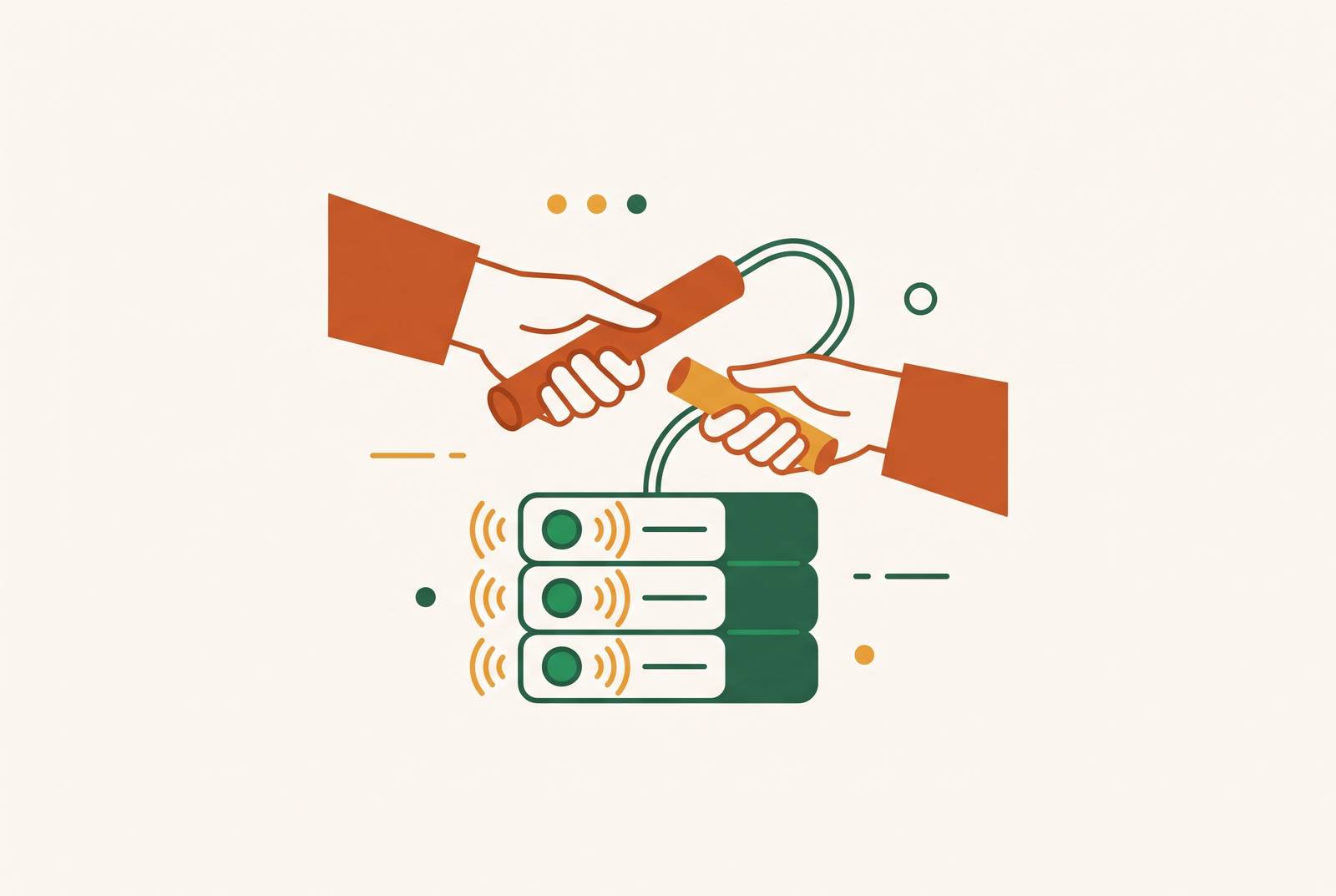
A technical debt assessment before hiring an engineering partner should show whether the receiving team can run the product without its original builder. A safe handoff requires evidence of automated deployment, tested recovery, working alerts, database-enforced data isolation, and business-owned accounts. These infrastructure readiness signals distinguish a product that works from one that is safe to take over.
Why "it works" is not the same as "safe to hand off"
A demo shows that a product can do what it was built to do. A handoff tests whether someone else can keep it running, recover its data, and control its accounts. Those are different tests. The receiving team inherits not just the codebase but every unresolved assumption behind it, including unverified backups, missing staging environments, and errors that surface only when a customer complains.
But what if the product has been running in production for months? Time in service does not prove operational readiness. A system can run while the original builder quietly fills the gaps, even if nobody has tested recovery or written down who owns it. Revoking that person's access can expose a dependency that ordinary use never revealed. AI tools and rapid prototyping can accelerate the path to working features without settling any of these questions.
What should a technical assessment cover between MVP and production?
An MVP asks whether people will use a product. A production system must also answer whether people can depend on it. That difference shapes the architecture from the start. Tenancy, vendor lock-in, deployment, integrations, authentication, monitoring, performance, backups, AI costs, and code health can all contain decisions that helped a prototype move quickly but leave its next owner exposed.
The risk therefore predates the transfer of ownership. Monitoring that was installed but never tested is not a new problem created by the handoff, although the departure of its builder may make the gap harder to resolve. The same applies to scheduled backups that nobody has restored. An assessment that records them shows how far working features are from operational readiness before either side signs off.
Signal 1: Deployment is automated and a staging environment exists
Can the receiving team trigger a deployment, observe it succeed, and roll it back without calling the outgoing team? That is a practical question to investigate in an hour. If deployment still requires the original builder, the documentation has not removed the dependency. When every change goes straight to production, the team tests its fixes on live users and live data.
With automated deployment, every push to the main branch builds, tests, and deploys on its own. A staging environment gives the team a place to test changes before they reach production. Both conditions need evidence. The receiving team should run the deployment and rollback itself before it takes over.
Control of the deployment machinery belongs in this test. Infrastructure defined with Terraform or Pulumi, and pipelines held in the project's own repository, help the receiving team inherit the means to operate the system. Access alone is not enough. A pipeline that the new owner cannot run or understand leaves the original builder as an operational dependency.
Signal 2: Backups have been restored, not just scheduled
A backup schedule proves that a process has been configured. It does not prove that the data can be recovered. The evidence standard is a completed restore into an isolated environment, with representative data integrity checked and the result documented. The handoff record should name the date, the destination environment, and the person who assessed the restored data.
The MacroMapper production handoff illustrates why this distinction deserves care. Its shared Infrastructure #4 record, cross-referenced from MacroMapper #236 on GitHub, documents DigitalOcean daily droplet backups and seven dated backup images. Yet the team still needed consistent evidence that restores worked. The existence of those images was not a confirmed acceptance criterion for successful recovery.
The same record distinguishes whole-VM backups from independently consistent application-level copies. A receiving team needs evidence covering both the platform and the application's data. A dated restore record turns a promise of recovery into something the next owner can evaluate.
Signal 3: Errors surface in your monitoring, not in customer emails
Once recovery is understood, the next question is how the team will know something has gone wrong. Customer emails are not an operational monitoring system. Production readiness requires structured logs, tracing, and configured alerts before ownership changes. Without them, the receiving team may inherit failures it cannot see during its first week.
The team needs evidence that an alert has actually triggered, rather than a screen showing that monitoring is enabled. The MacroMapper record reports a monitor finding zero issues and pending alerts, with timers active and enabled. Its closure was an owner-directed scope transfer, with acceptance of remaining requirements and proof that every alert path had passed still outstanding.
A system without alerts depends on someone watching it continuously, which is not sustainable once the original builder leaves. OpenTelemetry provides a standard for monitoring that allows the receiving team to change providers without rewiring the observability layer.
Signal 4: Data isolation is enforced by the database, not by application logic
In a multi-tenant product, several customers may have their data in the same tables. If separation depends only on a filter in application code, a bug or adversarial input can expose another customer's data. A demo that works is unlikely to show that weakness because normal use follows the expected path.
With database-enforced isolation, the boundary sits below the application code. Depending on the tenancy model, that can mean row-level security, separate schemas, or separate databases. The database then enforces the separation independently rather than trusting every application query to include the right filter. This is a technical distinction with a plain consequence for the owner, namely whether one application mistake can cross a customer boundary.
The reviewer on the receiving team should test whether a query using standard application credentials can return another tenant's data. Inspecting database permissions is central to the answer. If the only protection can be found by reading the application's filters, isolation is at the wrong layer. For Postgres-backed systems, Supabase provides row-level security as a built-in feature, giving reviewers a documented mechanism to assess.
Signal 5: Account and credential ownership has transferred to the business
A business may have the code while someone else still controls the services it needs. That is not a completed handoff. To show who owns what, the record should list each third-party provider, the account that owns it, the name of the person who holds the role in the receiving organization, and the date the previous builder's access was revoked. This is a business continuity question as much as a security question.
The MacroMapper record makes the end of operator control explicit. It says that deploy locks have been released and that no further rollout, paid AI call, or restart is scheduled. That kind of boundary clarifies when the outgoing team's operations stop and the owner's responsibility begins. It is more useful than a general statement that access has been “handed over.”
The ai-sous-chef handoff issue on GitHub sets a related acceptance condition. Another collaborator must be able to follow the setup and rollback instructions without someone else sending them secrets. Secrets therefore belong in a managed store controlled by the receiver. The access revocation record completes this signal after the receiving team has demonstrated that it can operate independently.
The one-day test that reveals whether the signals are real
The receiving team should run a one-day test before sign-off. A developer who has never touched the project starts with a clean machine, the repository, and the documentation, then produces a running application without calling the outgoing team. This tests whether the handoff depends on undocumented knowledge.
A complete handoff package makes that test possible. It includes a readiness report covering every infrastructure area, an architecture diagram matching the deployed system, operating runbooks, a recorded walkthrough, and a window for defect fixes and questions. The developer's progress exposes where those materials are usable and where they still assume the builder's knowledge. Starting the application tests whether the package lets someone else use the restore, alert, isolation, and account evidence and operate the product.
The ai-sous-chef issue expresses an acceptance requirement as “another collaborator can follow setup/smoke/rollback/replay instructions without receiving secrets”. Vendor access should be revoked last, after the receiving team passes the test. Removing it earlier would discard the safety net before independence has been demonstrated.
Why the handoff moment is especially dangerous for nonprofits and lean teams
For a nonprofit, a failed handoff can expose donor and beneficiary data or disable tools the mission depends on. Thin technical staffing leaves little room for recovery. The system may contain tools added over years to meet needs as they arose, including some that nobody now knows why the team chose. It can become unclear who owns what long before anyone formally announces a handoff.
Airtable can meet a need right away while leaving data on a vendor's servers, an API surface tied to pricing tiers, and no clear way to move to self-hosting. The receiving team inherits those constraints too. A technical assessment therefore needs to examine where data lives and how it can be operated.
Different tools offer different forms of control. Baserow supports self-hosting and holds GDPR, HIPAA, and SOC 2 compliance certifications. NocoDB can provide an Airtable-style interface over an existing production Postgres database, although its January 2026 change from AGPL-3.0 to a Sustainable Use License is significant for teams with open-source requirements. Grist stores each document as a portable SQLite file, making its backup and handoff a file copy. Supabase combines Postgres, authentication, file storage, generated APIs, and row-level security as a managed service.
These differences change what the receiving team must understand and operate across the five signals. For a lean organization, a long-term technical partner who understands nonprofit operating constraints can provide continuity that a one-time transfer cannot. The question of who owns operations after the handoff needs an answer before it occurs.
Using the five signals as a pre-handoff gate, not a post-handoff retrospective
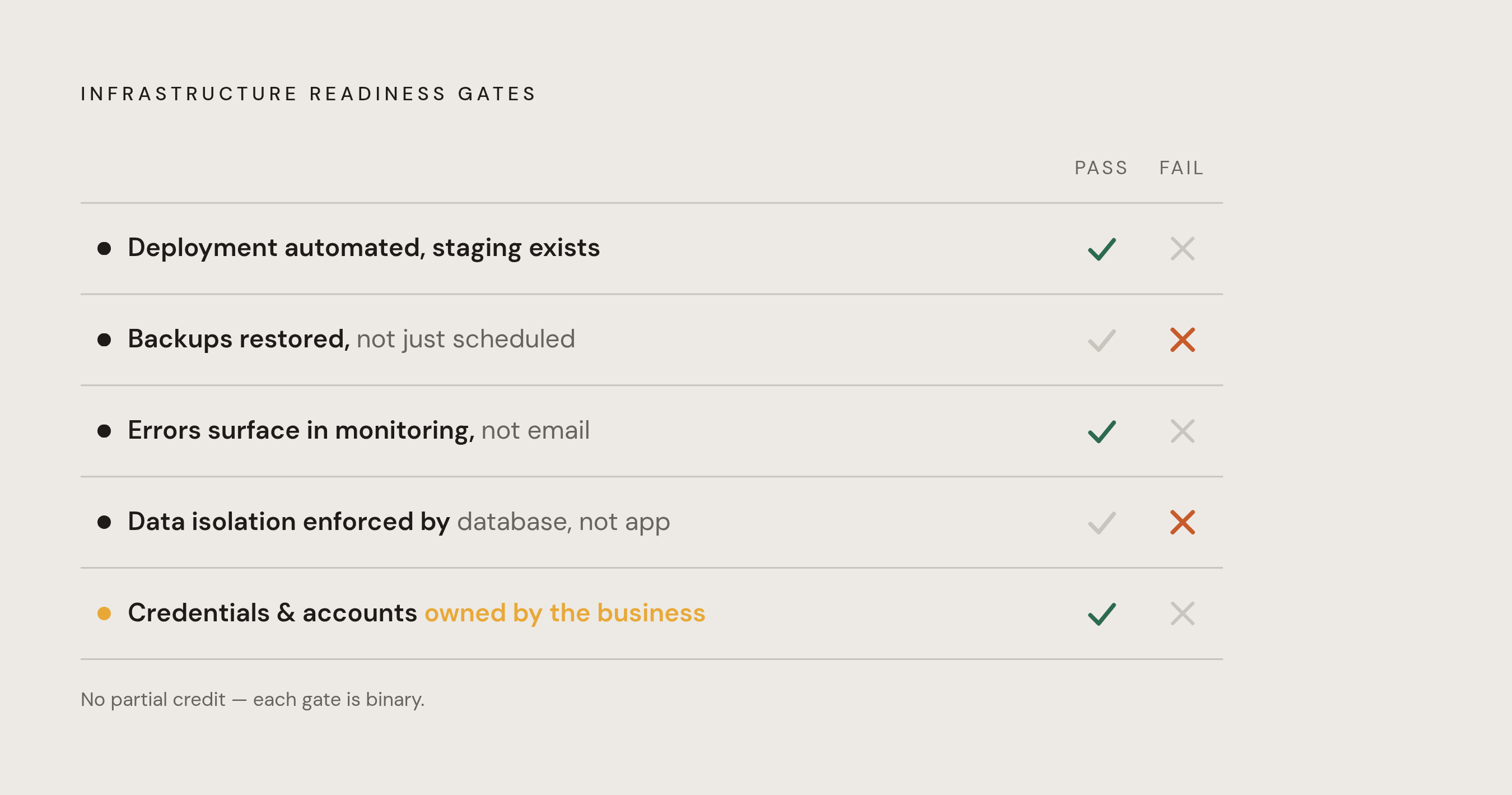
The receiving team should judge readiness from evidence. Each signal has a binary state. Deployment is automated or it is not, a restore has been tested or it has not, and an alert has triggered or it has not. Database isolation and business account ownership need the same clear yes-or-no answers.
For a technical assessment before signing with an engineering partner, the deliverable can be a scored register organized around those five criteria. Each entry records the condition, its supporting evidence, and whether it passes, while unresolved entries name an owner and a completion date. That gives a buyer something more useful than a broad assurance that the architecture looks sound.
The decision follows from that record. Proceed when the evidence supports acceptance, and pause when a required condition remains unproven. A responsible agreement records any work the teams explicitly agree to defer, who owns it and when it is due, and the rollback path if that work causes a production incident before it is done. A deferred condition is not a passed condition.
For founders without a technical co-founder and nonprofits with lean teams, an ongoing maintenance plan names who will keep the system running. A founder with five evidenced signals and a named technical partner is accepting an operable system with continuing support.