Grant Reporting Workflows Built on No-Code Tools
No-code tools can connect grant data across systems without custom engineering.

Before a nonprofit can explain its results, it must bring together program data, deadlines, and funder requirements that are spread across systems. No-code tools can connect those sources into a repeatable workflow without custom engineering, provided the organization understands both the integration work involved and the compliance limits it may eventually reach.
Why grant reporting keeps failing despite better tools
A housing services nonprofit with a HUD grant must report on the households it served, their income levels, and the outcomes it achieved. But its client records are in a case management system, while its grant documents are somewhere else. The report begins with a search. Staff must connect what the funder requires with what the program recorded before they can write a useful account of the work.
A platform has four jobs, including tracking deadlines and compliance, producing funder-compliant reports without manual assembly, connecting requirements to program performance, and remaining usable by a small team without a dedicated grants administrator. Most tools address the first two. The connection to program data is where nearly all fall short, leaving staff to bridge the gap themselves. What does it take to actually close that gap?
What "no-code" actually means in the grant workflow context
In this context, no-code means non-technical staff can configure a connected workflow without custom engineering. But “grant management” describes two different jobs. Grantseeker tools help nonprofits manage opportunities, deadlines, documents, and restricted-fund reporting after an award. Grantmaker tools help organizations run funding programmes, from application intake and scoring through disbursement and compliance reporting.
That distinction comes before any comparison of features. No-code tools fit naturally on the grantseeker side, where the central task is connecting existing information. Grantmakers that work at scale tend to need platforms built for that work, with a deeper architecture for compliance. An organization on both sides needs clean handoffs between those workflows.
The grantseeker workflow and where it breaks down
For a development director, the work starts with an opportunity pipeline and the deadlines attached to it. A document library holds material the team can reuse, while restricted-fund reporting shows what work was done after the funds arrived. Spreadsheets can handle the early stages reasonably well. Tracking prospects and dates is tractable, and document and answer libraries are manageable without a connected database.
The strain appears when a funder asks for outcomes. At that point, the development team needs information from wherever programs actually run, rather than another update to the opportunity tracker. A complete grant record does not necessarily contain the evidence needed for the report. Staff still have to assemble that evidence from separate systems before the deadline.
The problem also extends beyond staff time. Knack's grant management documentation identifies weak access controls, audit trails, and encryption as risks in spreadsheet-based grant workflows. Grant data frequently includes personally identifiable beneficiary information, so fragmented reporting can expose more than an unfinished draft. As the portfolio grows, the team is managing sensitive records as well as dates and documents.
How no-code platforms reconnect what spreadsheets keep separate
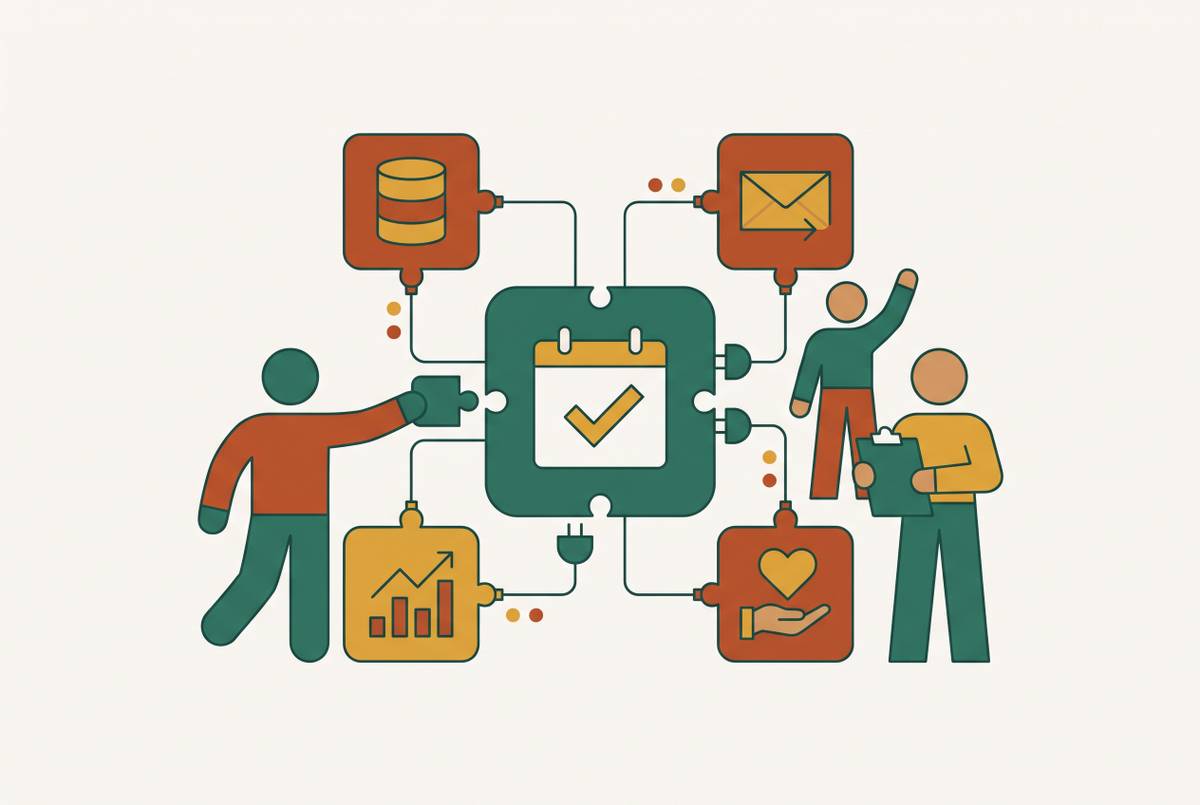
A connected workflow links grant requirements with program performance data and makes that information available for reporting. The integration layer does the essential work. Connections to case management, donor CRM, and finance systems allow the workflow to draw on information where it already lives. Without those connections, automation can organize the work, but staff still have to put the same information together by hand.
Five capabilities distinguish this approach from a spreadsheet. Access controls and audit trails govern sensitive information, while real-time collaboration avoids competing versions. Notifications and routing automate handoffs between staff. Reporting dashboards show the latest information, and mobile access lets staff in the field update program data. These capabilities support a repeatable process, although their availability and depth depend on the platform.
Knack documents an example at Louisiana State University's Social Research and Evaluation Center. SREC moved beyond spreadsheets using the platform, streamlining workflows, improving data security, and making information accessible in real time while significantly reducing administrative work. The setting was university-scale, but the structural problem is familiar to a mid-size nonprofit. The useful distinction is not the size of the institution, but whether program information and reporting work remain separate.
Purpose-built grant trackers for the grantseeker side
Purpose-built trackers give teams a workflow they do not have to design from scratch. LiveImpact is the only platform among the options covered here that connects grant requirements and program data in the same system. For direct-service nonprofits, outcomes are recorded as part of day-to-day program work, so staff can skip a separate export and manual reconciliation before a deadline. It also covers grant tracking, post-award compliance, funder reporting, and donor management integration.
Instrumentl suits nonprofits with dedicated grant staff who want prospecting together with post-award management. It covers tracking, compliance, and funder reporting, but does not integrate program data. Grantseeker is a simpler way for very small nonprofits on a tight budget to move off spreadsheets, with some tools for post-award compliance and reporting, but no full program-data connection. Grantable addresses a different bottleneck through AI-generated grant writing and proposal content aligned with funder requirements, with a free plan available. Staff still have to put the data together when they use help with drafting.
Foundant GrantHub illustrates a separate concern about fit. The widely used standalone tracker for small to mid-size nonprofits was discontinued on January 31, 2026. Its discontinuation forced thousands of nonprofits to choose between another purpose-built tool and a flexible no-code stack. A new tracker on its own does not create a program-data connection.
Flexible no-code database platforms that can be shaped into grant workflows
General-purpose database platforms offer more control over how the pieces connect. The organization must supply the design and maintenance. Knack lets nonprofits, universities, and government agencies build custom applications covering grantmaking, donor tracking, financial management, program management, and impact reporting. It offers AI-powered app-building and a free trial, with SREC providing an example of grant administration at scale. Its flexibility is useful when a standard tracker does not match the organization's reporting process.
Airtable is widely used for lightweight grant tracking. Its AI capabilities also reach into data assembly. Superagent, launched in January 2026, coordinates specialized AI agents working in parallel, while Field Agents retrieve, analyze, or generate data at the cell level. Those features broaden what teams can configure, but they do not remove the platform's record and row limits. Growing portfolios can still face migration pressure.
Baserow is permissively licensed and self-hostable, with no record caps or API limits, making it suited to growing teams that prioritize data ownership and scalability. SeaTable is an option for European nonprofits or those with GDPR obligations, with a provider based in Mainz and servers in Germany. Softr and Glide serve another need by adding approachable portals to existing Airtable or Google Sheets data. Zapier supports over 9,000 app integrations, making a cross-vendor workflow more viable, though someone must still maintain the connections.
Grantmaker tools for nonprofits that run their own funding programmes
A nonprofit awarding sub-grants, managing bursaries, or running a community fund has a different purchasing problem. It needs application forms, eligibility and triage rules, scoring, and external reviewer access. Decisions must be auditable by a board. After an award, teams track payments and handle grantee reporting, with encryption and role-based permissions to support that work. A grantseeker tracker is not a substitute for that process.
Submittable fits application-based processes and grantmaking programmes, with partial coverage of grant tracking, post-award compliance, and funder reporting. Fluxx is for organizations that give out grants and covers all of post-award compliance. Since acquiring Grantseeker in November 2025, it also serves grantseeking organizations. Consolidation is reshaping this market more broadly, with SmartSimple merging with Foundant in 2024 and GivingData joining the combined entity in 2025. SmartSimple now operates under Foundant, offering a workflow engine configurable by non-technical administrators for state agencies, research foundations, and CSR programs.
Where no-code workflows hit a ceiling and what that moment looks like
A federal or institutional funder may need an audit trail that the chosen platform cannot provide. Most no-code tools reserve deeper audit trails, role-based permissions, and encryption for premium tiers, or do not provide them at all. A configuration adequate for a small foundation grant may therefore be unsuitable for federal reporting, even if it assembles the report's data efficiently.
This is the strongest limitation of the approach. No-code can connect much of the reporting workflow while leaving its compliance-critical final portion unsupported. The tool may need a different engineering foundation. Depending on a platform brings another limit, as GrantHub's closure shows. A process that works can have to move to another platform on someone else's timetable.
Flexibility can also recreate the original fragmentation. If each team member builds a single-purpose application, the organization may exchange spreadsheet silos for application silos. Choose tools with a migration path and identify which compliance requirements the initial workflow defers. That distinction is easier to act on before a funder makes the missing capability urgent.
When a no-code grant workflow needs to be rebuilt on a production foundation
The workflow has to be rebuilt when the rules for its data go beyond what the configurable platform can do. Triggers include an unsupported federal audit requirement, beneficiary data volume beyond the platform's compliance posture, or multi-program reporting that requires tenanting across chapters or sites. A discontinuation can force the same decision under time pressure. None of these conditions means the earlier workflow had no value.
Validated workflow logic and product decisions remain, while the engineering underneath is rebuilt with a proper data model, security, tests, and an extensible architecture. The product stays live during that transition. Organizations that handle beneficiary information should weigh an engineering review before they grow much larger against the risk they face from a breach. Technical debt here is a predictable stage to address when the workflow has proved useful and real compliance obligations arrive.
Choosing the right architecture for where your grant portfolio actually is
Before booking demos, teams should ask how they take part in funding, what compliance duties they have now, and how quickly those duties may grow. Is the organization seeking funds, awarding them, or doing both? Does the immediate bottleneck involve missed deadlines, missing program evidence, or an audit requirement? These are different problems to solve. A tracker, a configurable database, or a grantmaker platform belongs in the shortlist according to those answers.
For a small nonprofit leaving spreadsheets, Grantseeker or a lightly configured Airtable base can address painful tracking gaps without over-engineering the process. Organizations running sub-granting or community funds need the grantmaker category, including Submit.com, Submittable, or Fluxx, regardless of size.
For federal grants or beneficiary information at scale, teams also need to check the depth of the audit trail, encryption, and role-based permissions before they commit. Teams should establish how the workflow connects to program systems and how its data could move if the platform becomes unsuitable.