How to Hand Off Production Ownership Without Losing Control of the Roadmap
A real handoff transfers decision rights, not just code and docs.
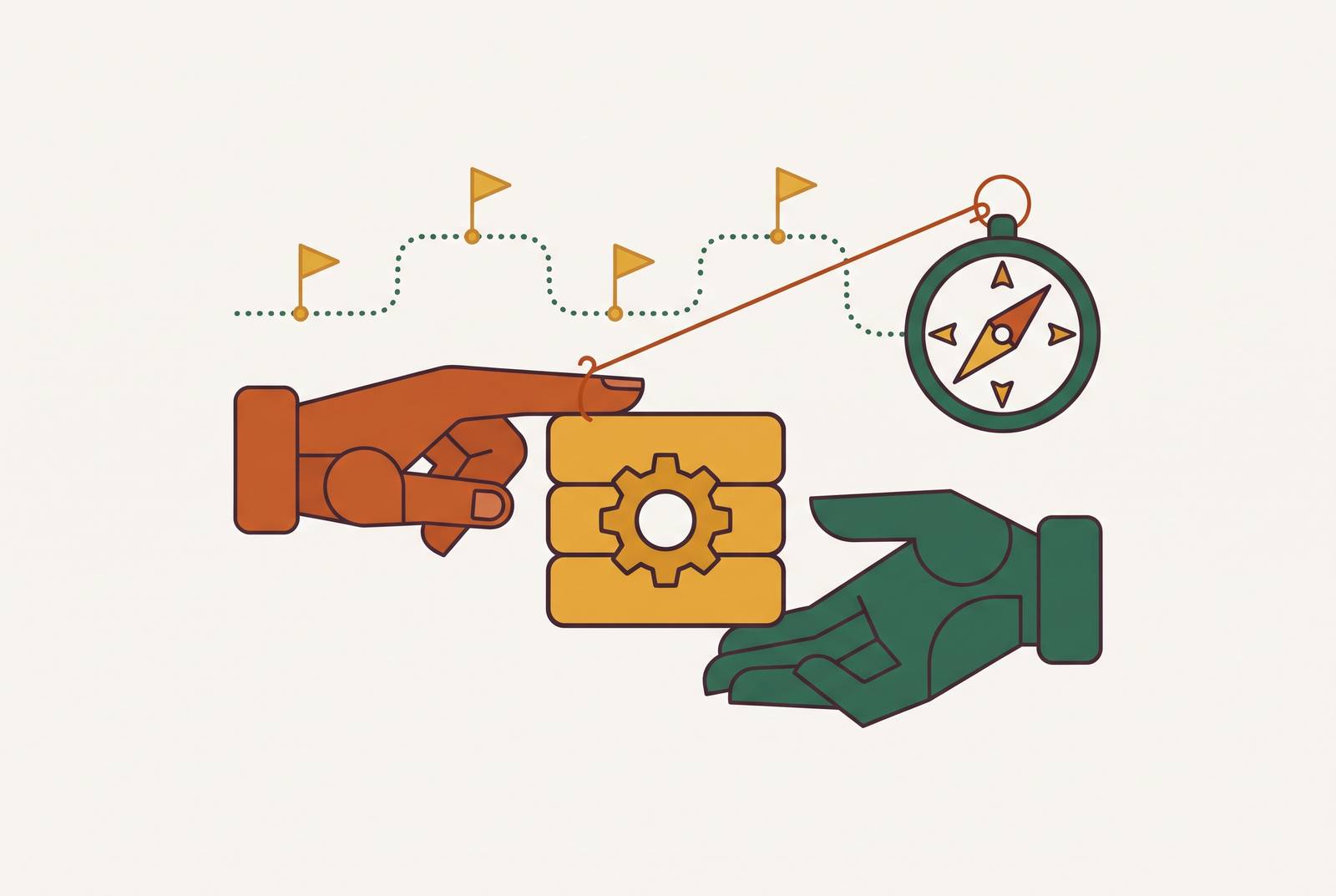
An ongoing engineering retainer for non-technical founders is an arrangement in which an engineering partner stays after launch to maintain production, respond to incidents, and support roadmap work without a full-time hire. Handing off production ownership without losing roadmap control requires more than continuing access to an engineer. It requires an ongoing transfer of decision authority, with the partner responsible for reliable operation and the founder retaining authority over product priorities.
Why founders lose roadmap control at the moment they think they've gained engineering capacity
Delegating engineering should free a founder to focus on customers, yet it can make every product decision harder to control. The founder gains someone who can build but becomes dependent on that person to explain what can change, how long it will take, and which compromises are unavoidable. Delegating execution without defining authority leaves the founder dependent on the engineering provider.
Contract engagements often reward delivery while leaving operability by the next team unrewarded. Documentation and knowledge transfer have no firm deadline or separate line item, so they get cut when delivery comes under pressure. When no one inside the organization leads the technical work, the vendor has to become the architect. The same people come to control estimation, scope, and architecture, leaving the founder to choose between options without being able to judge the assumptions behind them.
But what about a clean handoff with thorough documentation? Fahim Hossain’s vendor account describes a well-prepared transfer that still surfaced basic questions about whether anyone had restored a backup and where the secrets lived. These were operating questions. Documentation is necessary, but it cannot decide who approves a change, resolves a priority conflict, or accepts a technical tradeoff.
What a governance transfer actually consists of, versus what most handoffs deliver
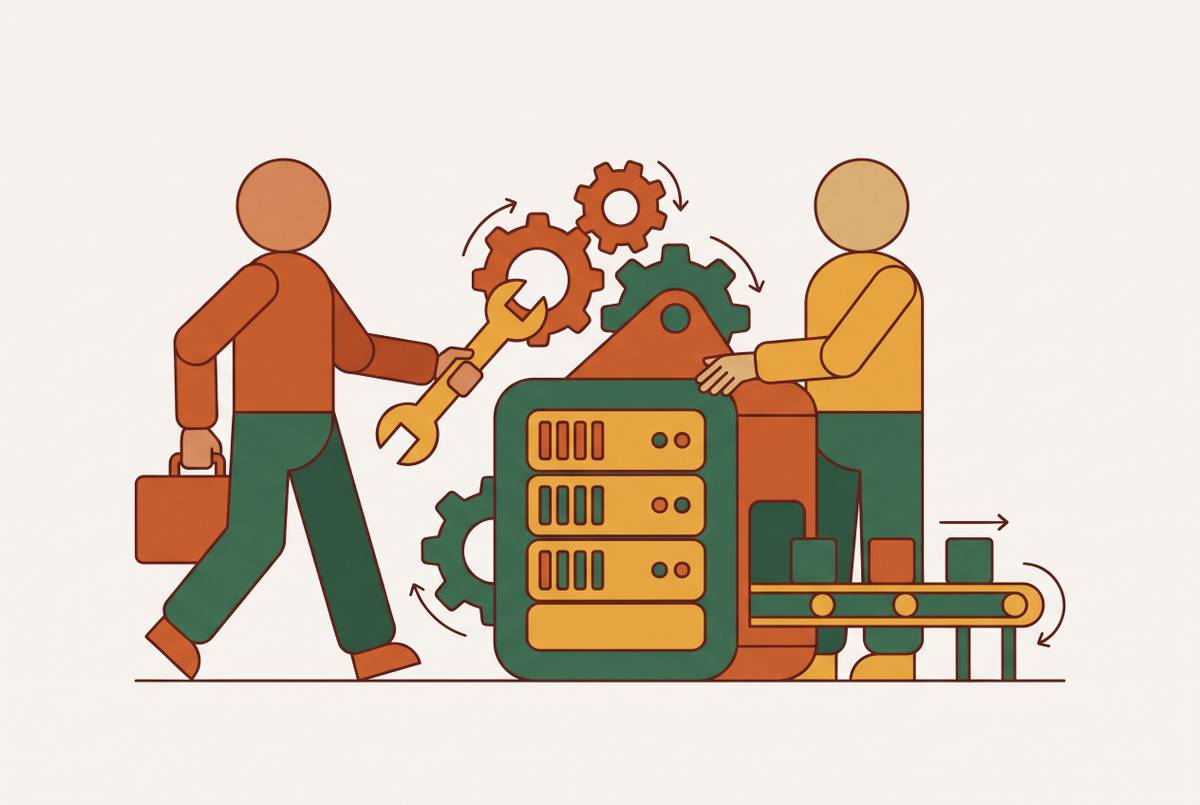
briskData’s transition framework identifies six workstreams in a complete handoff, extending well beyond source code. Decision rights sit above all six. Someone must have the authority to explain design choices, approve changes, settle clashes over priorities, and answer key questions quickly. Without that, a team can have every document and still lack permission to act or know what to do.
The first workstream, ownership and access, covers repositories, hosting accounts, domains, credentials, billing, contracts, and IP records. No production system should have to rely on a former developer’s personal email, credit card, phone number, or MFA device. The second, architecture and data, records how the system fits together, including versions, end-of-life components, data obligations, external jobs, and known defects. This is the operating context behind the code. It explains which changes are straightforward and which touch an accepted limitation.
The third workstream covers build, release, and production operations, from local setup and deployment to rollback, alerts, and a tested restore. The fourth transfers product and support knowledge, including critical workflows, unresolved incidents, customer commitments, roadmap work, and accepted tradeoffs. These connect technical operation to business purpose. A team that can deploy but cannot explain a customer commitment is not ready to make informed production decisions.
The fifth workstream transfers vendor and integration relationships, with account owners, billing, renewals, credentials, and emergency procedures established before the outgoing relationship ends. The sixth uses capability tests to set the terms for acceptance and exit. Can the incoming team deploy, roll back, acknowledge an alert, restore data, resolve a support request, and reach critical vendors using only transferred access? briskData flags accessible repositories without production access, untested restores, and single-person deployment knowledge as warning signs.
Why AI-accelerated development makes documentation debt the primary blocker to scaling
AI-assisted development makes this gap more urgent in 2026 because code can grow faster than anyone’s understanding of it. An incoming team may have to reconstruct both the system and the reasoning behind its architecture. The debt is often structural. Before changing a foundation, the team needs to understand why it exists and what depends on it, which makes missing explanations a direct constraint on further development.
The Lovable production failure illustrates the exposure that can remain behind a working product. A Broken Object Level Authorization flaw, which was reported in March 2026 and made public in April 2026, affected every project created before November 2025 and left source code, database credentials, and AI chat histories exposed across thousands of customer projects. Wiz’s report on MoltBook describes another production database exposure after its January 2026 launch. Private conversations had no encryption or access controls, and some had third-party API credentials in them. Neither case makes speed itself the enemy. They show why visible functionality is not proof of production readiness.
Tredence’s enterprise AI framework identifies unclear business ownership, incomplete governance, missing maintenance plans, and weak evaluation criteria among the blockers to readiness. A passing model accuracy score cannot resolve those gaps. The same distinction applies to documenting a fast-built initial product, whether AI-generated or no-code. A description of what exists cannot substitute for agreement about who owns its risks and ongoing upkeep.
Could a team simply document as it goes? Recording decisions while the reasoning is available helps, but retrospective documentation reconstructs what happened more readily than why it happened. Once the people who made those choices leave, their unstated reasoning may leave with them. Ownership also needs contractual clarity. Explicit assignment clauses covering AI-generated artifacts, including proprietary algorithms and custom-trained models, address legal uncertainty that a source-code transfer alone leaves unresolved.
How the "hero admin" pattern multiplies this risk in nonprofit organizations
Smaller IT budgets make re-engineering harder to absorb, while high staff turnover can turn each transition into another partial rebuild. A new administrator adds processes without fully understanding the old ones, so technical debt grows. The organization accumulates changes without accumulating shared understanding.
The “hero admin” holds the system’s logic, history, and structure in one person’s head. When that person leaves for another job, burns out, or reaches the end of a grant cycle, the organization loses both operation and institutional knowledge. Who can judge whether the replacement has received enough? The nonprofits most in need of documentation, test suites, and deployment runbooks often have the least in-house capacity to demand or assess them.
An Airtable-based operational stack makes this dependency concrete. A contractor builds donor tracking, program management, and reporting through linked tables, formulas, and automations, then remains the only person who understands how they fit together. The organization owns a working system but cannot maintain it independently. Calling the contractor back becomes a continuing requirement rather than a choice, binding technical knowledge to the commercial relationship.
Growth adds another source of pressure. As an organization grows, Airtable’s pricing tiers, record limits, automation-run limits, and editor caps can force it to move into paid tiers sooner than it expected. Meanwhile, nonprofits in 2026 face expectations for sophisticated impact measurement, secure systems, and professional-grade efficiency, even as many funders treat technology as overhead. Changing platforms may ease some of that pressure. It will not, by itself, remove dependence on the person who designed the stack.
Airtable alternatives for nonprofits ready to migrate off a contractor-dependent stack
For a nonprofit ready to migrate, licensing and compliance needs provide a more useful starting point than a general claim about the best alternative. Grist uses Apache 2.0, an OSI-approved license, so teams that want an open license without use restrictions can consider it. Teable uses AGPL-3.0, also OSI-approved, and offers free self-hosting under that license. Both belong in the evaluation. Their licensing gives organizations considering shared sector tooling a different starting point from a product with restricted permitted uses.
NocoDB’s Sustainable Use License, updated on 29 January 2026, permits use “only for your own internal business purposes or for non-commercial or personal use”. It permits distribution “only if you do so free of charge for non-commercial purposes”. An organization needs to check those conditions before it plans to share or offer its stack to peers. Grist and Teable’s OSI-approved licenses do not impose that same internal-business or non-commercial-use boundary.
Baserow’s official Trust Center states that it is “certified for various regulatory and industry standards (GDPR, SOC 2, HIPAA)”. Baserow B.V. is a Dutch company headquartered in Amsterdam, Netherlands. These are useful facts for organizations evaluating compliance posture, but they answer a different question from licensing. The choice still has to fit the organization’s data obligations and existing infrastructure.
Migration also needs an owner beyond the export. Moving records without also handing over automation rules, data relationships, and operational logic makes the same handoff fail again on a new platform. A values-aligned engineering partner can treat the move as re-engineering rather than file transfer, rebuilding the stack on a foundation the organization controls. Documentation and decision rights then remain inside the organization when the next contractor leaves.
The structural conditions that let a founder delegate engineering without surrendering roadmap authority
Three conditions make full delegation compatible with roadmap control. The organization needs an internal counterpart with real authority, explicit decision rights, and an engagement designed for both delivery and continuity. These conditions reinforce one another. A person held responsible but given no authority cannot settle a dispute, while authority written down may stay on paper if the people involved do not keep working together.
The internal counterpart must be able to resolve priority conflicts and bring technical authority to architectural decisions. The founder can leave some engineering judgments to others. It means the organization cannot leave that responsibility vacant and expect the external team to avoid filling it by default. Documented decision rights then distinguish business priorities from implementation choices and identify who settles conflicts between them.
Relevant Software’s 2026 outsourcing guide distinguishes staff augmentation from a dedicated product engineering model by the problem each addresses. An organization may need augmentation when it has strong engineering leadership and stable architecture but lacks a skill or ability for a short time. Sustained roadmap capacity, modernization, or delivery ownership calls for a dedicated model. Extra hands cannot repair an undefined authority structure.
Hossain argues that a well-run engagement gives the client ownership of every asset from the first week, leaving the vendor with access to remove at the end. A build-operate-transfer model formalizes that continuity. The vendor builds, operates for an agreed period, and transfers responsibility at an agreed trigger, while the client owns assets throughout. The final test is capability. The incoming team must access every environment, build from source, deploy and roll back, acknowledge an alert, and restore data using only transferred access and documentation.
How do non-technical founders get reliable engineering support month to month after handoff?
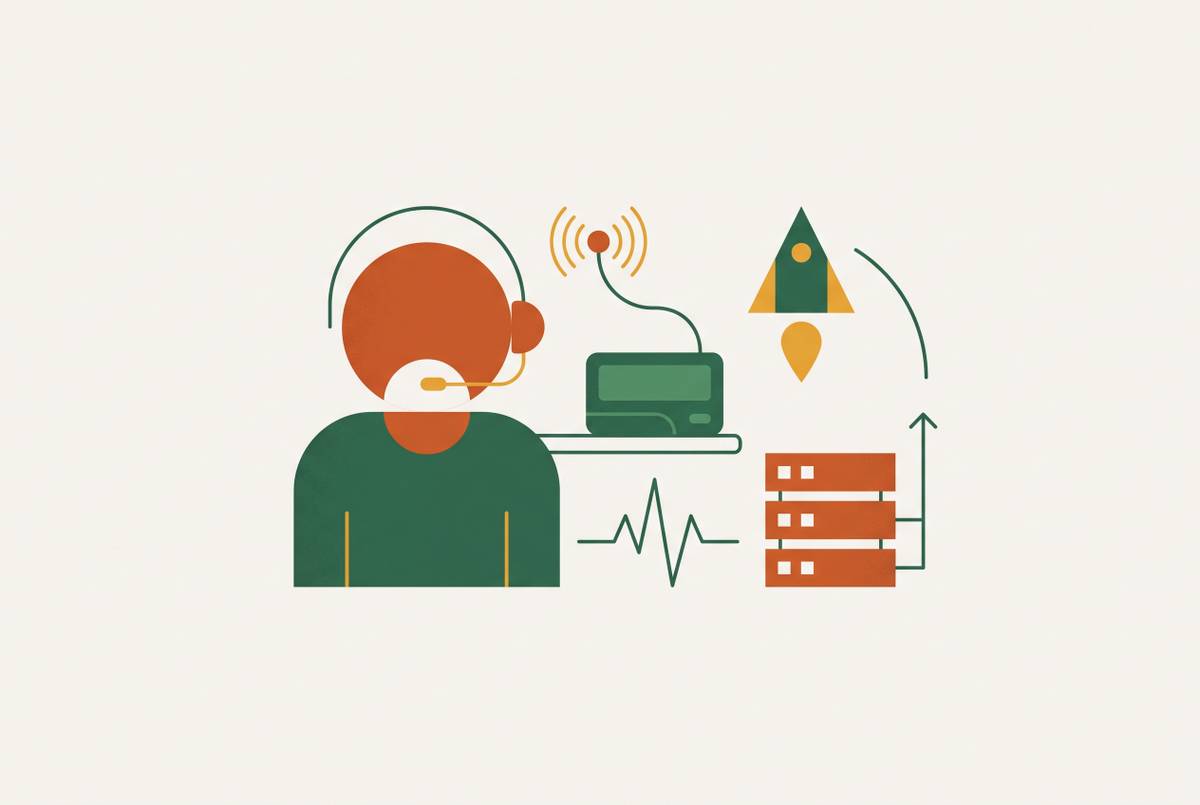
An ongoing engineering retainer makes the governance structure part of ordinary operations. Its scope includes regular alignment on roadmap priorities, recorded decisions and their rationale, monitoring, and incident response. The founder stays informed without becoming the default firefighter. The engineering partner owns production reliability so the founder can focus on GTM and client acquisition.
For a founder seeking a senior engineer on call without hiring full time, availability is only one criterion. The engagement also needs clarity about who owns production, who resolves competing requests, and how maintenance connects to roadmap work. A temporary capacity arrangement and a dedicated technical partnership solve different problems. The useful comparison is not simply how much engineering time each provides, but which continuing responsibilities each accepts.
Why is this work being done, and who decides? What will it produce, and how will the team know it worked? Where can AI help without becoming the decision-maker? When teams keep answering those questions as they work, the maintenance relationship stays clear about what each task is for and who has authority over it.
Choosing a partner for that ongoing work is more like choosing a co-founder than buying a set of separate deliverables. Shared values and long-term commitment support investment in documentation, decision rights, and continuity that delivery milestones alone do not reward. The practical criteria are whether the partner will rebuild an initial product on solid foundations rather than keep patching it, stay through growth, and treat the founder’s roadmap authority as a constraint. A studio that rebuilds and remains as a long-term technical counterpart fits that operating model. The founder’s position is the deciding test, with engineering fully delegated, product priorities still theirs, and future transitions no longer dependent on one person’s memory.