Technical Debt in Acquired or Inherited Codebases
Assess technical debt across five categories before integrating an acquired or inherited codebase.

Buying a house means paying for an inspection before you close, not after. Acquiring or inheriting a codebase works the same way, except too many new owners skip the inspection and find out what's wrong with the foundation after they've already moved in. A real technical assessment, done before an engineering partner signs on, has to cover five distinct types of debt, three different inheritance scenarios, and a specific sequence for fixing what it finds, in that order, or the remediation itself becomes the next mess.
Why inheriting a codebase is different from inheriting a project
A home inspector doesn't just flip the light switches and call it done. A good one checks inside the walls, climbs into the attic, tests the water pressure, because the seller may have let things slide in places that don't show from the curb. Software due diligence runs on the same logic. When a codebase changes hands, that codebase is the asset, and like a house, it can look fine on the surface while hiding problems that cost real money to fix.
What actually transfers in an acquisition or handover is bigger than the code itself. The new owner also inherits the context around it: business rules nobody wrote down, architectural trade-offs that made sense to someone six months ago and to nobody today, integrations that work for reasons no living person can fully reconstruct. In a team that's been building the same system for years, debt builds up gradually, and there's time to manage it as it comes. Acquisition or handover doesn't work that way. The new owner takes on the full balance at once, usually under a deadline, usually without the person who made the original decisions still around to explain them.
This situation is common. Inherited and acquired codebases appear constantly across the industry, produced by business acquisitions, vendor switches, founder departures, and the handoff from MVP to real product. Anyone who runs a software company long enough will eventually stand on one side of this transfer or the other.
The five debt types a new owner is taking on
Technical debt is five separate liabilities, each with its own risk level, its own owner, and its own fix. Sorting them out early gives a new owner the vocabulary to think clearly about what's actually been taken on, before worrying about which one deserves attention first.
Code quality debt is the messy, undocumented code that makes maintenance and extension miserable. It's the most visible kind of debt, the one a new engineer notices in the first afternoon of poking around, and Black Duck identifies it as costing an acquiring engineering team months just to understand what it inherited. Visible doesn't mean most dangerous: it's often the least threatening of the five on its own, since bad code that works can usually be cleaned up in place.
Architectural debt is a different animal. It's a system design that made sense at a modest customer count but can't carry the load at ten times the size. This is the structural constraint that decides whether everything else is even fixable, or whether the whole thing needs a near-rebuild. A wrong call about data models early on ripples through thousands of downstream decisions, and those decisions get harder to reverse the longer they sit. Architectural debt tends to be the leading source of long-term pain precisely because it constrains every layer built on top of it.
Security debt is vulnerabilities that got flagged at some point and never patched. Of the five, this one runs on the least forgiving clock. Black Duck notes that vulnerabilities discovered after a deal closes need remediation immediately or they become breach risk, and that risk doesn't pause while a new owner gets oriented.
Open-source license debt hides restrictively-licensed or entirely unlicensed code inside a commercial product. It stays invisible until the product ships, or until a deal is already signed and someone finally runs a scan.
Process debt covers teams that have been shipping without real testing, review, or documentation discipline. This is the debt that sets the pace at which every other kind of debt will keep growing after the handover. Atlassian describes the pattern familiar to any engineer who's worked a system with no process behind it: fix one bug and two more show up, because the practices that produced the first bug are still running in the background.
Comprehension debt is the toll on human attention and judgment when nobody on the new team fully understands why the system behaves the way it does. It compounds every other category, because a team that doesn't understand the system can't accurately judge how bad the debt actually is. This strain is most visible in AI-generated and vibe-coded MVPs, where the logic got written faster than any human being fully absorbed it.
Where most inherited debt comes from: the MVP pipeline
Most inherited codebases trace back to the same place: an MVP built to hit a launch date, not to survive what came after. MVP delivery is designed around shortcuts, in architecture, in testing, in infrastructure, and every trade-off made to ship on time tends to sit untouched once the product starts working. Atlassian describes the honest version of this: deliberate debt is a conscious decision, developers know they're creating future work and choose speed anyway.
AI tools have sharpened this pattern rather than solved it. Code produced by AI can carry meaningfully higher rates of architectural inconsistency and security vulnerability than code written by hand, because these tools are built to produce something plausible, not something built to last.
An MVP gets funded, and the founder needs to bring in an engineering partner, either hiring in-house or switching vendors. If the original MVP was built on sensible foundations, that transition goes smoothly. If the codebase has no tests, no documentation, and logic nobody can explain, the transition turns into a crisis on day one.
Product studios that work with founders who've acquired or inherited a codebase mid-stream know this asymmetry well, whether the handoff came through acquisition, a vendor switch, or an MVP maturing into a real product. The new owner inherits more than code. They inherit undocumented business rules, architectural trade-offs nobody wrote down, and integrations that function for reasons nobody can fully reconstruct. The first job is rebuilding enough understanding of the system to move forward without grinding to a halt.
The pattern repeats with specific shape: a founder shipped with AI tools or a freelancer, the product found real users, and now the system needs to be rebuilt to survive them. Getting a product to launch and keeping it reliable under real traffic are two different standards entirely. Shortcuts that were perfectly reasonable at MVP stage start failing once paying customers depend on the thing actually working.
None of this means the original shortcuts were careless. Skipping automated tests or choosing a simpler database schema to ship a first version faster is often exactly the right call at that stage. Atlassian borrows Martin Fowler's framing here: deliberate and prudent debt, the kind where the team knows what they're trading and plans to deal with the consequences, is a reasonable bet. Reckless and inadvertent debt, the kind nobody even noticed accumulating, compounds fast and without warning. What separates an MVP that ages well from one that becomes a crisis is whether anyone tracked the original trade-off and came back to revisit it before real users arrived.
Which situation you are in determines what you do first
Not every inherited codebase carries the same urgency, and the label "inherited codebase" actually covers three fundamentally different situations. Treating an emergency like a planned handover, or the reverse, compounds the damage before any remediation work even starts.
An emergency takeover happens when a developer disappears or gets terminated mid-project. The product may be incomplete, or live without anyone who built it still around, and access to critical assets may be in dispute. The first priority here is securing the repository, the hosting credentials, the domain registrar, and the data before anyone looks at a single line of code. The single most damaging discovery in this scenario, and a common one, is finding that the repository, hosting access, and third-party accounts are all sitting under the departed vendor's control rather than the new owner's.
A planned vendor switch looks very different. The product is running, the relationship has simply broken down, and there's time to run a structured handover. The risk here is losing momentum during the transition, while both the outgoing and incoming teams are only half paying attention.
An inherited project from an acquisition or internal team change is the third case. The product is live, the new team needs to understand it well enough to maintain and extend it, and the main danger is making changes to a system nobody fully understands yet, which introduces regressions or breaks behavior nobody documented. This scenario carries the lowest day-one urgency of the three but the highest long-term stakes, because unknown debt tends to compound into system failures through a chain of small, seemingly unrelated changes.
Whichever of the three applies, the obligation at the start is identical: figure out what's actually there before touching anything.
Technical assessment before hiring an engineering partner
A real audit of an inherited codebase is a structured look across all five debt types, built to produce a remediation roadmap rather than just a list of worries. Black Duck's 2025 guidance on M&A technical due diligence lays out four dimensions that apply just as well outside an acquisition context as inside one, and they're the closest thing to a standard checklist a founder can hand to a prospective engineering partner.
Code quality analysis looks at structure, maintainability, and how well the codebase is documented. Open-source composition analysis, often called SCA, inventories every open-source component in use, flags any with known security vulnerabilities, and checks license obligations against how the product is actually sold. Security assessment covers both the code itself and the process used to build and ship it, since a clean codebase built on a sloppy deployment pipeline is still exposed. Development process review examines testing practices, release cadence, and how debt has historically been tracked, which sets the pace at which new debt will pile up after the handover completes.
The output that matters is a prioritized roadmap, not a catalog of flaws. A useful audit answers four questions directly: what issues exist, how severe is each one, what will fixing it cost, and how long will it take. IT Convergence's 2025 guide points to concrete symptoms to hunt for in an inherited legacy system: modules with logic so tightly coupled that touching one thing breaks three others, parts of the system engineers quietly avoid because changes there "break everything," integrations with almost no documentation, and manual workarounds buried in day-to-day operations that nobody wrote down anywhere official.
AI tools can speed up the discovery phase of this process. A language model running in read-only mode can trace feature flows, flag dead code, summarize unfamiliar modules, and mine git history far faster than a human reading top to bottom. Treat that output as a fast first pass, something a senior engineer still has to verify, not as the final word. These tools accelerate analysis, but they don't recover undocumented business rules on their own and they don't resolve architectural constraints by themselves. A complex legacy system still can't be safely modernized without someone addressing its actual dependencies by hand.
Comprehension debt is where this gets hardest to measure. When no engineer on the new team fully understands why the system behaves the way it does, that strain sits on top of all five debt categories and makes each one worse. It's especially sharp in AI-generated and vibe-coded MVPs, where the logic moved faster than any human fully absorbed it, which makes it genuinely difficult for a new owner to tell the difference between debt that can be managed incrementally and debt serious enough to require a rebuild before anyone can move forward safely.
Black Duck's research points to a clear payoff for doing this work up front: companies that run a thorough pre-close audit use the findings to negotiate better deal terms, or to make an informed call about remediation before signing anything. Companies that skip the audit find out what's wrong during integration instead, when it's expensive, disruptive, and far harder to walk away from.
The sequence in which inherited debt needs to be addressed
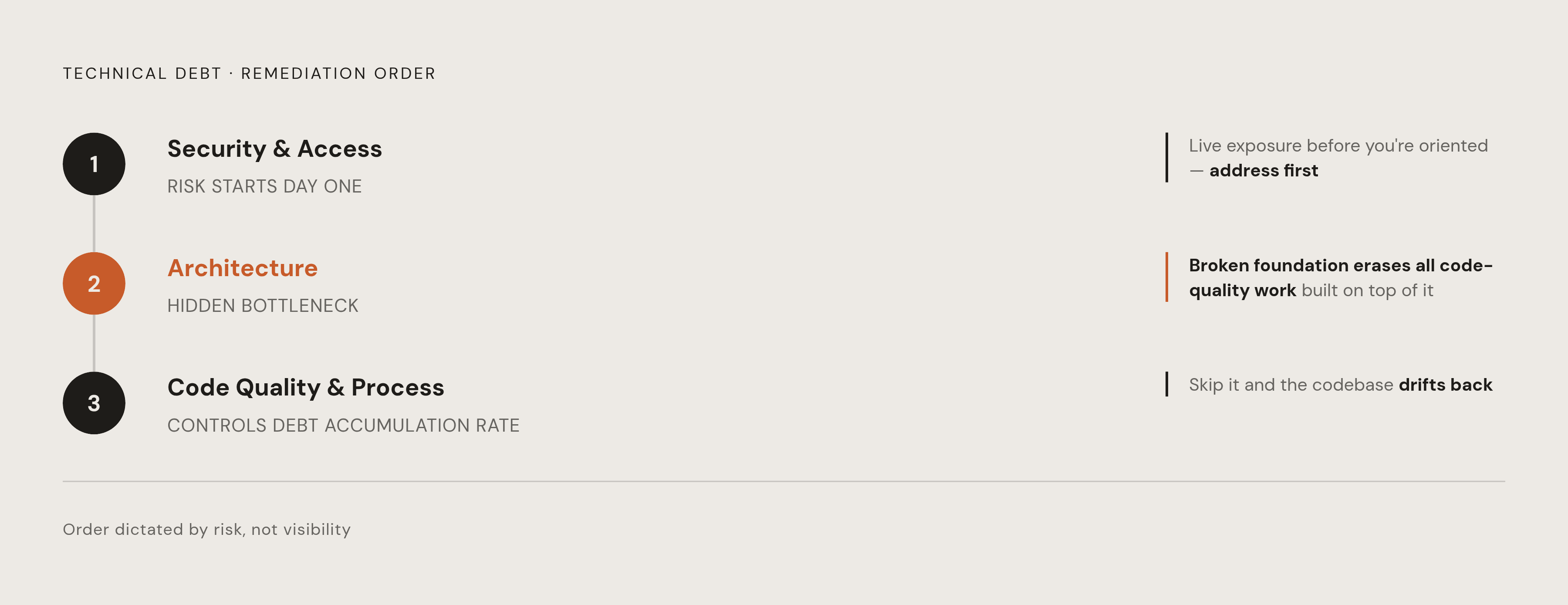
Finding the debt is only half the job. Fixing it in the wrong order, polishing code style before patching a known security hole, or refactoring modules before the foundation underneath them is stable, creates brand-new failures on top of the old ones.
The right order follows risk, not visibility. Security debt and access gaps come first, architectural constraints second, code quality and process debt third. Security vulnerabilities carry risk from the first day of the inheritance, whether or not the new owner has had time to get oriented. Architectural debt comes next because it decides whether code-quality work is even possible, or whether cleanup effort gets erased by the next feature change built on the same broken foundation. Process debt, the testing, review, and documentation habits around the code, comes third because it sets the rate at which new debt accumulates. Skip that layer and the codebase drifts right back to where it started, no matter how much got cleaned up in the meantime.
Inside this sequence sits the real decision most new owners are actually weighing: rescue the existing codebase, or rebuild it. In most cases, rescue costs less and moves faster than people expect going in. A rebuild becomes the right call when the architecture is broken at a level where patching it piece by piece costs more than starting fresh, or when the security exposure is severe enough that nothing in the existing codebase can be trusted without a full rewrite. When a founder has shipped an MVP with AI tools or a freelancer and the codebase has no tests, no documentation, and logic nobody can explain, that refactor-versus-rebuild call becomes the central decision, even when the product itself is live and bringing in revenue.
IT Convergence frames modernization usefully here: it doesn't have to mean a full replatform. Hybrid approaches, containerizing and refactoring one piece at a time, often preserve business continuity while steadily working down architectural debt instead of betting the whole product on a clean rewrite. Quwa Labs is among the studios that evaluate an inherited codebase against this exact framework before an engagement starts, treating the audit as the thing that determines the sequence rather than skipping to remediation first. Whoever does the work, the lesson holds: the order of operations is the difference between a system that stabilizes under real load and one that breaks again a few months after the cleanup was supposed to be finished.