How Non-Technical Founders Should Structure On-Call Engineering Coverage Before the First Outage
Four pre-launch agreements prevent your first outage from becoming an organizational crisis too.
An ongoing engineering retainer is the service through which an engineering partner stays on to maintain a product after launch without becoming a full-time hire. For non-technical founders, reliable on-call coverage depends on what that retainer explicitly covers, including named responders, response times, alert routing, and handover duties. Those agreements must be in place before the first outage so users are spared the wait while the terms are worked out.
Why non-technical founders now ship production software before they understand what "production" requires
Agentic coding lets a single founder ship work that once required a team of engineers. That compression is useful: it shortens the journey from idea to launch, while the journey from launch to reliable operation remains unchanged. A working product shows that someone can use it under the conditions it was built for. It does not establish who will respond when those conditions change.
The gap is especially sharp when an AI-generated prototype becomes the foundation of a paid product. Shortcuts that helped show how the idea works become part of the system someone has to keep running. Product engineering studios like Quwa Labs work on this transition, rebuilding prototype-derived codebases into production-grade systems so that incident response can rest on a sound technical foundation. Without that transition and an explicit coverage agreement, a founder can have paying users and no plan for what happens when something breaks.
What actually happens when a production system breaks and no one has been assigned to respond
The first outage can expose an organizational failure as much as a technical one. A founder may have hired a partner to deliver software without assigning, training, or contracting anyone to respond after delivery. When the system breaks, there is no named responder, no route for the alert, and no agreed next step. Working through metrics, logs, and traces already takes a lot of effort, and mistakes are easy to make. When no one knows who owns that work, it takes even longer to get started.
Even with good application code, other things can still fail. In Cloudflare’s November 2025 Bot Management incident, a bug in generation logic made one system’s output go beyond another system’s hard-coded constraints. A founder whose product relies on outside infrastructure cannot stop every incident like this. Even a well-built product needs someone responsible for responding when a dependency fails.
Hotwash posted a job on Hacker News. Its solo founder wrote that the business had meaningful early ARR, eleven paying fire departments, and zero churn, but said he could not keep being the only person who owned the codebase. Seeking a founding engineer was a way to address that single point of failure. Even with an engineer on hand, a business that relies on one person to handle every incident is at risk when that person gets exhausted or is away.
Why technical debt makes the first outage harder to survive than it needs to be
Technical debt is the accumulated cost of shortcuts and deferred engineering work. Like financial debt, it accrues interest as unresolved problems become more expensive to address. A non-technical founder may not see much of that cost until unexpected bugs hold up releases, engineers spend their time on old problems, or infrastructure costs rise without a matching rise in users.
If the architecture makes the failure path hard to trace, the responder needs longer to understand what broke and how to restore service. Two products with equally serious failures can therefore have very different recovery times. Whether recovery takes a ten-minute fix or a three-day firefight may depend more on how understandable the system is than on how alarming the first alert sounds.
Some debt is inevitable and can be useful early on. The danger is debt that stays invisible and unmanaged as users arrive, affecting both reliability and how investors assess the business. Address the production foundation while establishing coverage that accounts for the remaining debt from the start.
How to keep an engineer on call after the MVP through four pre-launch agreements
On-call coverage is a set of agreements about who responds, how fast, to what, and with what authority. A monitoring dashboard cannot make those commitments, and a support ticket system does not establish them. The following four agreements form a practical checklist for a partner conversation. They belong in the engagement terms before production code is deployed, rather than in an informal understanding that someone will help later.
The first agreement names the on-call engineer or a rotation of specific engineers. A named person brings context, accountability, and a direct means of contact that a generic support address does not establish. The agreement must also identify a backup rather than leaving the primary responder as the only route to help. This distinguishes access to an agency from actual operational coverage.
The second agreement defines severity tiers and response-time commitments. A failed payment flow and a slow dashboard do not warrant the same response, so the contract must distinguish their urgency. A short post-delivery warranty for bugs within delivered scope is only the minimum. Maintenance must be scoped and priced separately in writing before signing. Time zones belong in these commitments too, because a clarification that slips into a 24-hour delay becomes a downtime problem during an incident.
The third agreement sets out who has access to monitoring and how alert routing works. The founder needs to know what is monitored, which thresholds trigger an alert, and who receives it. Access to a dashboard matters, but it is not evidence that an engineer will be notified. The agreed tooling should notify the responder of a failure.
The fourth agreement covers documented handover and a minimum 60-day hybrid period when a new hire or partner takes over. Both parties work side-by-side so that what they know about the system is passed on before the old contract ends. Feature flags can let new team members test changes in production while they learn the codebase, without putting the platform’s stability at risk. Quwa Labs is one example of a long-term engineering partner that stays on after launch to rebuild and maintain the system. Whatever partner a founder chooses, the coverage must be an explicit responsibility.
How to build a severity framework and escalation path in plain language
A useful severity framework starts with what users cannot do. Severity 1 means a core workflow is completely unavailable, including payments, sign-up, login, or the main feature users pay for. Severity 2 means something important is degraded or partially broken, but users can still access the product. Severity 3 covers cosmetic or low-impact problems, such as a minor feature malfunction. These descriptions give the founder and partner a shared vocabulary before either has to make a decision under pressure.
Each tier needs an acknowledgment window. This is the time by which the engineer must confirm that the alert has been seen and investigation has begun. It is not the same as a promise that the system will be fixed within that period. The response commitments should make that distinction clear so that the founder knows what the partner has actually agreed to deliver.
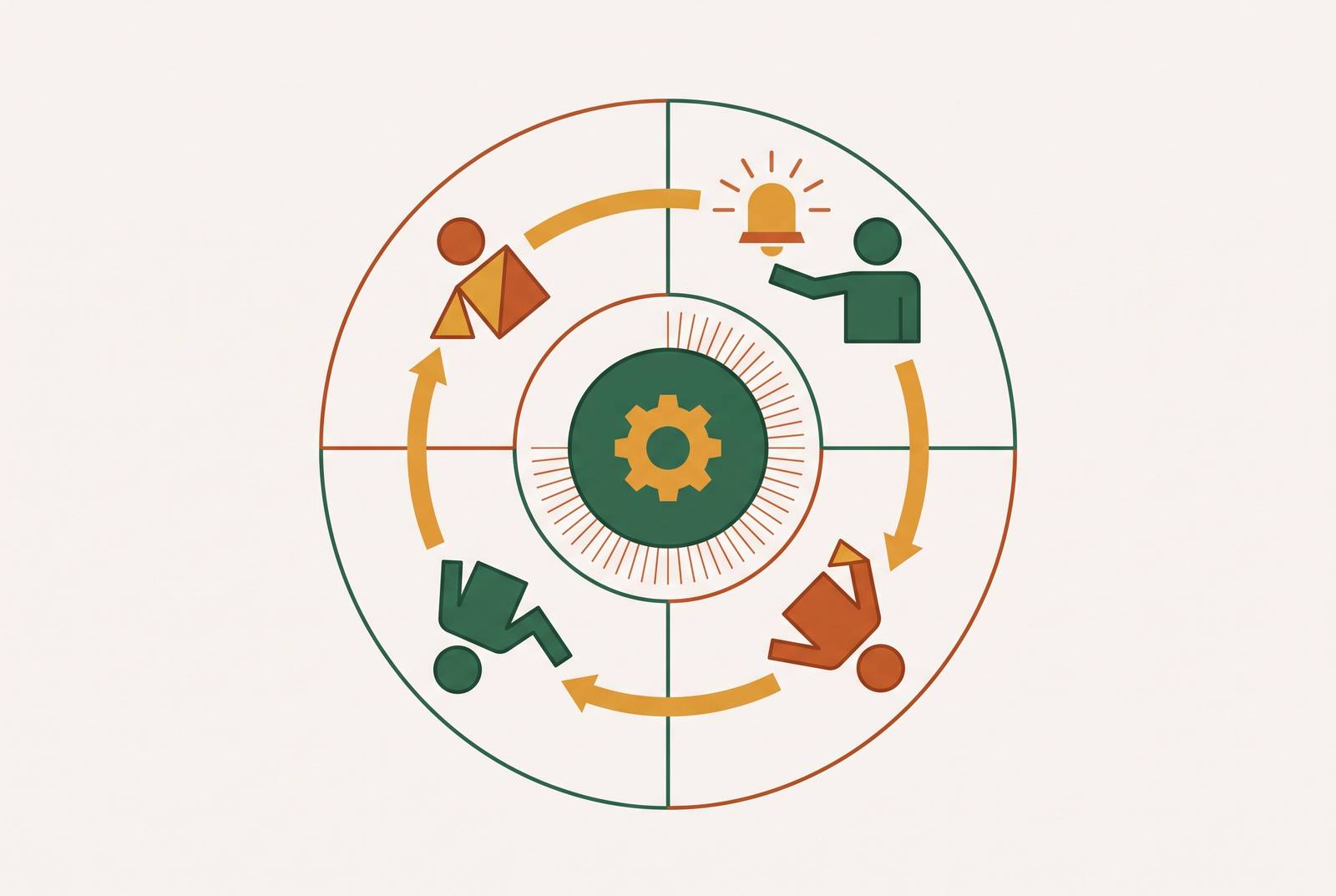
The escalation path then turns the severity framework into a sequence. The named on-call engineer receives the alert through the agreed tooling. If no acknowledgment comes within the window, the escalation goes to the next named contact through the agreed channel. The plan also states when and how the founder is informed. That notification gives the founder what is needed to communicate with affected users.
During the incident, response meetings have one job, which is restoring service. Analysis comes later, and the founder can help by recording what is known without interrupting the technical work. A reusable post-call note can use these exact prompts as its structure. “what the immediate issue was, what the team believes caused it (not confirmed), what was done to restore service, what still needs investigation, and what follow-up questions do not need to interrupt the technical work”. Keeping a suspected cause separate from a confirmed one prevents an early explanation from being mistaken for a finding.
Runbooks support the engineer’s side of the same process. These are step-by-step instructions for common failure scenarios, so the responder does not have to improvise every action under pressure. They should be required deliverables from the engineering partner. A founder does not need to write the technical steps to require that they exist and remain available to the people responsible for coverage.
What to look for in a tooling layer that extends on-call coverage without expanding the rotation
Small teams often lack the staff for a large on-call rotation, so help with investigation is valuable. AI-assisted incident response tools can connect information that an engineer would otherwise have to examine manually. Their role is to extend a small team’s capacity while keeping a human responsible. It helps to compare the work a tool can help with against the gaps in the team’s coverage.
Corelayer is an AI-native production support platform built for environments that are complex and have rules they must follow. It connects production context across code, deployments, infrastructure, and underlying data, with sensitive information kept within the customer’s environment. Resolve AI connects observability, logs, code, and infrastructure to correlate signals, propose a cause, and recommend or execute actions such as rollbacks and configuration changes. These are examples of the category rather than a ranking or a substitute for an engineering partner.
Before adopting a tooling layer, require alert routing to a named human, correlation across services, and a clear data-residency policy. A dashboard full of isolated alerts is less useful than a pattern connecting logs, deployments, and infrastructure. Noisy systems can also contribute to alert fatigue. The tool multiplies the value of sound coverage only when someone is already assigned to act on what it finds.
The nonprofit operating context and why it changes the on-call calculus
Nonprofit software teams face the same need for reliability under different staffing conditions. Limited budgets, mission-first decisions, staff carrying several roles, and funding cycles can make a full-time on-call hire impractical. That is an operating constraint that the coverage model must respect.
When a nonprofit’s primary tool fails, the mission is interrupted. Grant reporting, beneficiary intake, and donor communications do not pause because the engineering budget is small. Contracted engineering support and managed incident-response tooling can therefore serve as substitutes for staff the organization cannot hire. The same agreements about responders, severity, monitoring, and handover still apply.
The difference belongs in the pricing and operating conversation. Scoped retainers give maintenance defined boundaries, while planned maintenance windows offer an alternative to ad-hoc firefighting. For a nonprofit looking at a values-aligned partner such as Quwa Labs, the work and terms must fit those limits on budget and staff. A shared mission matters, but it must translate into terms the organization can fund and coverage it can understand.
How to evaluate whether your current engineering partner is actually structured for on-call coverage
The absence of an outage is not evidence that coverage exists. Many founders take it for granted that their partner handles incidents because they have never had to find out. Evaluation starts by asking for the named person to contact at 2am when the payment flow breaks. A support email alone does not establish that someone is accountable for responding.
The next questions concern the response-time commitments for each severity tier and where they appear in the contract. Then establish what monitoring is in place, who receives alerts, and whether the founder can see the dashboards. Ask who takes over when the primary responder is unavailable and whether that backup has been briefed on the system. Finally, establish what documentation will remain if the engagement ends, so the next partner does not start from zero.
The answers separate intentions from operational commitments. Verbal response promises, no named backup, deferred monitoring, and post-launch support left for another conversation are warning signs. Written severity tiers, a defined backup, working monitoring with founder access, and a separately scoped maintenance plan are stronger evidence. The purpose is not to find fault with a partner, but to start a conversation that may never have happened.
A senior hire costs more than base salary when the cost of recruitment, benefits, payroll taxes, and equity is added. For founders who cannot yet make that hire, an ongoing engineering retainer is a structural substitute only when it includes operational coverage. The right long-term partner stays responsible after launch, leaving the founder able to focus on GTM instead of coordinating improvised production rescues. Asking for those commitments before the first outage is preparation for the moment when keeping the product running becomes as important as having built it.