What a Fractional CTO Actually Does Versus What a Solo Founder Actually Needs
A long-term engineering partner can own the rebuild and ongoing reliability work itself.
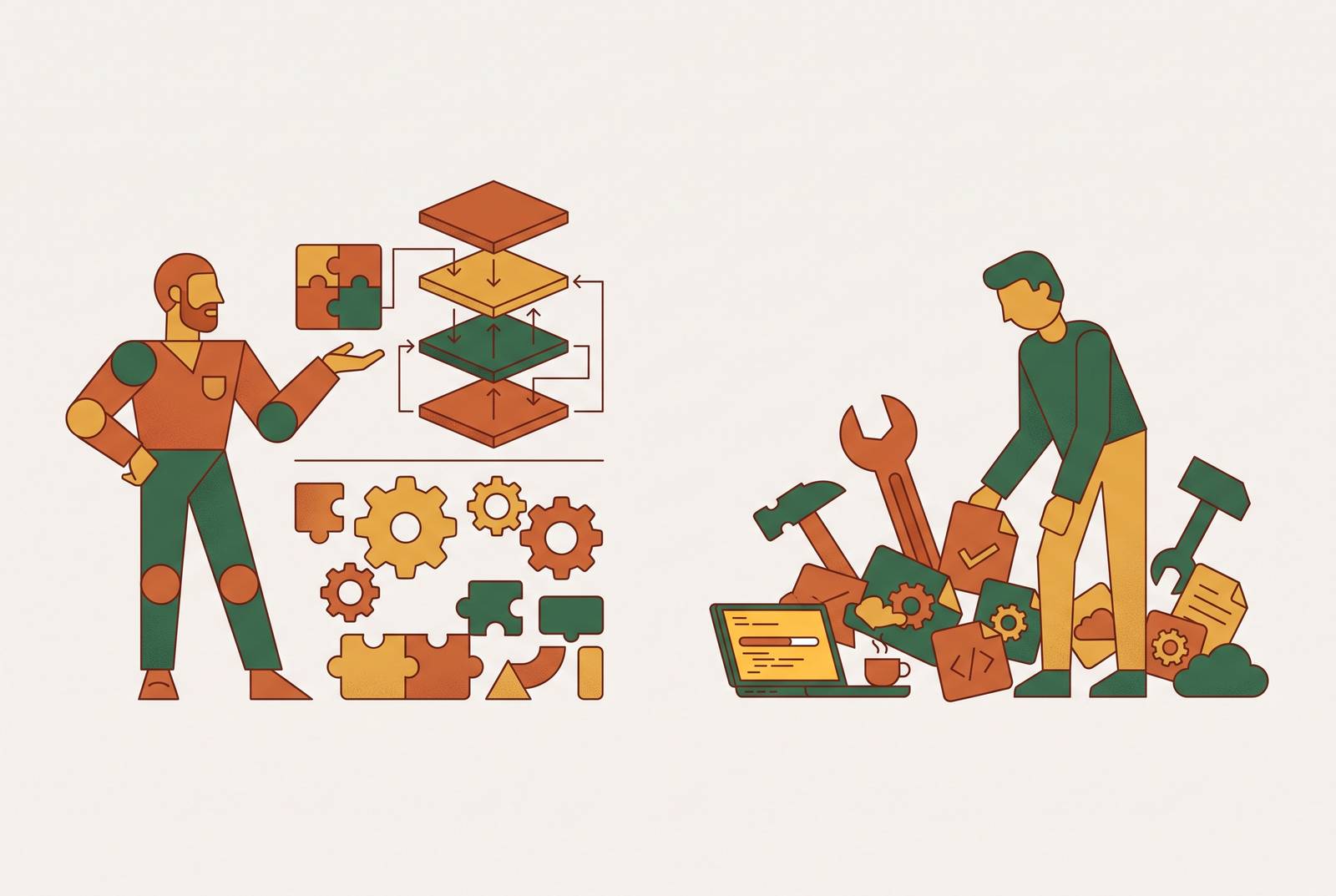
An ongoing engineering retainer for non-technical founders is a maintenance relationship with a technical partner who stays responsible for the product after launch. It answers a different need from a fractional CTO, whose main job is executive leadership.
Why solo founders keep reaching for a role that was not designed for their stage
A solo founder searches online for “do I need a fractional CTO” when technical decisions start taking time away from customers. There may be an early product, but no engineer responsible for making it reliable. The title seems to name the missing person, someone senior enough to take the technical problem off the founder’s hands. Marketing aimed at non-technical founders reinforces that impression. Yet the title often names someone who leads engineers rather than someone who provides engineers to do the work.
AI tools have made that mismatch more pressing by lowering the cost of early product development. A founder can get further alone before needing outside technical help, but getting to an MVP leaves open what kind of help comes next. The uncertainty makes an authoritative title appealing, especially when the founder cannot easily separate architecture advice from implementation work. Those are connected needs, but they are not interchangeable services. The gap is structural.
What a fractional CTO actually owns — and what the role explicitly does not cover
A fractional CTO is a senior technology executive doing the CTO job part-time. The fraction describes the share of the week, with the full level of judgment and responsibility. CTO Academy defines the role around technology direction tied to business goals, clear decision rights, architecture guardrails, engineering leadership, and risk management. That remit includes security, reliability, and deciding which technical debt needs attention first. It also includes setting a rhythm for decisions and delivery, so technical work has direction and accountability.
In practice, the role covers eight substantive jobs. A fractional CTO sets the technical roadmap and hires and evaluates engineers. They review codebase architecture and technical debt, manage vendor and tool selection, and set a security and compliance baseline. They also translate between engineers and business stakeholders, lead technical due diligence for fundraising, and serve as the engineering escalation point during production incidents.
CTO Academy also sets clear limits on what the role takes on. Daily executive presence requires a full-time leader, while accountability requires actual authority to make decisions. The role does not promise results without the team’s participation in carrying out the strategy. Nor does it mean permanent “hero coding”, although occasional hands-on work can be part of an engagement. A fractional CTO can therefore take substantial responsibility without becoming the person who writes and maintains the product every day.
“A fractional CTO embeds in your team, joins your standups, reviews your pull requests, and owns outcomes, not just recommendations. That is a more involved relationship than giving advice and leaving. The executive participates in the team’s work and remains answerable for the decisions that shape it. Even so, the description locates that responsibility within an engineering team, with work to review and people to lead.
Why this is an executive role, not a builder role — and why that distinction matters structurally
A fractional CTO multiplies an engineering team’s capacity. Roadmaps require people to implement them, architecture guardrails require people to build within them, and hiring standards require a hiring process to govern. Reviewing pull requests presupposes someone writing the code. Sprint planning and mentoring also need people who can do the delivery work, either already on the team or being brought in. Leadership can improve that capacity, but leadership alone does not supply it.
The strongest objection is that fractional CTOs explicitly work with founders before they have established engineering teams. Kompella names pre-seed and seed-stage startups as a use case, so this is not a role reserved for mature companies. But an early-stage engagement still needs an agency, contractors, or engineers being hired to do the work. The CTO can scope that work, choose the approach, and oversee its delivery.
A capable executive may also write code, and an occasional hands-on intervention can be useful. If the engagement depends on the fractional CTO continually acting as the senior engineer, it has crossed the boundary CTO Academy describes. The service must take responsibility for supplying the sustained engineering work the product needs.
For a non-technical solo founder with no product and no engineers, hiring leadership first means paying to direct work that has no one assigned to execute it. That can make sense when the immediate task is establishing a team, but it does not by itself close a building gap. By contrast, an execution partner, the model represented by studios such as Quwa Labs, takes on the rebuild and ongoing reliability work itself. This gives the founder a different division of responsibility, with engineering owned by the partner and GTM owned by the founder.
What the product-building stage actually demands from a solo founder
At the building stage, the founder’s immediate problem is often that no one owns shipping a reliable product. An AI-built, freelancer-built, or no-code MVP may already show what the product is meant to do. Real users arriving changes the standard it must meet. The founder now has to resolve how the database is set up, whether user data is secure, and what happens when a payment fails. These engineering decisions need to be put into practice after someone approves a roadmap.
AI tools are a genuine accelerant in getting to this point. They compress the time and cost of an early MVP, making solo product development more achievable. But they do not remove the need for judgment about architecture or production readiness. When generated code arrives faster than a founder can review it, technical debt can accumulate without being caught during the build. More code can arrive while no one takes responsibility for the structure beneath it.
Schema debt makes that distinction concrete because the way the database is set up is part of the product’s foundation. A founder may need help deciding whether that foundation is sound, but the decision is only the beginning of the work. If the structure needs re-engineering, someone must carry out the changes. The obligation to carry out a recommended fix is where an MVP’s “good enough” standard can stop being enough for a live product.
Production hardening adds further work, including auth hardening, database optimization, a security audit, payments integration, a CI/CD pipeline, and monitoring. Each item needs engineers to do the work, even when a senior leader helps set the standard. A security baseline still needs to be put into practice, and a decision to add monitoring still needs someone to do it. This work does not in itself need a full-time executive there five days a week.
The consequence is a constraint on both execution velocity and production reliability. Founder time spent debugging or managing production issues is time pulled away from customers and GTM. At this stage, re-engineering may do more for the product than another layer of roadmap oversight. A long-term engineering partner can take on that work and remain responsible through maintenance, without the founder first having to hire and manage engineers.
How do you keep engineering support after your MVP is built, and how is that different from fractional CTO work
Quwa Labs represents the execution-partner model through product engineering and an ongoing maintenance relationship. Its approach emphasizes values alignment in choosing founders to work with, in the way a co-founder would. The relevant distinction is not a price claim, but the responsibility the relationship is meant to carry. The partner rebuilds on solid foundations and stays involved after launch. For a founder seeking month-to-month technical support, a leadership engagement alone does not provide that continuity.
An ongoing engineering retainer names this continuing relationship more clearly than the fractional CTO title. It describes having a technical partner remain responsible for maintenance after the initial build, without turning that need into a full-time hire. But the label does not itself establish that a senior engineer is available on call. The meaningful criteria are execution ownership, production responsibility, and continuity beyond handoff. A maintenance relationship and an executive engagement should be compared on those responsibilities.
Staying on means that production work does not simply return to the founder once the MVP ships. The founder can own customers and GTM rather than becoming the default person responsible for technical firefighting. That matters because a single broken flow can lose a customer for good. Reliability is therefore part of supporting growth from the outset.
A development agency also supplies execution capacity, usually by building what has been specified. That can meet the needs of a defined project, but strategy, staying involved through production, and long-term technical accountability may fall outside the work. The execution-partner model differs through that continuing ownership. It combines the ability to do the work with a relationship that extends beyond completing the initial scope.
Some founders need a combined model of leadership and delivery. A fractional CTO can set architecture standards, scope work, hold the delivery partner accountable, and speak to investors about the technology. The delivery partner then executes the work, while the founder owns GTM. This arrangement gives each role a distinct job instead of assuming that senior judgment automatically includes implementation.
How to decide which gap you are actually trying to close
The useful diagnostic is whether the missing capacity is execution, leadership, or both. A founder who already has engineers or a delivery partner may need someone to set direction and hold that team accountable. Preparing technical due diligence for fundraising can also create a genuine need for an experienced technology executive. After product-market fit, scaling a live product may make architecture and how the team is set up the main things to work out. These are strong reasons to consider a fractional CTO because there is delivery work for that executive to lead.
An execution partner fits a different situation, where an MVP exists but reliability is becoming the constraint as users arrive. The same applies when debugging and production issues repeatedly pull the founder away from customers. If the product needs rebuilding and continued care, the requirement is someone who carries the work through. For that need, Quwa Labs offers engineering and maintenance.
This diagnosis also applies to nonprofit teams managing donor data, volunteer coordination, or grant workflows on tools that are breaking under operational load. Their immediate constraint may be keeping essential workflows usable. Many founders and teams will at some point need both people to do the delivery work and technical leadership. Where the foundation is broken and no one owns the repair, closing the execution gap comes first. Getting to launch and staying live are different standards, and the support relationship has to cover the one the product now needs.