The Refactor-or-Rebuild Conversation Your Engineering Studio Should Have Before Touching a Single File
A good studio diagnoses your codebase before choosing between refactoring and rebuilding.

For a post-MVP rebuild of an AI-generated or freelancer-built codebase, hire an engineering studio that assesses codebase health, architectural limits, business trajectory, and risk tolerance before proposing work. Refactor when the structure can support what comes next, and rebuild when it cannot. The decision concerns the business’s ability to keep operating and growing.
Why the refactor-or-rebuild question is a business decision, not a technical one
“Can’t we just start over?” is an understandable response when every change feels difficult and nobody trusts the code. But frustration is not a diagnosis. Asked whether a working codebase is good, engineers can almost always find reasons to say no. Technical debt is a normal condition of working software. Treating its presence as an emergency makes a rebuild feel justified before anyone has established what it would solve.
Assess whether the architecture prevents the business from doing what it needs to do next. That changes the burden of proof. A proposal to rebuild must identify a structural constraint, while a proposal to refactor must show that the existing structure can support the required changes. Either answer can be expensive when it is wrong. Refactoring a system that needs to be replaced pours money into a dead end, while rebuilding one that needs cleanup adds a lot of risk without improving its structure.
What “legacy” actually means and why the label misleads the conversation
Calling software “legacy” often closes a conversation that should still be open. Age alone tells the team very little. A mature system maintained with discipline, supported by tests, and documented well enough for available engineers to understand it may still be fit for continued use. Conversely, a recent build can already be difficult to change safely if nobody understands its behavior. The diagnostic needs words that describe the condition of the system.
Refactoring means changing the code while preserving what the system is meant to do. Architectural limits are constraints in the underlying design that cleanup alone cannot remove. Rebuilding means replacing the implementation, while modernization is the broader range of choices that includes smaller interventions as well as replacement.
How can an engineering studio assess whether to refactor or rewrite a first build?
Codebase health comes first because every later judgment depends on knowing what is already there. The assessment looks at test coverage, documentation, separation of concerns, and the institutional knowledge that engineers who are still available have. Those are practical conditions for safe change. Tests help the team check behavior, while documentation and what engineers still know help explain what that behavior is supposed to be. Where that understanding is missing, a refactoring estimate may conceal a large amount of investigation.
Good test coverage is useful, but it is not a verdict. VREF Aviation’s OCR module had decent test coverage, yet Horizon Dev ultimately chose a full rebuild. The example shows why one favorable signal cannot settle the choice on its own. The team needs both a way to check changes and an understanding of the system those checks are meant to protect. Does the team still understand what the system does well enough to change it safely?
Architectural limits come next, and the data model is the clearest place to start. Do the fundamental entities and relationships still match the business, or has translation code accumulated to disguise the mismatch? Cleaning up code around the wrong model does not make the model right. A second warning appears when changing a module safely requires manually checking multiple other parts of the system, and that pattern holds across most of the codebase.
In that situation, the cost of understanding each change may exceed the cost of a clean rebuild. Other signs that a rebuild may be needed include architecture that cannot support what the business needs now, an end-of-life technology stack, and structural security vulnerabilities. The original team’s departure combined with sparse documentation also weakens the case for safe incremental change. A system can become a hiring liability, too, when strong engineers avoid roles tied to dying technology. These are reasons to investigate replacement as part of the remaining diagnosis.
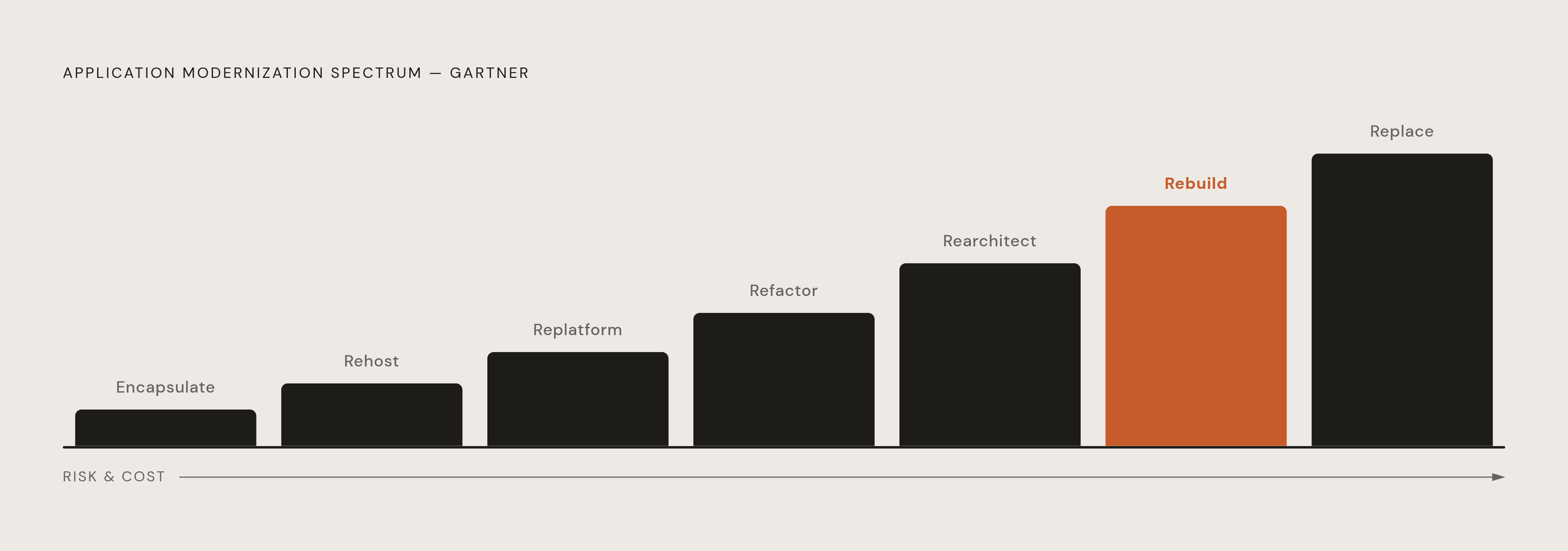
Gartner frames modernization as a spectrum of options with rising risk and cost. It runs from encapsulate and rehost through replatform, refactor, and rearchitect, up to rebuild and replace. The smallest sufficient intervention is the useful discipline. A feature gap is not the same as a structure that cannot support the business, and treating them alike can turn a limited repair into an unnecessary replacement. Is the architecture itself the constraint, or is it the code sitting on top of a sound structure?
Business trajectory then tests whether the proposed technical work serves the product’s future. Competitors keep shipping and the market keeps moving while the team rebuilds. Teams also typically maintain two systems during the transition. That cost belongs in the decision, rather than appearing later as an unfortunate complication. The studio and client must weigh what the new system enables against what the transition delays.
The strongest objection to a rewrite may have nothing to do with engineering. If users struggle with onboarding or pricing blocks sales, changing the stack does not address the cause. Code can feel easier to change than a product decision, which makes it an appealing substitute for the harder conversation. Will the architecture under discussion still serve the business in two to three years, and would a rebuild actually change what customers experience?
Risk tolerance comes last because it qualifies every technically plausible option. The existing system has built up business logic, edge cases, and fixes that may take much longer to reproduce than the estimate allows. That is the hidden rebuild tax. A fresh implementation does not remove the need to recover those decisions, even when the old code is unpleasant to read. The business has to consider that uncertainty as part of the transition alongside development estimates.
When continuous delivery is non-negotiable, refactoring allows new features to ship in parallel with modernization work. A plan to rebuild must be just as clear about how the business will keep running during the change. Not every replacement requires a single cutover, but a plan that does deserves particular scrutiny. Can this business tolerate an extended feature freeze and a binary success-or-failure cutover?
Where the diagnostic changes for MVP-to-production transitions
Moving from MVP to production is almost never, by itself, a reason to rebuild. Yet it is a point where teams often skip the diagnosis and let early architectural mistakes compound. Once real users arrive, the question shifts from whether the product works to whether it can hold up under the demands now being placed on it. An AI-generated or freelancer-built MVP needs that examination regardless of who or what produced its code.
The wall appears when the product needs something the original build was never designed to provide. That may be custom logic it cannot express, performance it cannot reach, data ownership it does not allow, integrations it does not support, or compliance it cannot satisfy. The constraint needs a name. Without one, “production-ready” risks becoming a vague justification for replacing everything. With one, the team can examine whether the problem sits in the implementation or in the underlying design.
For a team at this transition, the lesson is to audit the data model first. If the fundamental entities and relationships are roughly right, refactoring is the appropriate starting point. Bad code around a sound model needs cleanup, while a wrong model has a problem in its structure. The rest of the diagnostic still applies, including the team’s ability to verify changes safely.
Technical debt at this stage is a predictable part of reaching a working product, and real users mark the point when that debt deserves deliberate attention. Addressing it before that point can mean solving problems the product has not yet encountered, while leaving it for years allows constraints to deepen. An engineering partner should be able to weigh those trade-offs and still see the value in the original build. Its task is to preserve what can support production and identify what cannot.
How the diagnostic shifts for resource-constrained organizations like nonprofits
For nonprofits and small mission-driven teams, the four domains stay the same, but the thresholds change. A wrong decision can affect programs as well as budgets. When money is tight and staff wear several hats, the team especially needs to know what it will cost to investigate, make the transition, and keep up with maintenance. A technically attractive option may therefore be unsuitable for the organization expected to operate it. Risk tolerance has to reflect what that organization can handle in its work as well as its willingness to take on uncertainty.
The nature of the debt also changes the response. Prudent-deliberate debt can be a conscious trade-off to meet a grant deadline, supported by a documented repayment plan. That is different from reckless-inadvertent debt caused by gaps in skill or understanding. Both may need attention, but they do not reveal the same underlying problem.
Airtable illustrates how an operational scaffold can reach a structural limit. Nonprofits use it for grant tracking and donor management, but automation action limits on lower tiers and record limits in a growing CRM can force a migrate-or-rebuild conversation. Hitting a limit does not settle that conversation. The same questions about the data model, business needs, and transition risk still apply.
What staff can take on also affects what the organization can afford. If institutional knowledge is no longer held by anyone at the organization, understanding the existing system may become a substantial part of refactoring work. Compliance can pull the decision in the other direction. In healthcare, financial services, or government-adjacent nonprofit work, the need to meet regulatory validation requirements may make it less risky to change things within the existing system boundary than to do a full rebuild. The diagnosis must weigh both pressures against the program consequences of a failed launch.
Why the diagnostic conversation must be a paid, structured sprint — not a free scoping call
A free scoping call can help a studio and client decide whether to look into working together. It cannot substitute for an engineering assessment. The diagnostic needs to be paid and time-boxed so it can clear up what is unknown before either side commits to development. Otherwise, a sales conversation can quietly become the reason to recommend a rebuild. The client receives a proposed engagement without a defensible explanation of why that engagement is necessary.
The sprint must follow the four domains and connect its recommendation to the constraints it finds. If requirements remain undefined, discovery and scoping should be the first engagement. That protects the founder from committing to a replacement before the need for one has been established. A credible partner should welcome this pre-work because it protects both parties from an agreement built on assumptions.
The studio’s incentives deserve scrutiny as well. A partner that remains responsible for maintenance lives with a different set of consequences from one whose involvement ends at handoff. Quwa Labs, an engineering and design studio that rebuilds AI-generated and freelancer-built MVPs once real users arrive, is one option that runs this diagnostic before choosing between cleanup and a full rebuild. It stays on as a long-term technical partner, so the decision also shapes the system it will help maintain.
A team can run the conversation itself or require a prospective partner to work through codebase health, architectural limits, business trajectory, and risk tolerance in that order. Before authorizing changes to a single file, the client should be able to explain which constraint the proposed work removes and why a smaller intervention would not suffice.